
Usine de Moulage d'Alliage Monocristallin pour Aubes de Compresseur en Superalliage PWA 1484
Introduction
Le PWA 1484 est un superalliage à base de nickel de deuxième génération à monocristal, développé pour offrir une résistance au fluage supérieure, une excellente résistance à l'oxydation et une durée de vie en fatigue remarquable à des températures de service allant jusqu'à 1100°C. Avec une résistance à la traction d'environ 1420 MPa et une stabilité exceptionnelle de la phase γ', le PWA 1484 est largement utilisé pour produire des aubes de compresseur pour les moteurs aérospatiaux avancés et les turbines à gaz à haute efficacité.
Chez Neway AeroTech, nous sommes spécialisés dans la fabrication d'aubes de compresseur en PWA 1484 en utilisant le moulage de précision sous vide à monocristal (cristal unique), garantissant une haute précision dimensionnelle, une orientation cristallographique parfaite et des performances mécaniques maximales dans des conditions de service extrêmes.
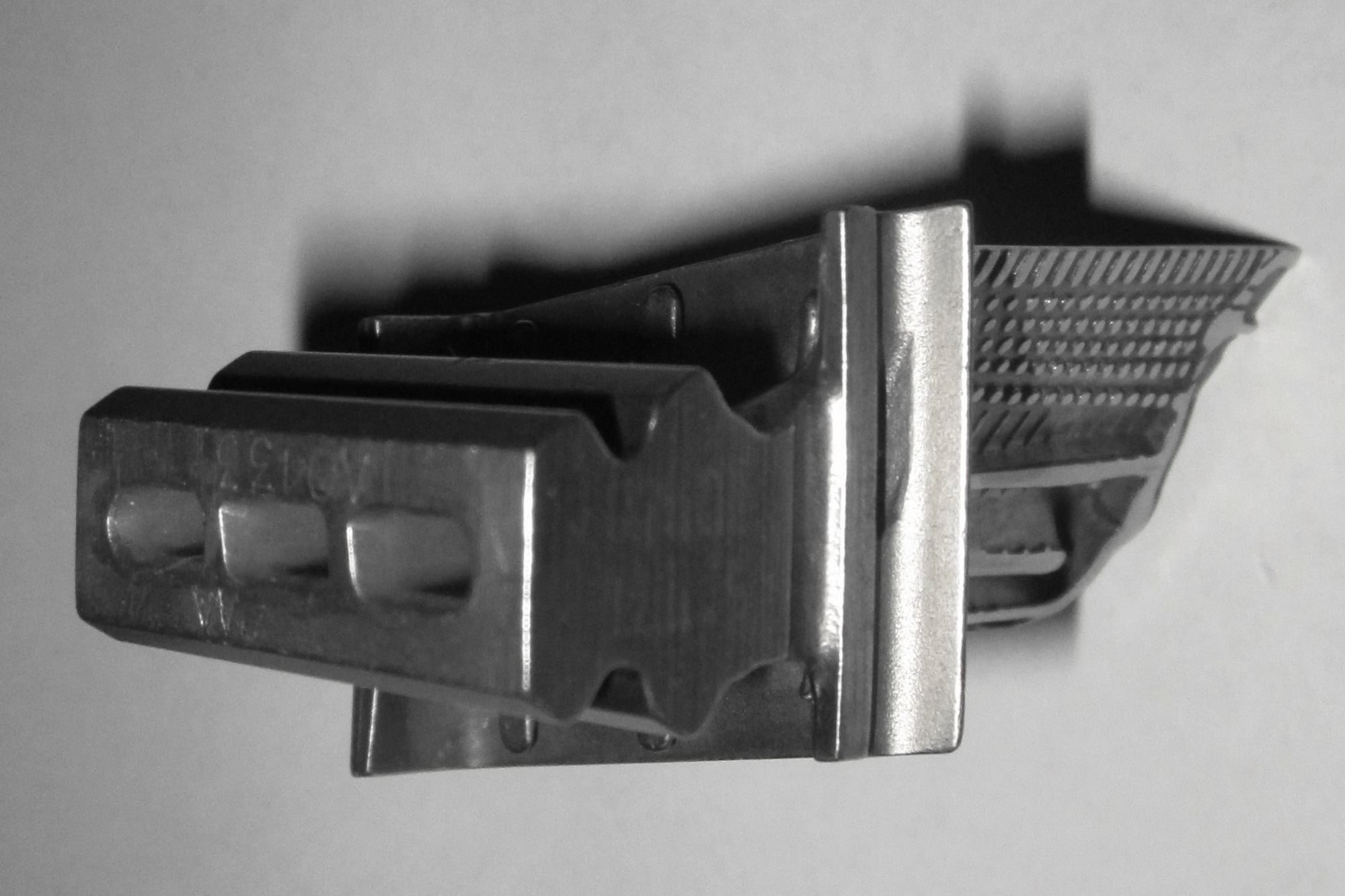
Principaux Défis de Fabrication pour les Aubes de Compresseur PWA 1484
Maintenir une composition d'alliage précise (base Ni, Cr ~5%, Co ~10%, Al ~5,6%, Ta ~8,5%, W ~6%, Re ~3%).
Contrôler la solidification monocristalline pour obtenir une orientation cristallographique [001] sans défauts et sans joints de grains.
Atteindre des tolérances dimensionnelles strictes (±0,03 mm) cruciales pour l'efficacité aérodynamique et l'ajustement mécanique.
Garantir des finitions de surface (Ra ≤1,6 µm) pour un écoulement d'air optimal et une traînée minimisée.
Processus de Moulage Monocristallin pour les Aubes de Compresseur PWA 1484
Le processus de fabrication comprend :
Fabrication du Modèle en Cire : Moulage par injection de modèles en cire de haute précision avec une cohérence dimensionnelle de ±0,1%.
Construction de la Coquille : Construction de moules en céramique réfractaire à haute température en utilisant des barbotines de zircone stabilisée à l'yttria.
Décirure : Autoclavage à la vapeur à ~150°C pour éliminer la cire et préserver l'intégrité de la coquille.
Fusion sous Vide et Coulée : L'alliage est fondu à ~1450°C sous vide (<10⁻³ Pa) pour éviter l'oxydation.
Croissance du Monocristal : Retrait contrôlé (~3–6 mm/min) à travers un gradient thermique pour faire croître un monocristal orienté [001].
Élimination de la Coquille et Finition CNC : Élimination finale de la coquille, suivie d'un usinage de précision et d'un polissage pour obtenir les profils aérodynamiques.
Analyse Comparative des Méthodes de Fabrication pour les Aubes de Compresseur
Procédé | Structure Granulaire | Finition de Surface | Précision Dimensionnelle | Résistance Mécanique | Résistance Max à la Température |
|---|---|---|---|---|---|
Moulage à la Cire Perdue Monocristallin | Monocristal | Excellente (Ra ≤1,6 µm) | Très Haute (±0,03 mm) | Supérieure (~1420 MPa) | Exceptionnelle (~1100°C) |
Solidification Directionnelle | Grains colonnaires | Bonne (Ra ~3 µm) | Haute (±0,05 mm) | Très Bonne (~1350 MPa) | Excellente (~1050°C) |
Moulage à Grains Équiaxes | Grains aléatoires | Modérée (Ra ~3–5 µm) | Modérée (±0,1 mm) | Bonne (~1250 MPa) | Haute (~980°C) |
Stratégie de Fabrication Optimale pour les Aubes de Compresseur PWA 1484
Le moulage à la cire perdue monocristallin offre une finition de surface Ra ≤1,6 µm, une précision dimensionnelle de ±0,03 mm, et maximise la résistance à haute température et la durée de vie en fatigue.
La solidification directionnelle offre une structure à grains colonnaires avec d'excellentes propriétés mécaniques, mais une résistance à la fatigue inférieure à celle des vrais monocristaux.
Le moulage à grains équiaxes est plus économique mais offre une résistance au fluage et une durée de vie en fatigue inférieures, limitant son application dans les étages chauds des turbines.
Aperçu des Performances de l'Alliage PWA 1484
Propriété | Valeur | Pertinence pour l'Application |
|---|---|---|
Résistance à la Traction | ~1420 MPa | Supporte les charges centrifuges et thermiques extrêmes |
Limite d'Élasticité | ~1250 MPa | Assure la stabilité dans des conditions de contrainte élevée |
Température Maximale de Fonctionnement | ~1100°C | Permet le fonctionnement dans les conditions d'entrée de turbine |
Résistance au Fluage | Exceptionnelle | Prolonge la durée de vie des aubes de compresseur |
Résistance à la Fatigue | ~720 MPa | Résiste à l'amorçage de fissures sous chargement cyclique |
Avantages de l'Utilisation du PWA 1484 pour les Aubes de Compresseur
Une résistance supérieure au fluage et à la fatigue assure la stabilité des aubes aux températures de fonctionnement des turbines jusqu'à 1100°C.
Une excellente résistance à l'oxydation protège les surfaces des aubes sous exposition aux gaz chauds.
Une structure monocristalline parfaite élimine les faiblesses des joints de grains, améliorant la durabilité globale.
Une haute résistance mécanique maintient la forme des aubes sous des charges centrifuges et thermiques élevées.
Techniques de Post-Traitement pour les Aubes de Compresseur PWA 1484
Pressage Isostatique à Chaud (HIP) : Densifie les pièces coulées à ~1160°C et 100 MPa, éliminant la microporosité.
Traitement Thermique de Mise en Solution et de Vieillissement : Stabilise la phase γ', améliorant la résistance et la résistance au fluage à haute température.
Usinage CNC de Précision : Atteint des tolérances de ±0,01 mm et un Ra ≤0,8 µm pour les surfaces aérodynamiques.
Polissage de Surface et Grenailage : Induit des contraintes de surface en compression, améliorant la résistance à la fatigue de 20 à 30%.
Inspection et Assurance Qualité pour les Aubes de Compresseur
Machine à Mesurer Tridimensionnelle (MMT) : Garantit une précision dimensionnelle de ±0,03 mm pour les surfaces aérodynamiques.
Contrôle par Ultrasons (UT) : Identifie les défauts internes de manière non destructive.
Contrôle par Pénétration de Liquide (PT) : Détecte les fissures de surface jusqu'à 0,002 mm.
Analyse Métallographique : Vérifie l'orientation du monocristal et la distribution de la phase γ'.
Applications Industrielles et Étude de Cas
Les aubes de compresseur en PWA 1484 fabriquées par Neway AeroTech sont largement utilisées dans la dernière génération de moteurs aérospatiaux et de turbines à gaz industrielles. Dans un programme récent de moteur aérospatial, les aubes monocristallines en PWA 1484 ont démontré plus de 18 000 heures de vol sous des températures d'entrée de turbine dépassant 1080°C, atteignant une augmentation de 40% de la durée de vie par rapport aux aubes conventionnelles à grains équiaxes et à solidification directionnelle.
FAQ
Quelles tolérances dimensionnelles Neway AeroTech peut-elle atteindre pour les aubes de compresseur en PWA 1484 ?
Pourquoi le moulage monocristallin est-il crucial pour la fabrication des aubes de turbine en PWA 1484 ?
Comment le PWA 1484 se compare-t-il aux autres superalliages pour aubes de turbine à haute température ?
Quelles industries utilisent couramment les aubes de compresseur monocristallines en PWA 1484 ?
Comment Neway AeroTech assure-t-elle la qualité métallurgique et la durabilité des pièces coulées en PWA 1484 ?
