日本語

Ti-6.5Al-1Mo-1V-2Zr (TA15) Titanium Selective Laser Melting (SLM) 3D Printing

目次
Introduction to TA15 Titanium Alloy Additive Manufacturing
SLM Technology for TA15 Titanium Alloy
Process Capabilities and Parameters
TA15 Material Properties and Performance
Why Choose TA15 for Additive Manufacturing
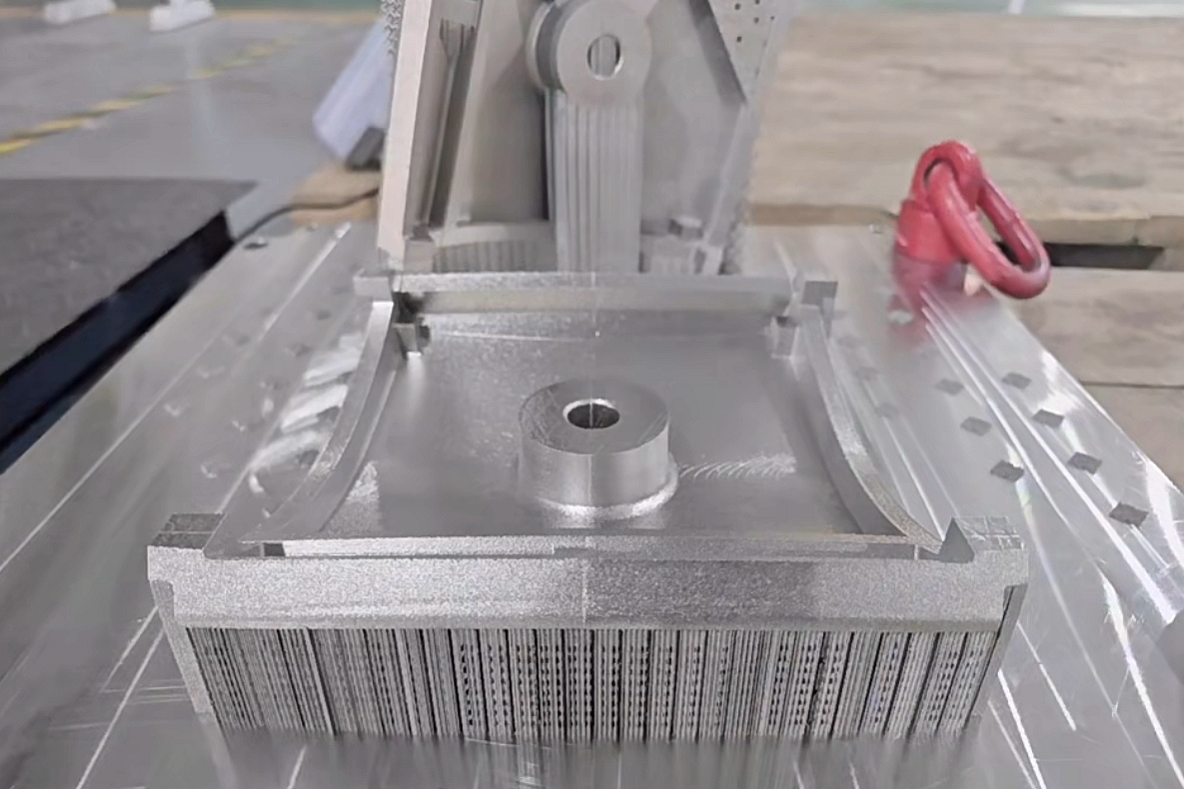
Case Study: TA15 SLM 3D Printed Truss Support Bracket for Aerospace Airframe
Project Background
Manufacturing Workflow
Surface Finishing & Inspection
Results and Verification
FAQs

Introduction to TA15 Titanium Alloy Additive Manufacturing

TA15 (Ti-6.5Al-1Mo-1V-2Zr) is a near-α titanium alloy developed for high strength, excellent creep resistance, and superior weldability. With SLM 3D printing, TA15 enables the fabrication of lightweight, high-performance aerospace and structural components with complex geometries.

At Neway Aerotech, our SLM titanium 3D printing services deliver precision TA15 components optimized for aircraft, energy, and defense-grade applications.

SLM Technology for TA15 Titanium Alloy

Process Capabilities and Parameters

Parameter

Value

Description

Layer Thickness

30–50 μm

Fine resolution for complex aerospace geometries

Build Chamber Atmosphere

Inert Argon

Prevents oxidation and alpha case formation

Laser Power

200–400 W

Optimized for uniform fusion and minimal porosity

Relative Density

≥ 99.5%

Ensures structural integrity

Heat Treatment

Anneal @ 800–850°C

Refines microstructure and reduces residual stress

TA15 Material Properties and Performance

Property

Value

Relevance in Application

Ultimate Tensile Strength

1100–1200 MPa

High load capacity in aerospace frames

Yield Strength

~1000 MPa

Structural support under dynamic stress

Density

4.48 g/cm³

Lightweight compared to steels or nickel alloys

Fatigue Limit (R=0.1)

~550 MPa

Long service life in cycling environments

Operating Temperature

Up to 500°C

Thermal stability for engine and airframe parts

Why Choose TA15 for Additive Manufacturing

  • TA15 combines near-α alloy strength with good weldability, making it ideal for SLM 3D printing.

  • Its creep resistance and low oxygen sensitivity ensure stability during high-altitude and thermal fluctuation conditions.

  • Unlike Ti-6Al-4V, TA15 offers improved high-temperature strength and is widely used in high-speed aircraft and rocket structures.

Case Study: TA15 SLM 3D Printed Truss Support Bracket for Aerospace Airframe

Project Background

An aerospace OEM required a high-strength, lightweight truss support bracket optimized for topology and weight reduction. The bracket needed to withstand 40 kN axial load at 480°C, with geometric constraints not suitable for machining.

Manufacturing Workflow

  1. Design: Topology optimized geometry imported in STL; minimum wall thickness 1.2 mm; fillets and radii >1 mm for fusion reliability.

  2. Material: TA15 titanium powder, D50 ~35 µm, argon atomized.

  3. Printing Process: SLM at 40 µm layers, 350 W laser, argon atmosphere, 200 mm/s scan speed.

  4. Post Processing: HIP at 920°C / 100 MPa for 2 hours; annealed at 830°C for stress relief.

  5. Machining & Fitting: Mounting holes and flange surfaces finished via 5-axis CNC to ±0.01 mm tolerance.

Surface Finishing & Inspection

  • Ra reduced from 14 μm to 3 μm via micro blasting and mechanical polishing.

  • CMM inspection confirmed geometric accuracy within ±0.02 mm.

  • X-ray CT scan detected no internal porosity or fusion defects.

  • Fatigue tested to 10⁷ cycles at 500 MPa with no failure.

Results and Verification

The SLM-printed TA15 bracket achieved a 38% weight reduction over forged aluminum equivalent and passed both tensile (1150 MPa) and fatigue (10⁷ cycles) tests. The customer approved production for flight hardware following qualification in simulated altitude and thermal load conditions.

FAQs

  1. How does TA15 compare to Ti-6Al-4V in mechanical and thermal performance?

  2. What is the recommended post-process heat treatment for SLM printed TA15 parts?

  3. Can TA15 be used in structural aerospace components with safety-critical loads?

  4. How fine can internal lattice structures be printed with TA15 using SLM?

  5. What surface finishing is best for improving fatigue life in TA15 printed components?