
Ti-6.5Al-1Mo-1V-2Zr (TA15) Titanium Selective Laser Melting (SLM) 3D Printing
Introduction to TA15 Titanium Alloy Additive Manufacturing
TA15 (Ti-6.5Al-1Mo-1V-2Zr) is a near-α titanium alloy developed for high strength, excellent creep resistance, and superior weldability. With SLM 3D printing, TA15 enables the fabrication of lightweight, high-performance aerospace and structural components with complex geometries.
At Neway Aerotech, our SLM titanium 3D printing services deliver precision TA15 components optimized for aircraft, energy, and defense-grade applications.
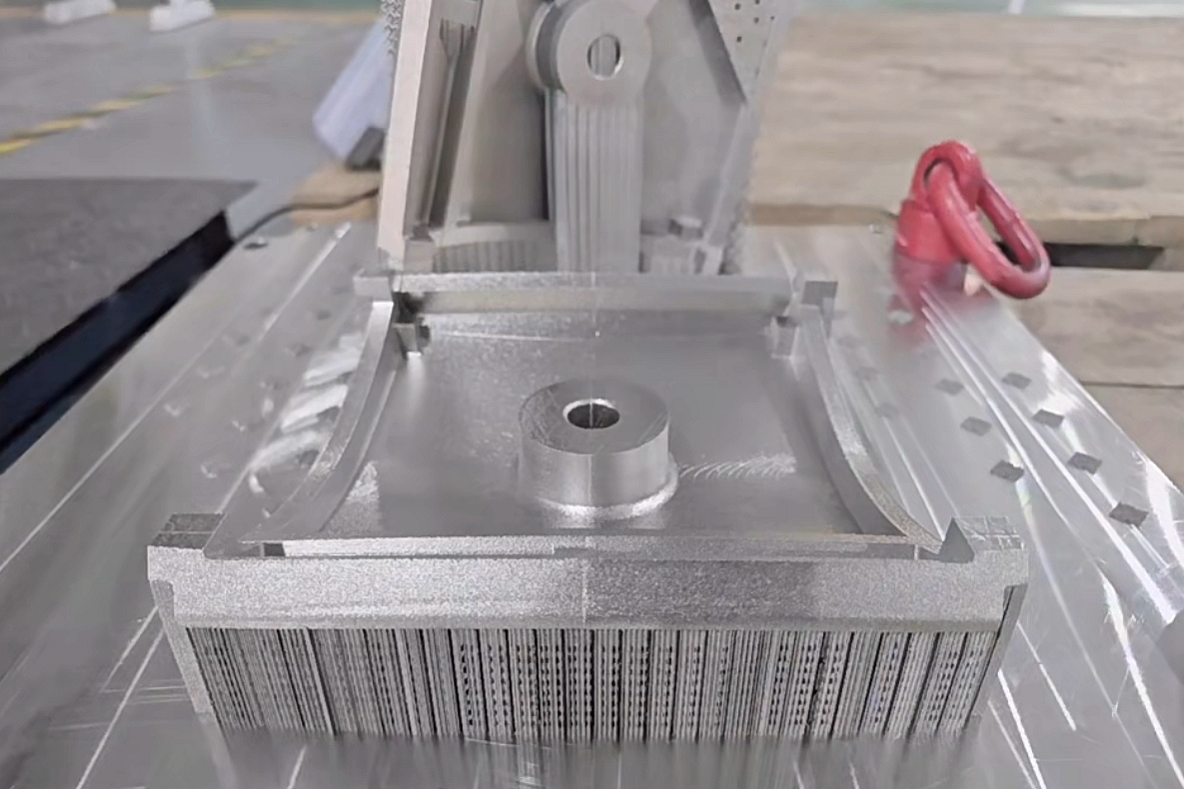
SLM Technology for TA15 Titanium Alloy
Process Capabilities and Parameters
Parameter | Value | Description |
|---|---|---|
Layer Thickness | 30–50 μm | Fine resolution for complex aerospace geometries |
Build Chamber Atmosphere | Inert Argon | Prevents oxidation and alpha case formation |
Laser Power | 200–400 W | Optimized for uniform fusion and minimal porosity |
Relative Density | ≥ 99.5% | Ensures structural integrity |
Heat Treatment | Anneal @ 800–850°C | Refines microstructure and reduces residual stress |
TA15 Material Properties and Performance
Property | Value | Relevance in Application |
|---|---|---|
Ultimate Tensile Strength | 1100–1200 MPa | High load capacity in aerospace frames |
Yield Strength | ~1000 MPa | Structural support under dynamic stress |
Density | 4.48 g/cm³ | Lightweight compared to steels or nickel alloys |
Fatigue Limit (R=0.1) | ~550 MPa | Long service life in cycling environments |
Operating Temperature | Up to 500°C | Thermal stability for engine and airframe parts |
Why Choose TA15 for Additive Manufacturing
TA15 combines near-α alloy strength with good weldability, making it ideal for SLM 3D printing.
Its creep resistance and low oxygen sensitivity ensure stability during high-altitude and thermal fluctuation conditions.
Unlike Ti-6Al-4V, TA15 offers improved high-temperature strength and is widely used in high-speed aircraft and rocket structures.
Case Study: TA15 SLM 3D Printed Truss Support Bracket for Aerospace Airframe
Project Background
An aerospace OEM required a high-strength, lightweight truss support bracket optimized for topology and weight reduction. The bracket needed to withstand 40 kN axial load at 480°C, with geometric constraints not suitable for machining.
Manufacturing Workflow
Design: Topology optimized geometry imported in STL; minimum wall thickness 1.2 mm; fillets and radii >1 mm for fusion reliability.
Material: TA15 titanium powder, D50 ~35 µm, argon atomized.
Printing Process: SLM at 40 µm layers, 350 W laser, argon atmosphere, 200 mm/s scan speed.
Post Processing: HIP at 920°C / 100 MPa for 2 hours; annealed at 830°C for stress relief.
Machining & Fitting: Mounting holes and flange surfaces finished via 5-axis CNC to ±0.01 mm tolerance.
Surface Finishing & Inspection
Ra reduced from 14 μm to 3 μm via micro blasting and mechanical polishing.
CMM inspection confirmed geometric accuracy within ±0.02 mm.
X-ray CT scan detected no internal porosity or fusion defects.
Fatigue tested to 10⁷ cycles at 500 MPa with no failure.
Results and Verification
The SLM-printed TA15 bracket achieved a 38% weight reduction over forged aluminum equivalent and passed both tensile (1150 MPa) and fatigue (10⁷ cycles) tests. The customer approved production for flight hardware following qualification in simulated altitude and thermal load conditions.
FAQs
How does TA15 compare to Ti-6Al-4V in mechanical and thermal performance?
What is the recommended post-process heat treatment for SLM printed TA15 parts?
Can TA15 be used in structural aerospace components with safety-critical loads?
How fine can internal lattice structures be printed with TA15 using SLM?
What surface finishing is best for improving fatigue life in TA15 printed components?
