日本語

Superalloy Deep Bore Structural Parts CNC Deep Drilling Service

目次
Precision Structural Boring in High-Strength Alloys
Core Technology for Structural Deep Bore Components
Typical Superalloy Materials for Deep Bore Structural Applications
Case Study: Inconel 718 Structural Frame with Deep Cooling Bore
Project Background
Typical Deep Bore Component Models and Applications
Machining Challenges in Deep Bore Superalloy Structures
CNC Solutions for Deep Bore Structural Part Machining
Results and Verification
Manufacturing Methods
Precision Finishing
Post-Processing
Inspection
FAQs

Precision Structural Boring in High-Strength Alloys

Superalloy structural parts with deep bores are essential in aerospace, nuclear, and turbine applications where high axial loading, internal fluid routing, and thermal endurance are critical. These bores often exceed 20×D in depth and must maintain concentricity, straightness, and dimensional integrity under temperatures above 1000°C and mechanical stresses over 1000 MPa.

Neway AeroTech delivers advanced superalloy CNC machining and deep hole drilling solutions for forged or cast structural parts in Inconel 718, CMSX-4, Hastelloy X, and Rene 41.

Core Technology for Structural Deep Bore Components

Neway AeroTech integrates heavy-duty vertical and horizontal CNC centers with high-precision drilling and finishing systems to manufacture structural components with deep bores.

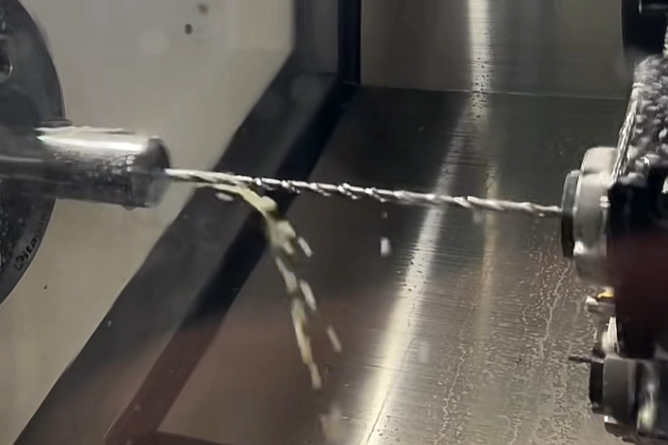
  • BTA and gun drilling with tool runout ≤ 0.01 mm over 25×D depth

  • 5-axis machining for orthogonal features and load interfaces

  • Vacuum investment casting or forged blanks prepared for bore alignment

  • Bore support jigs and anti-vibration fixturing to ensure concentricity

CNC programming and simulation tools validate every pass prior to production runs.

Typical Superalloy Materials for Deep Bore Structural Applications

Alloy

Max Temp (°C)

Yield Strength (MPa)

Application

Inconel 718

704

1035

Jet engine casings, bearing supports

Rene 41

980

950

Missile structural assemblies

CMSX-4

1140

980

Load-bearing turbine segments

Hastelloy X

1175

790

High-temperature frames, reactor cores

These materials are selected for excellent fatigue, creep, and thermal resistance under sustained mechanical stress.

Case Study: Inconel 718 Structural Frame with Deep Cooling Bore

Project Background

An aerospace client required a 420 mm thick Inconel 718 structural ring featuring two 6 mm diameter bores at 25×D. These bores had to be concentric within 0.007 mm, Ra ≤ 0.5 μm, and pressure-tight post-assembly. Gun drilling and multi-axis CNC machining were combined with advanced fixturing and inspection.

Typical Deep Bore Component Models and Applications

Model

Description

Material

Depth Ratio

Industry

SBC-700

Structural beam block with dual bores

Inconel 718

24×D

Aerospace

LBS-550

Load-bearing turbine segment with cooling ducts

CMSX-4

22×D

Power Generation

PRF-400

Pressure ring with stepped internal bore

Rene 41

25×D

Defense

RCS-600

Reactor core support pipe with thermal channel

Hastelloy X

20×D

Nuclear

These parts operate under fluctuating load and thermal shock, requiring exact bore location and durability.

Machining Challenges in Deep Bore Superalloy Structures

  1. Entry angle accuracy ±0.01 mm to avoid off-center misalignment over long distances

  2. Thermal stress and deflection in forged parts during drilling and finishing

  3. Surface finish Ra ≤ 0.5 μm for flow-critical channels

  4. Internal vibration and tool harmonics affecting bore straightness

  5. Post-machining deformation under load without stress relief

CNC Solutions for Deep Bore Structural Part Machining

  • Gun drilling with vibration dampers and 100 bar coolant pressure for chip evacuation

  • Pre-machining heat treatment to stabilize internal grain structures

  • 5-axis rough-finishing with controlled peck drilling and low chip load

  • Post-drilling HIP and surface treatments for crack prevention

  • Integrated CMM verification and 3D laser scanning for validation

Results and Verification

Manufacturing Methods

Each component was cast or forged, then rough-milled and drilled using deep hole drilling with peck and coolant-fed cycles. Bore axis deviation was kept within 0.008 mm over 150 mm.

Precision Finishing

Critical features were EDM-polished to Ra ≤ 0.4 μm. Threaded ports were CNC milled to ISO 6H. Bore exit and inlet faces held flatness within 0.01 mm for pressure sealing.

Post-Processing

HIP and stress relief cycles were applied between operations. Final passivation or TBC coating was added per application specs. Optional welding or joining surfaces machined to required fit tolerances.

Inspection

CMM ensured dimensional accuracy. X-ray verified bore consistency and straightness. SEM analysis validated surface integrity and microstructure after drilling.

FAQs

  1. What bore depths can be achieved in superalloy structural parts?

  2. How is bore straightness verified in deep structural components?

  3. What alloys are preferred for bore-critical aerospace structures?

  4. Can these bores withstand cyclic loading without distortion?

  5. What post-processing is necessary for nuclear-rated parts?