日本語

Turbine Arc Segments Rough Forging Service

目次
Introduction
Core Technology of Turbine Arc Segment Rough Forging
Material Characteristics of Turbine Arc Segment Alloys
Case Study: Rough Forging of Turbine Arc Segments
Project Background
Common Applications of Forged Arc Segments
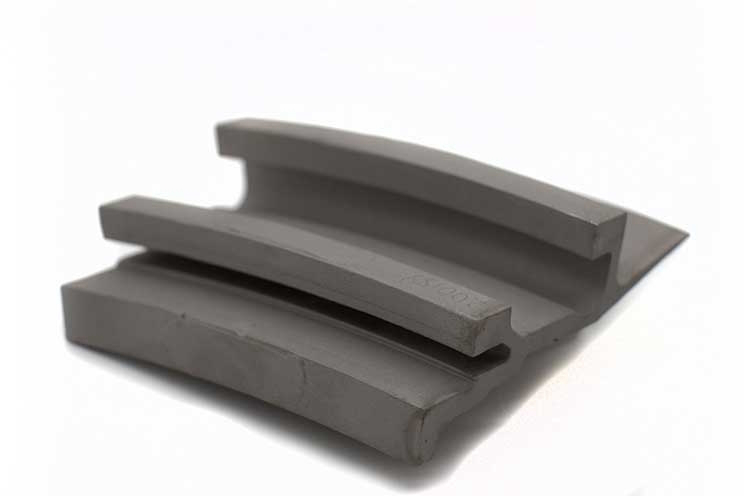
Structural Features of Turbine Arc Segments
Turbine Arc Segment Manufacturing Solution
Core Challenges in Rough Forging of Arc Segments
Results and Verification
FAQs

Introduction

Turbine arc segments are essential components used in gas turbines and aero-engines to direct high-velocity flow through turbine stages. These parts operate under cyclic thermal and mechanical stresses and require exceptional strength, oxidation resistance, and dimensional stability. Rough forging is the foundational process for producing high-performance arc segments prior to precision machining and finishing.

Neway AeroTech delivers superalloy rough forging services for high-temperature turbine arc segments using advanced press systems and strict metallurgical controls. Our expertise in forging nickel-based alloys including IN713LC, Inconel 738, and Rene 80 ensures consistent microstructure, excellent mechanical properties, and long service life.

turbine-arc-segments-rough-forging-service

Core Technology of Turbine Arc Segment Rough Forging

  1. Alloy Preparation: High-purity superalloy ingots such as IN713LC are melted using vacuum induction melting and cast into billets for forging readiness.

  2. Billet Preheating: Billets are uniformly heated to 1080–1180°C in controlled-atmosphere furnaces, ensuring proper deformation behavior without surface oxidation.

  3. Closed-Die Rough Forging: Hydraulic presses (2500–4000 tons) deform billets into arc segment profiles, achieving near-net-shape blanks with controlled grain flow orientation.

  4. Intermediate Annealing: After forging, parts undergo annealing at 1020–1060°C to relieve internal stress and homogenize microstructure before further shaping operations.

  5. Dimensional Flattening: Forged segments are mechanically flattened under precision jigs to ensure geometric consistency prior to final machining stages.

  6. Deflash and Trimming: Forged flash and excess material are removed using mechanical trimming tools to prepare blanks for follow-up CNC machining.

  7. Surface Conditioning: Surface oxides are removed through shot blasting and pickling, preparing parts for non-destructive testing and heat treatment.

  8. Mechanical Testing Samples: Representative test coupons are extracted from each batch for hardness, tensile, and grain size verification as per material testing standards.

Material Characteristics of Turbine Arc Segment Alloys

Forged turbine arc segments are typically made from high-performance superalloys like IN713LC, Inconel 738, and Rene 80. Key properties include:

  • Operating Temperature: Up to 1000–1050°C depending on alloy

  • Tensile Strength: ≥1030 MPa at room temperature

  • Creep Resistance: ≥200 MPa after 1000 hours at 800°C

  • Oxidation Resistance: Excellent under cyclic thermal loading

  • Grain Size Control: ASTM 5–8 via precision forging practices

These properties enable the arc segments to endure extreme operational conditions across turbine hot sections.

Case Study: Rough Forging of Turbine Arc Segments

Project Background

Neway AeroTech was selected to manufacture forged arc segments for a leading power turbine OEM. The client required arc segments made of IN713LC for use in land-based gas turbines operating at continuous 950°C, with tight mechanical performance requirements and minimal material removal during finish machining.

Common Applications of Forged Arc Segments

  • Industrial Gas Turbines (e.g., GE Frame 6B): Arc segments direct exhaust gases through first and second turbine stages.

  • Aero-Engines (e.g., CFM56): Guide vanes and static arc segments operate in high-cycle fatigue zones in aerospace turbines.

  • Marine Gas Turbines (e.g., LM2500): Forged arc segments are used in high-load propulsion turbines with corrosive environments.

  • Power Generation Turbines (e.g., Siemens SGT): Static turbine casings and flow vanes require forged arc segments with low thermal distortion in power plants.

Structural Features of Turbine Arc Segments

  • Curved profiles matched to turbine inner/outer diameters

  • Complex airfoil base shapes for nozzle integration

  • Precision bosses and grooves for segment interlocking

  • Controlled deformation to support downstream machining accuracy

Turbine Arc Segment Manufacturing Solution

  1. Material Procurement and Ingot Casting: High-purity IN713LC alloy is vacuum cast into billets, ensuring chemistry control and low residual gas content.

  2. Billet Forging and Shaping: Billets heated to 1150°C and forged in closed dies under 3000-ton presses into arc-shaped blanks with directional grain flow.

  3. Heat Treatment and Annealing: Post-forging annealing at 1040°C refines grain size and eliminates residual forging stresses for dimensional stability.

  4. Surface Preparation: Shot blasting removes scale; acid pickling preconditions surfaces for non-destructive testing.

  5. Mechanical Properties Validation: Tensile testing confirms ≥1030 MPa UTS, and grain size ASTM 6–7 is validated through metallographic inspection.

  6. Dimensional Flattening: Arcs are placed in tooling and pressed under ambient conditions to ensure flatness within ±0.1 mm.

  7. Pre-Machining Trimming: Excess flash is removed with saws and shears to enable accurate CNC finishing.

  8. Nondestructive Evaluation: Segments undergo fluorescent penetrant and ultrasonic testing to detect internal and surface discontinuities.

Core Challenges in Rough Forging of Arc Segments

  • Maintaining shape control over curved thin-walled geometry during hot deformation

  • Achieving uniform grain structure across varying cross-sections

  • Preventing micro-cracks and thermal fatigue zones at corners

  • Ensuring repeatability in large-volume production batches

Results and Verification

  • Grain size control achieved at ASTM 6–7 with low inclusion content

  • Dimensional deviations within ±0.1 mm after flattening, confirmed via 3D scanning

  • Tensile and creep performance exceeded required 1030 MPa UTS and 200 MPa creep rupture

  • NDT clearance rate >99% with zero rejection in final inspection phase

FAQs

  1. What alloys are commonly used for turbine arc segment rough forging?

  2. How is grain size controlled during rough forging of arc segments?

  3. What dimensional tolerances can be achieved before final machining?

  4. What NDT methods are used to inspect forged turbine arc segments?

  5. Can Neway AeroTech provide post-forging machining for arc segments?