日本語

Single Crystal Casting IN713LC Gas Turbines Components

目次
Introduction
Core Technology of Single Crystal Casting for Gas Turbine Components
IN713LC Material Properties for Single Crystal Components
Case Study: Single Crystal IN713LC Components for Industrial Gas Turbine
Project Background
Component Applications
Manufacturing Solution for IN713LC Single Crystal Gas Turbine Components
Core Challenges in Single Crystal Gas Turbine Component Casting
Results and Verification
FAQs

Introduction

Gas turbines operate in environments that subject components to high temperatures, extreme mechanical loads, and aggressive oxidation. To meet these challenges, single crystal casting has become the standard for manufacturing critical parts with no grain boundaries, enhancing creep resistance, fatigue life, and structural integrity. IN713LC is a widely used nickel-based superalloy that, when processed through single crystal casting, delivers excellent high-temperature performance and mechanical strength.

Neway AeroTech offers advanced vacuum investment casting of IN713LC for gas turbine components, serving aerospace, power generation, and defense industries. Our capabilities ensure reliable, high-performance single crystal components tailored to the extreme demands of turbine hot sections.

single-crystal-casting-in713lc-gas-turbines-components

Core Technology of Single Crystal Casting for Gas Turbine Components

  1. Wax Pattern Production Injection-molded wax patterns are made with precision (±0.05 mm) to match complex turbine geometries including cooling holes and integrated shrouds.

  2. Ceramic Shell Mold Fabrication Ceramic shells are built layer by layer to a thickness of 6–8 mm, providing high thermal resistance during alloy pouring.

  3. Helical Grain Selector Integration Mold assemblies include spiral selectors to initiate single crystal growth along the [001] crystallographic axis, eliminating transverse grain boundaries.

  4. Vacuum Induction Melting IN713LC alloy is melted in vacuum (≤10⁻³ Pa) at 1450°C using vacuum induction melting, ensuring a clean, homogenous molten pool.

  5. Directional Solidification The mold is withdrawn slowly (2–4 mm/min) from the heating zone to produce controlled [001] single crystal growth with minimal stray grains.

  6. Shell Removal and Cleaning After cooling, shells are removed using vibration and high-pressure blasting, preserving blade tips and thin cooling walls.

  7. Hot Isostatic Pressing (HIP) HIP treatment at 1150°C and 150 MPa removes porosity and enhances fatigue life.

  8. Heat Treatment A solution and aging heat treatment refines γ' precipitate distribution for optimal high-temperature strength.

IN713LC Material Properties for Single Crystal Components

IN713LC is a gamma-prime strengthened superalloy with proven performance in high-temperature turbine components:

  • Operating Temperature: Up to 982°C (1800°F)

  • Tensile Strength: ≥1034 MPa

  • Yield Strength: ≥862 MPa

  • Creep Rupture Strength: ≥200 MPa after 1000 hrs at 760°C

  • Gamma Prime Phase: >50% volume fraction

  • Oxidation Resistance: Stable under cyclic hot gas exposure

Case Study: Single Crystal IN713LC Components for Industrial Gas Turbine

Project Background

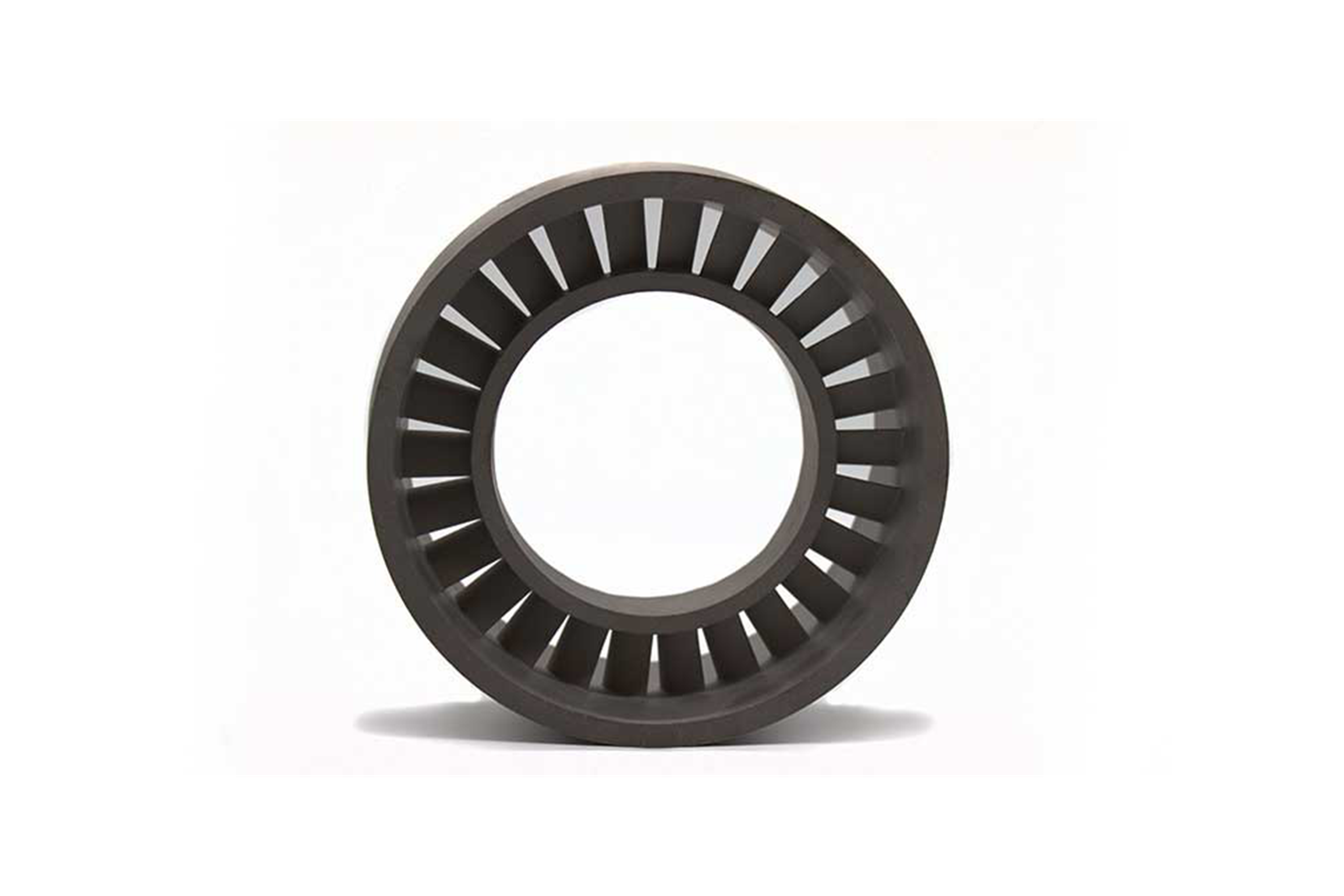
Neway AeroTech was selected to produce single crystal IN713LC vanes, nozzle segments, and shrouds for a 100+ MW industrial gas turbine. The goal was to increase component life cycles under continuous 950°C operating conditions.

Component Applications

  • Turbine Nozzle Guide Vanes Guide high-temperature combustion gases toward the rotor; require high creep and oxidation resistance.

  • First-Stage Shrouds Seal the turbine blade tips and prevent gas leakage; demand dimensional stability and wear resistance.

  • Inner and Outer Seals Isolate hot sections from cooling circuits; must resist thermal distortion and fatigue.

  • Blade Platforms and Dampers Integrate with rotor to support blades; require strength and precise alignment.

Manufacturing Solution for IN713LC Single Crystal Gas Turbine Components

  1. Wax Assembly Engineering CFD-informed gating and selector designs are integrated to ensure clean metal flow and grain alignment.

  2. Vacuum Melting & Casting Using vacuum investment casting, IN713LC alloy is poured into ceramic shells under precise temperature and withdrawal controls.

  3. HIP Processing Hot isostatic pressing is applied to consolidate any microvoids and increase fatigue resistance.

  4. Heat Treatment Cycles Controlled heat treatment enhances γ' phase uniformity, critical for maintaining strength during prolonged exposure.

  5. Machining and Finishing CNC machining and EDM ensure tolerance control and completion of internal cooling paths.

  6. NDT and Quality Assurance Each component undergoes X-ray, ultrasonic, and CMM inspection to verify casting integrity and compliance.

Core Challenges in Single Crystal Gas Turbine Component Casting

  • Avoiding stray grain formation in thin, complex-walled components

  • Managing solidification rates in large cross-section transitions

  • Achieving phase balance post heat treatment

  • Maintaining dimensional accuracy for mating surfaces and cooling passages

Results and Verification

  • Grain orientation confirmed within <2° deviation via EBSD analysis

  • X-ray and ultrasonic NDT confirmed 100% internal soundness post HIP

  • Mechanical testing exceeded 1034 MPa tensile and 200 MPa creep standards

  • Dimensional inspection within ±0.03 mm via 5-axis CMM

FAQs

  1. What makes IN713LC suitable for single crystal gas turbine components?

  2. What types of turbine parts benefit most from single crystal casting?

  3. How do you ensure [001] grain orientation in complex castings?

  4. Is HIP always necessary for single crystal turbine parts?

  5. What industries use IN713LC single crystal cast components?