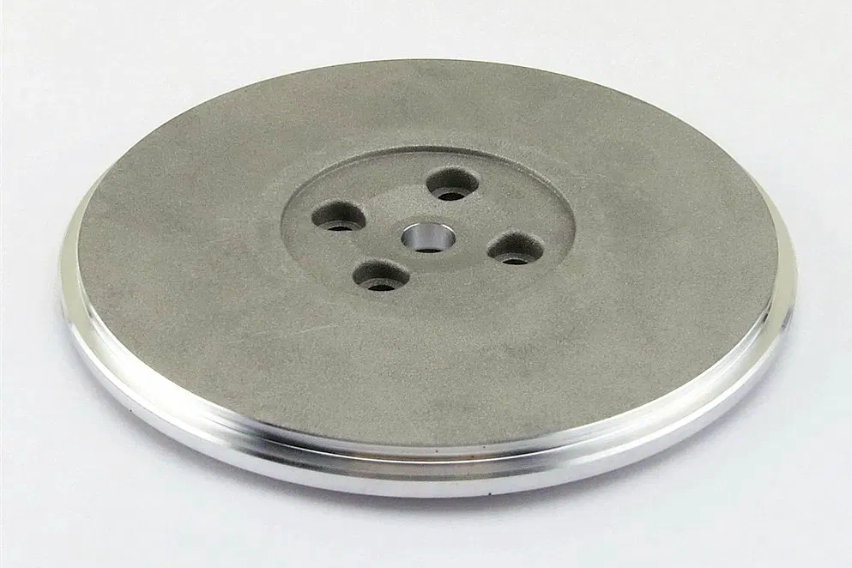
Titanium alloys are increasingly favored for turbine disc manufacturing due to their excellent strength-to-weight ratio, high-temperature resistance, and outstanding fatigue properties. At Neway AeroTech, we specialize in isothermal forging of titanium alloys, producing turbine discs with exceptional mechanical performance, precise dimensional tolerances (±0.03 mm), and optimized microstructures for maximum durability.
Leveraging advanced isothermal forging technology ensures that titanium turbine discs achieve superior creep resistance, thermal stability, and fatigue life essential for aerospace and industrial gas turbine applications.
Producing turbine discs from alloys such as Ti-6Al-4V and Ti-6Al-2Sn-4Zr-6Mo involves several technical challenges:
Strict control of narrow forging temperature ranges (850–950°C) to prevent cracking or excessive grain growth.
Achieving uniform fine-grain microstructure to enhance creep and fatigue performance.
Maintaining extremely tight dimensional tolerances (±0.03 mm) critical for rotor balance and operational reliability.
Managing post-forging stress and distortion for high rotational speed applications.
The isothermal forging process for titanium turbine discs includes:
Billet Preparation: Homogenization and surface conditioning to eliminate defects.
Isothermal Die Heating: Dies maintained at temperatures matching the forging temperature (~900°C) to minimize thermal gradients.
Forging Operation: Slow, controlled deformation under consistent temperature and pressure, promoting uniform grain flow and fine microstructure.
Controlled Cooling: Furnace or air cooling designed to preserve phase stability and minimize residual stresses.
Post-Forging Heat Treatment: Solution annealing typically at 940–970°C followed by aging to optimize tensile strength, ductility, and creep resistance.
Final CNC Machining: Precision machining operations achieving final tolerances of ±0.01 mm and surface finishes of Ra ≤1.6 µm.
Manufacturing Method | Dimensional Accuracy | Surface Finish (Ra) | Grain Structure Control | Mechanical Performance | Cost Efficiency |
|---|---|---|---|---|---|
Isothermal Forging | ±0.03 mm | ≤3.2 µm | Excellent | Superior | Medium |
Conventional Precision Forging | ±0.05 mm | ≤3.2 µm | Good | Good | Medium |
Vacuum Investment Casting | ±0.1 mm | ≤3.2 µm | Moderate | Moderate | Medium |
CNC Machining (from Solid) | ±0.01 mm | ≤0.8 µm | Limited | Good | High |
Choosing the right method for titanium turbine disc production requires careful consideration:
Isothermal Forging: The superior method for aerospace-grade turbine discs. It delivers fine-grained microstructures, achieving 20–30% higher fatigue and creep resistance than conventional forging, and supports precise dimensional control (±0.03 mm).
Conventional Precision Forging: Suitable for moderately demanding discs but offers slightly lower mechanical properties due to less refined grain structures.
Vacuum Investment Casting: Used for less critical components where high strength and fine fatigue performance are not paramount.
CNC Machining (from Solid): Reserved for prototypes and very low-volume production due to high material waste and cost, though capable of extreme precision (±0.01 mm).
Alloy Material | Max Service Temp (°C) | Tensile Strength (MPa) | Density (g/cm³) | Creep Resistance | Typical Applications |
|---|---|---|---|---|---|
400 | 930 | 4.43 | Good | Turbine discs, compressor rotors | |
550 | 1030 | 4.62 | Excellent | High-temperature turbine discs | |
480 | 870 | 4.5 | Good | Lightweight turbine components | |
540 | 965 | 4.6 | Excellent | Rotor and disc applications | |
370 | 980 | 4.68 | Moderate | Lightweight aerospace structures |
Choosing the appropriate titanium alloy depends on service conditions and component requirements:
Ti-6Al-4V: The industry standard for turbine discs where high strength and fatigue resistance are essential up to 400°C.
Ti-6Al-2Sn-4Zr-6Mo: Preferred for high-temperature discs operating up to 550°C, providing excellent creep resistance and tensile strength (1030 MPa).
Ti-5Al-2.5Sn: Used for lighter-weight components with moderate temperature resistance, offering good weldability and mechanical performance.
Ti-6Al-2Sn-4Zr-2Mo: Selected for rotor and disc parts exposed to higher temperatures, balancing strength and thermal stability.
Ti-15V-3Cr-3Sn-3Al: Best suited for lightweight aerospace systems where lower density and moderate strength are critical.
Essential post-processing steps:
Hot Isostatic Pressing (HIP): Increases density, eliminates porosity, and improves fatigue life.
Precision CNC Machining: Achieves final dimensional tolerances (±0.01 mm) and enhances surface finishes (Ra ≤0.8 µm).
Heat Treatment: Custom annealing and aging treatments optimize tensile, creep, and fatigue properties.
Surface Finishing: Micro-polishing and coating applications enhance surface durability and thermal barrier performance.
At Neway AeroTech, every titanium turbine disc undergoes:
Coordinate Measuring Machine (CMM): Dimensional inspections with ±0.005 mm accuracy.
X-ray Non-destructive Testing: Defect detection and internal integrity checks.
Metallographic Microscopy: Microstructure evaluation for grain uniformity.
Tensile Testing: Verification of mechanical properties compliance.
All processes are certified to AS9100 aerospace quality standards.
Neway AeroTech produced Ti-6Al-2Sn-4Zr-6Mo turbine discs for an aerospace engine project, achieving:
Operating Temperature: Continuous service up to 550°C
Fatigue Life: Enhanced by 35% after HIP and solution aging treatments
Dimensional Precision: ±0.03 mm maintained consistently
Certification: Fully compliant with AS9100 aerospace quality standards
What are the benefits of isothermal forging for titanium turbine discs?
Which titanium alloys are best for high-temperature turbine disc applications?
How does isothermal forging improve fatigue and creep resistance?
What dimensional tolerances can be achieved with titanium forged discs?
What quality certifications do your titanium turbine discs meet?