日本語

Titanium Alloy CNC Machining Services for Reliable Turbocharging Unit Components

目次
Introduction
Core Manufacturing Challenges for Titanium Turbo Components
Precision CNC Machining Process for Titanium Turbo Components
Comparison of Manufacturing Methods for Titanium Turbo Components
Manufacturing Method Selection Strategy
Titanium Alloy Performance Matrix
Alloy Selection Strategy for Turbocharger Components
Key Post-processing Techniques
Testing Methods and Quality Assurance
Case Study: CNC Machined Ti-6Al-4V Turbocharger Wheels
FAQs

Introduction

Titanium alloys offer a unique combination of lightweight strength, corrosion resistance, and high-temperature stability, making them ideal for manufacturing critical turbocharging unit components. At Neway AeroTech, we provide precision CNC machining services for titanium alloys, producing high-performance turbo parts with ultra-tight dimensional tolerances (±0.005 mm) and exceptional fatigue resistance.

Using advanced multi-axis CNC machining centers, optimized cutting strategies, and aerospace-grade quality control systems, Neway ensures titanium turbocharger components deliver superior performance under extreme rotational speeds, pressures, and temperatures.

Core Manufacturing Challenges for Titanium Turbo Components

CNC machining titanium alloys such as Ti-6Al-4V and Ti-6Al-2Sn-4Zr-6Mo involves specific challenges:

  • Low thermal conductivity causing heat buildup during machining and potential tool wear.

  • High elasticity leading to material spring-back, complicating precision machining.

  • Achieving tight dimensional tolerances (±0.005 mm) critical for rotor balance and aerodynamic sealing.

  • Maintaining fine surface finishes (Ra ≤0.8 µm) for optimal airflow efficiency.

Precision CNC Machining Process for Titanium Turbo Components

The precision CNC machining process includes:

  1. Material Assessment: Evaluation of microstructure and hardness for machining strategy optimization.

  2. Advanced Tooling: Utilization of coated carbide or PCD (polycrystalline diamond) tools to minimize wear.

  3. Multi-Axis CNC Machining: 5-axis machining for complex features with minimal repositioning errors.

  4. Optimized Machining Parameters: Lower cutting speeds (20–60 m/min) and high feed rates to manage heat and avoid work hardening.

  5. Surface Finishing: Final fine cuts and polishing to achieve Ra ≤0.8 µm.

  6. Precision Inspection: Full CMM verification for dimensional and surface finish compliance.

Comparison of Manufacturing Methods for Titanium Turbo Components

Manufacturing Method

Dimensional Accuracy

Surface Finish (Ra)

Fatigue Resistance

Thermal Stability

Cost Efficiency

Precision CNC Machining

±0.005 mm

≤0.8 µm

Superior

Excellent

Medium-High

Wire EDM Machining

±0.003 mm

≤0.4 µm

Excellent

Excellent

High

Conventional Machining

±0.01 mm

≤1.6 µm

Good

Good

Medium

Manufacturing Method Selection Strategy

Choosing the correct method depends on geometry complexity and required mechanical performance:

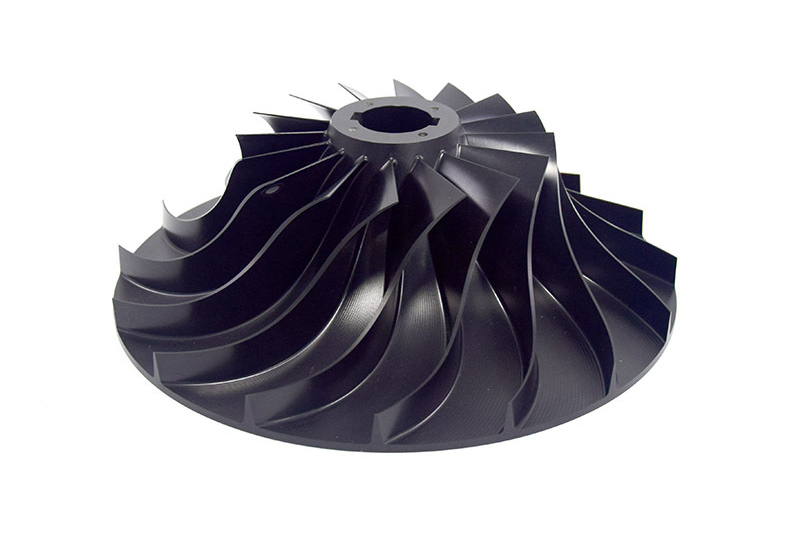
  • Precision CNC Machining: Ideal for compressor wheels, turbo housings, and lightweight turbo components where strength-to-weight ratio and dimensional accuracy (±0.005 mm) are critical.

  • Wire EDM Machining: Best for extremely fine internal features where maximum precision (±0.003 mm) is essential.

  • Conventional Machining: Suitable for basic secondary operations where ±0.01 mm tolerances are acceptable.

Titanium Alloy Performance Matrix

Alloy Material

Max Service Temp (°C)

Tensile Strength (MPa)

Density (g/cm³)

Fatigue Resistance

Typical Applications

Ti-6Al-4V

400

930

4.43

Excellent

Compressor wheels, turbo shafts

Ti-6Al-2Sn-4Zr-6Mo

550

1030

4.62

Superior

Turbocharger hot-section parts

Ti-5Al-2.5Sn

480

870

4.5

Good

Low-pressure turbo components

Ti-6Al-2Sn-4Zr-2Mo

540

965

4.6

Excellent

Exhaust turbo parts

Ti-15V-3Cr-3Sn-3Al

370

980

4.68

Good

Lightweight aerospace turbo units

Alloy Selection Strategy for Turbocharger Components

Proper alloy selection ensures superior mechanical performance and durability:

  • Ti-6Al-4V: The standard choice for lightweight, high-strength turbo components operating up to 400°C.

  • Ti-6Al-2Sn-4Zr-6Mo: Ideal for hot-section turbo components exposed to higher temperatures (~550°C) needing excellent creep and fatigue resistance.

  • Ti-5Al-2.5Sn: Selected for lower-temperature components where good mechanical properties and lower density are needed.

  • Ti-6Al-2Sn-4Zr-2Mo: Used for exhaust and turbo hot-side parts needing excellent thermal fatigue resistance.

  • Ti-15V-3Cr-3Sn-3Al: Chosen for lightweight, high-speed rotating turbo components requiring high strength and good machinability.

Key Post-processing Techniques

Post-processing enhances mechanical properties and component reliability:

Testing Methods and Quality Assurance

Every titanium turbo component at Neway AeroTech undergoes:

Our production processes comply fully with AS9100 aerospace standards.

Case Study: CNC Machined Ti-6Al-4V Turbocharger Wheels

Neway AeroTech successfully delivered CNC machined Ti-6Al-4V compressor wheels for high-performance turbocharger systems:

  • Service Temperature: Up to 400°C continuous

  • Dimensional Precision: ±0.005 mm consistently achieved

  • Surface Finish: Ra ≤0.6 µm optimized for airflow performance

  • Certification: Fully AS9100 aerospace quality certified

FAQs

  1. Why are titanium alloys preferred for turbocharger components?

  2. What dimensional tolerances can Neway AeroTech achieve for titanium CNC parts?

  3. How is machining heat controlled when working with titanium alloys?

  4. Which titanium grades are recommended for compressor wheels and shafts?

  5. What quality control methods guarantee the reliability of titanium turbo components?