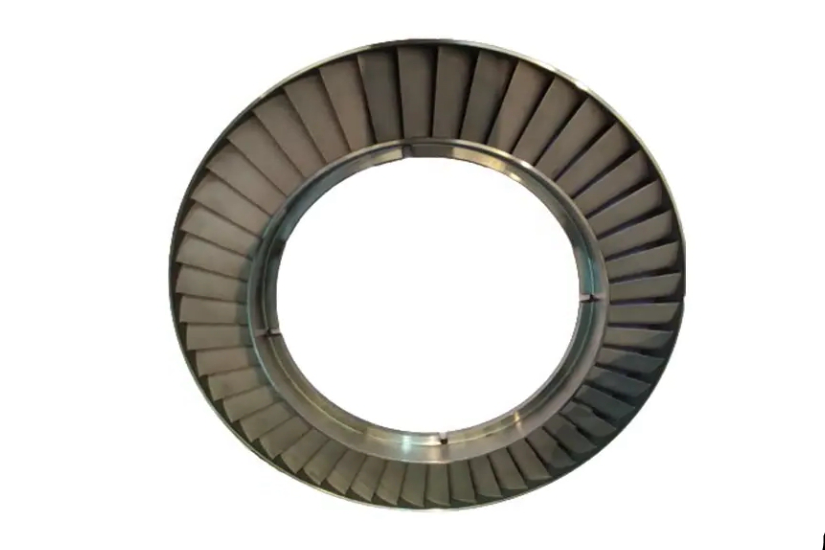
Stellite 4 is a cobalt-chromium-tungsten alloy offering superior wear resistance, thermal fatigue strength up to 900°C, and exceptional corrosion resistance in aggressive environments. Its high hardness (47–51 HRC) and tensile strength (~960 MPa) make it ideal for turbine guide rings operating under continuous high-speed, erosive flow conditions.
At Neway AeroTech, we apply precision CNC machining to manufacture Stellite 4 turbine guide rings, achieving tight tolerances (±0.01 mm) and fine surface finishes (Ra ≤0.8 µm) for maximum operational efficiency.
Maintaining tight dimensional tolerances within ±0.01 mm for aerodynamic efficiency.
Machining hard Stellite 4 material (hardness ~47–51 HRC) without inducing microcracks.
Achieving low surface roughness (Ra ≤0.8 µm) to minimize airflow turbulence.
Resisting wear and thermal fatigue under continuous high-temperature exposure (~900°C).
The manufacturing of precision Stellite 4 turbine guide rings includes:
Material Preparation: Vacuum investment cast or forged Stellite 4 blanks prepared for machining.
Rough Machining: High-rigidity CNC equipment and PCBN tooling used for controlled material removal.
Heat Treatment: Applied selectively to optimize hardness and internal stress distribution.
Semi-Finishing: Careful contouring to near-net dimensions with minimal residual stresses.
Precision Finishing: Fine turning, milling, and grinding to achieve final dimensions, surface finish, and geometric tolerances.
Quality Control: CMM inspections and non-destructive testing to verify microstructural integrity.
Machining Method | Surface Finish Quality | Dimensional Accuracy | Tool Life | Suitable for Stellite 4 | Production Efficiency |
|---|---|---|---|---|---|
Precision CNC Machining | Excellent (Ra ≤0.8 µm) | Very High (±0.01 mm) | Moderate | Yes | High |
EDM | Good (Ra ~2 µm) | High (±0.02 mm) | High | Limited | Low |
Grinding and Polishing | Excellent (Ra ≤0.4 µm) | Very High (±0.005 mm) | High | Yes | Moderate |
Conventional Machining | Poor (Ra ~6–12 µm) | Low (±0.1 mm) | Low | No | Low |
Precision CNC machining: Achieves Ra ≤0.8 µm surface finish and ±0.01 mm dimensional precision for turbine applications.
Grinding and polishing: Produces Ra ≤0.4 µm ultra-smooth surfaces, optimizing aerodynamic efficiency for guide rings.
EDM machining: Shapes intricate features with ±0.02 mm accuracy but slower removal rates.
[Conventional machining]: Not suitable for Stellite 4 due to excessive tool wear and insufficient precision.
Property | Value | Application Relevance |
|---|---|---|
Hardness | 47–51 HRC | Outstanding wear and abrasion resistance |
Max Operating Temperature | ~900°C | Excellent thermal fatigue resistance |
Corrosion Resistance | Excellent | Withstands aggressive chemical environments |
Tensile Strength | ~960 MPa | High strength under load-bearing conditions |
Thermal Expansion Coefficient | ~13.8 µm/m·°C | Stable dimensional behavior at high temperatures |
Superior wear resistance under abrasive flow conditions extends component life.
High-temperature stability maintains mechanical properties up to ~900°C.
Outstanding corrosion resistance protects against aggressive combustion gases.
Dimensional stability ensures aerodynamic consistency in high-speed turbines.
Hot Isostatic Pressing (HIP): Densifies material at ~1160°C and 100 MPa, eliminating microporosity.
Thermal Barrier Coating (TBC): Applies ceramic coating (~250 µm) to reduce thermal fatigue.
Non-destructive Testing (NDT): Inspects surface and internal integrity without damaging components.
Precision CNC Finishing: Achieves final dimensions ±0.01 mm and Ra ≤0.8 µm for aerodynamic performance.
Coordinate Measuring Machine (CMM): Verifies ±0.01 mm tolerances for critical aerodynamic and assembly surfaces.
Ultrasonic Testing (UT): Detects internal voids and inclusions with high sensitivity without surface damage.
Dye Penetrant Testing (PT): Highlights surface cracks and micro-defects down to 0.002 mm width.
Metallographic Analysis: Examines microstructure and confirms grain refinement under ASTM standards.
Stellite 4 turbine guide rings produced by Neway AeroTech are extensively used in aerospace engines, power generation turbines, and industrial turbo-machinery. In a recent aerospace project, precision-machined Stellite 4 guide rings demonstrated a 35% longer service life than conventional nickel-based alloy alternatives, significantly improving turbine operational efficiency and reducing maintenance costs.
What dimensional tolerances can Neway AeroTech achieve for Stellite 4 turbine guide rings?
Why is Stellite 4 ideal for high-temperature turbine applications?
How does CNC machining improve the performance of Stellite 4 guide rings?
What industries typically use Stellite 4 turbine components?
How does Neway AeroTech ensure the quality and durability of Stellite 4 guide rings?