
Pressage Isostatique à Chaud (HIP) pour l'Amélioration des Pièces en Alliage Haute Température
Optimisation de la Densité Interne pour les Performances Thermiques et Structurelles
Les composants en alliage haute température utilisés dans les systèmes aérospatiaux, de turbines, nucléaires et énergétiques sont soumis à des charges thermiques extrêmes et à de la fatigue. La porosité interne, souvent introduite lors de la fonderie à cire perdue sous vide ou de la métallurgie des poudres, compromet l'intégrité mécanique et la résistance au fluage. Le Pressage Isostatique à Chaud (HIP) est une étape de post-traitement critique qui élimine les vides internes, affine les structures de grains et améliore la durée de vie en fatigue des pièces en superalliage.
Neway AeroTech fournit un traitement HIP pour des composants complexes fabriqués à partir d'alliages Inconel, Rene, CMSX et Hastelloy, garantissant une résistance thermique, au fluage et à la pression supérieure.
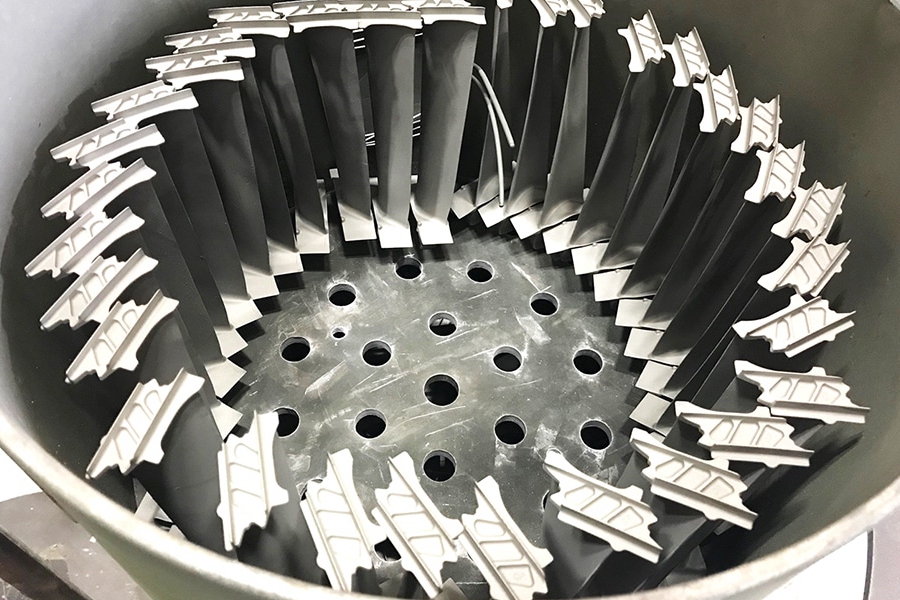
Aperçu du Procédé HIP et Paramètres
Le HIP applique simultanément une haute température et une pression isostatique pour éliminer la porosité et améliorer l'isotropie dans les composants en alliage haute performance.
Plage de température : 900–1260°C selon l'alliage
Plage de pression : 100–200 MPa via un gaz argon inerte
Durée : 2–4 heures pour les pièces typiques de turbine ou structurelles
Atmosphère : Argon dans une chambre d'autoclave scellée sous vide
Ce traitement restaure la cohésion interne et prépare les pièces pour un traitement thermique ou des procédés de revêtement ultérieurs.
Alliages et Composants Couramment Traités par HIP
Alliage | Température Max (°C) | Pièces Traitées | Industrie |
|---|---|---|---|
704 | Moyeux de rotor, carter d'étanchéité | ||
980 | Aubes de turbine, tuyères | ||
1140 | Aubes de premier étage, profils aérodynamiques | ||
1175 | Enveloppes de combustion, manchons |
Le HIP améliore l'uniformité structurelle pour les pièces moulées à grains équiaxes et à solidification directionnelle.
Étude de Cas : HIP d'un Profil Aérodynamique de Turbine en CMSX-4
Contexte du Projet
Un profil aérodynamique en CMSX-4 présentait des niveaux de porosité >0,4% issus de la fonderie à cire perdue. La pièce a subi un HIP à 1190°C, 170 MPa pendant 4 heures. Les tests post-HIP ont confirmé une densité >99,9%, une résistance à la traction améliorée à 1000°C, et une durée de vie en fatigue augmentée de 2,3× sous chargement thermique cyclique.
Modèles de Composants Typiquement Traités par HIP et Applications
Composant | Alliage | Type de Procédé | Industrie |
|---|---|---|---|
Segment de Tuyère de Turbine | Rene 88 | Moulage + HIP | |
Anneau de Chambre de Combustion Interne | Hastelloy X | HIP + TBC | |
Disque de Rotor | Inconel 718 | HIP + usinage | |
Bloc de Carénage | CMSX-4 | Moulage + HIP |
Le HIP permet un usinage sans défaut et l'application de TBC sur ces assemblages exposés à la chaleur.
Avantages Techniques du HIP dans les Composants en Superalliage
Densité interne >99,9% élimine la porosité de retrait et les inclusions non métalliques des composants moulés et en métallurgie des poudres
Résistance au fluage améliorée prolonge la durée de vie des composants sous des températures allant jusqu'à 1150°C dans des environnements de chargement cyclique
Restaure la cohésion des joints de grains dans les structures cristallines à solidification directionnelle ou à grains équiaxes
Prépare les surfaces internes pour un post-traitement fiable par EDM, perçage et usinage CNC
Réduit le taux de rebut jusqu'à 40% grâce au sauvetage de pièces moulées limites ou réparables
Flux de Travail HIP + Post-Traitement
HIP en atmosphère d'argon à la pression nominale et au temps de maintien
Traitement thermique pour la restauration de la dureté et de la résistance
Optionnel usinage CNC pour la finition des profils aérodynamiques, des carter ou des brides
Revêtements TBC appliqués pour la protection thermique
Contrôle final d'inspection incluant validation par rayons X, MMT et MEB
Résultats et Vérification
Méthodes de Fabrication
Le HIP a été appliqué dans une cuve de 1,1 m de diamètre avec une précision de contrôle de ±3°C et une pressurisation automatique du gaz. Traçabilité complète maintenue.
Amélioration Structurelle
Porosité réduite à <0,05%. Limite élastique à 800°C améliorée de 12%. Les tests de fatigue à faible nombre de cycles ont confirmé des gains de durabilité par rapport aux pièces de référence.
Finition de Surface et Dimensionnelle
Toutes les pièces ont été finies par usinage post-HIP et revêtues le cas échéant. Tolérances maintenues dans ±0,01 mm. Préparation de surface vérifiée pour l'adhérence du TBC.
Inspection
MMT a confirmé la précision dimensionnelle. Inspection par rayons X a validé la consolidation interne. MEB a confirmé la guérison des joints de grains et une microstructure exempte d'oxydes.
FAQ
Quels alliages bénéficient le plus du traitement HIP ?
Le HIP peut-il être utilisé sur des pièces moulées et fabriquées de manière additive ?
Comment le HIP affecte-t-il les étapes d'usinage ou de revêtement ultérieures ?
Quelle est la plage de pression et de température typiquement utilisée ?
Comment la qualité du HIP est-elle validée après traitement ?
