GDMS Trace Element Analysis for Superalloy Casting RFQs
GDMS trace element analysis is useful in a superalloy casting RFQ when the buyer needs chemistry evidence beyond the normal alloy grade name. A nickel or cobalt superalloy casting can be called by the correct grade and still require review of residual elements, tramp elements, melt history, sample location, and the report boundary before the part is released for hot-section service. The test request should therefore state what decision the result must support: incoming alloy confirmation, casting lot release, deviation review, post-process planning, or comparison with a customer specification.
NewayAeroTech can support superalloy material testing and analysis as part of drawing-based custom turbine casting projects, depending on the alloy, sample condition, and inspection requirement. For buyers sourcing investment cast turbine blades, vanes, shrouds, heat shields, or other hot gas path components, GDMS should not be treated as a lab add-on after the quotation is finished. It belongs in the RFQ when trace chemistry affects acceptance records, rework decisions, HIP or heat treatment planning, or the confidence needed before machining expensive castings.
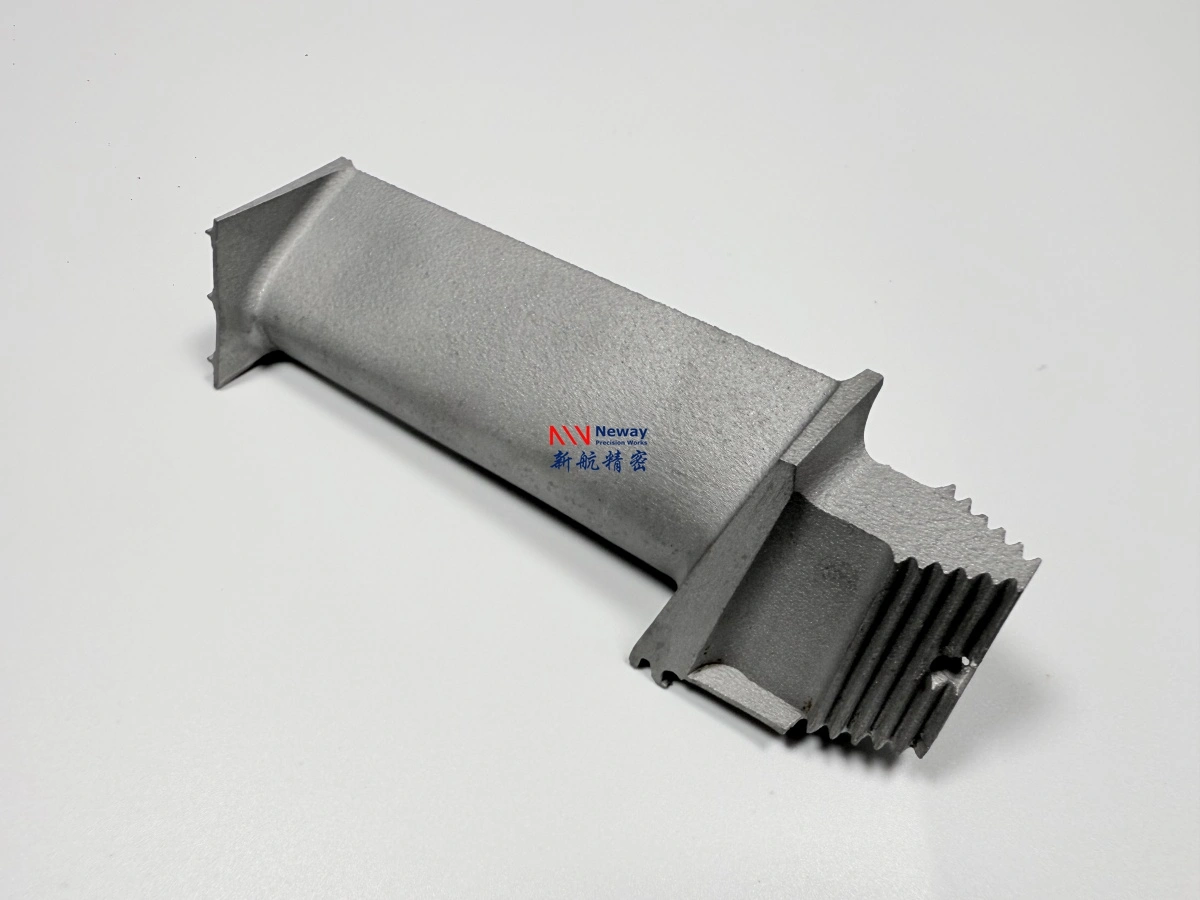
When GDMS Belongs in a Casting RFQ
For this RFQ, buyers should first define the chemistry question. GDMS can support trace-level review when the casting lot has a strict chemistry window, when the alloy source has changed, when a returned sample must be compared with a target grade, or when a customer specification asks for evidence beyond a routine certificate. The supplier cannot quote the analysis properly until the buyer states whether the sample comes from a casting, a gate, a runner, a coupon, a machined surface, or a used component.
The request also needs a link between testing and manufacturing action. If GDMS is only requested as a line item, the report may arrive without telling the buyer what to do next. If the RFQ states that the result will support alloy confirmation before vacuum investment casting, lot release after casting, or review before machining, the supplier can build the inspection hold point into the route. That makes the analysis part of the manufacturing decision instead of a disconnected document.
RFQ trigger | Useful GDMS question | Manufacturing decision it supports |
|---|---|---|
New alloy source or remelt route | Do residual or tramp elements stay within the buyer's specification boundary? | Whether the material can move into casting or needs engineering review before use. |
Critical turbine casting lot | Does the sample evidence support release of the casting lot for downstream operations? | Whether to continue to HIP, heat treatment, machining, or additional inspection. |
Used or legacy sample comparison | Is the sample chemistry consistent with the expected superalloy family? | Whether reverse review can proceed, and which material assumption is unsafe. |
Deviation or investigation | Are unusual trace elements present that may explain processing or service risk? | Whether to isolate the lot, request further testing, or adjust acceptance discussion. |
Trace Elements That Can Change Superalloy Acceptance
Trace chemistry is not only a paperwork detail for hot-section castings. Nickel-based and cobalt-based superalloys depend on controlled alloying additions, and small unwanted elements may influence melting practice, casting cleanliness, grain behavior, corrosion resistance, or later processing response. Buyers should avoid sending a broad request for every detectable element without naming the alloy specification. The useful question is which elements are controlled by the drawing, customer requirement, or project acceptance plan.
For Inconel, IN738LC, Rene, CMSX, MAR-M247, Hastelloy, Stellite, and related casting alloys, a GDMS request may look at residual metallic elements, low-level contaminants, or elements that indicate alloy mixing risk. For a single crystal or directionally solidified part, chemistry evidence may sit beside crystal orientation and macrostructure review. For an equiaxed hot-section casting, it may support lot release together with radiographic inspection, FPI, dimensional inspection, and metallography when those checks are required.
The buyer should also understand what GDMS should not replace. It is not a substitute for dimensional inspection, X-ray or CT review, metallographic examination, mechanical testing, or a dedicated carbon sulfur test when those are specified. It answers a chemistry question. The RFQ becomes stronger when it states how that chemistry question connects to the part family and the acceptance record.
Alloy or project family | Trace chemistry concern to define | Related evidence often reviewed with it |
|---|---|---|
Nickel superalloy turbine blades and vanes | Residual metallic elements, alloy mix risk, and specification-controlled additions. | FPI, X-ray or CT, CMM, heat treatment records, and machining release notes. |
Cobalt superalloy nozzles or wear exposed parts | Elements that affect corrosion, oxidation, or weld and coating compatibility. | Surface inspection, metallography when specified, coating boundary review, and hardness. |
Single crystal or DS castings | Low-level chemistry differences that may be reviewed with crystal route evidence. | Orientation inspection, macrostructure review, grain defect screening, and casting records. |
Legacy sample or MRO comparison | Chemistry consistency with the expected alloy family, without treating a worn part as perfect reference geometry. | Visual condition review, dimensional comparison, coating residue review, and material confirmation. |
Sample Preparation and Report Boundary for Cast Parts
The sample boundary can change the meaning of the report. A sample cut from a gate or runner may represent the melt better than a contaminated service surface, but it may not answer every question about a finished part. A sample from a machined surface can be convenient, yet the buyer should state whether the surface has coating residue, oxidation, previous repair, or machining coolant contamination. A used turbine part needs extra caution, because service exposure can change the outer surface and mislead a chemistry review if the sample location is not controlled.
For cast components, NewayAeroTech prefers the RFQ to identify the sample origin, sampling surface, part number or drawing reference, alloy grade, lot or heat information if available, and the acceptance document the report must support. When the sample is small, irregular, coated, or taken from a restricted area, the buyer should tell the supplier before quotation. Sample mass, surface preparation, contamination removal, and destructive sampling permission may affect the testing route.
The report boundary should also be explicit. A buyer may need raw element readings, pass/fail comparison to a supplied specification, a comment on whether the sample matches an expected alloy family, or a testing record to be attached to a casting release package. These are different outputs. A report that is useful for incoming confirmation may not be enough for a customer-controlled release package unless the acceptance rule is named.
Sample issue | Buyer should state | Reason it changes the quotation |
|---|---|---|
Sample origin | Casting, coupon, gate, runner, machined blank, finished part, or used sample. | Defines how representative the result is for the casting lot or component. |
Surface condition | As-cast, machined, oxidized, coated, cleaned, or service-exposed surface. | Controls preparation risk and the chance of surface contamination. |
Specification boundary | Alloy grade, customer chemistry requirement, and any controlled trace elements. | Lets the report compare results against the right acceptance basis. |
Report purpose | Material confirmation, lot release, deviation review, or manufacturing-route decision. | Determines whether the result is enough or needs supporting inspection records. |
How GDMS Supports Casting, HIP, and Heat Treatment Decisions
Trace element analysis should be placed at the correct point in the route. If the buyer is qualifying an alloy source for high-temperature superalloy casting, the chemistry review belongs before the project commits to tooling, wax patterns, and shell scheduling. If the buyer is reviewing a casting lot after pour, the sample plan should be tied to the lot record and the downstream hold point. If the result will influence whether parts continue to machining, the report should be available before expensive datum creation and finishing work begins.
GDMS may also sit beside HIP treatment or superalloy heat treatment planning when chemistry evidence is part of the buyer's release logic. The analysis does not prove that HIP closed internal porosity or that heat treatment produced the required microstructure. Those questions need other inspection or material evidence. It can, however, help confirm that the alloy chemistry being processed is consistent with the planned route, subject to the supplied specification and project review.
For a turbine casting RFQ, this sequence avoids a common mistake: testing is requested only after a disagreement occurs. If the buyer already knows chemistry evidence will be needed for release, it should be quoted with the manufacturing route. The supplier can then identify who provides the sample, who prepares it, when the result is needed, and whether production waits for the report. That level of planning matters more than adding a test name to a purchase order.
What Buyers Should Send for GDMS-Based Quotation Review
A strong GDMS-based quotation request gives the supplier enough technical context to quote the analysis and connect it to the casting decision. Buyers should send the alloy grade, drawing or part description, application environment, sample type, sample condition, quantity of samples, required report language, and the specification or acceptance rule used for comparison. If the part is a turbine blade, nozzle guide vane, shroud, combustor component, or other hot-section casting, include which surface or lot the sample represents.
The RFQ should also state the manufacturing scope around the testing request. NewayAeroTech may be reviewing only the material test, or it may be asked to support casting, HIP, heat treatment, CNC machining, and inspection for the same project. Those are different supplier responsibilities. A buyer requesting only GDMS should not assume the testing supplier has accepted the whole casting route. A buyer requesting a full custom-manufacturing package should ask for chemistry evidence to be integrated into the route plan.
When the requirement is uncertain, the buyer can send a question instead of forcing a fixed test list. For example: "We need trace element confirmation for an IN738LC turbine vane casting lot before machining; please review whether GDMS is suitable and what sample condition is required." That wording lets the supplier respond with test suitability, sample preparation notes, and any supporting inspection that may be needed.
RFQ item | Minimum information to provide | Supplier review output |
|---|---|---|
Alloy and specification | Grade name, material standard or customer chemistry limits, and whether substitution is permitted. | Confirms the comparison basis and flags unclear acceptance rules. |
Sample information | Sample origin, surface condition, quantity, size, coating or oxidation notes, and destructive-test permission. | Determines preparation route, report validity, and whether more sample data is needed. |
Component and route | Turbine part type, casting route, lot boundary, and downstream operations such as HIP or machining. | Places GDMS at the correct hold point in the manufacturing sequence. |
Report requirement | Raw results, comparison to supplied limits, release record, or deviation review support. | Defines the report scope and prevents missing evidence at release. |
Send the alloy specification, sample origin, part drawing or description, casting lot context, required report scope, and any downstream manufacturing decisions tied to the result. NewayAeroTech can review whether GDMS trace element analysis, together with casting, HIP, heat treatment, machining, and inspection support where needed, fits the custom superalloy turbine casting RFQ.
Related FAQs
What is chemical verification and why is it essential in superalloy manufacturing?
What defects can material testing reveal in superalloy parts?
Which testing methods ensure integrity and reliability of superalloy components?
Which testing methods ensure quality of superalloy components?
How does industrial CT scanning help detect internal defects in superalloy parts?
How does NDT ensure the quality and integrity of superalloy components?
What inspections are typically conducted to ensure quality in gas turbine components?