
Pièces moulées à la cire perdue en superalliage et usinage par électro-érosion de précision
Introduction à l'électro-érosion pour les pièces moulées à la cire perdue en superalliage
L'usinage par électro-érosion (EDM) est essentiel pour le post-traitement des caractéristiques de précision dans les pièces moulées à la cire perdue en superalliage. Il permet une usinage à tolérance serrée sans induire de contraintes mécaniques dans les matériaux à haute dureté ou les géométries complexes difficiles à usiner par des méthodes conventionnelles.
Chez Neway Aerotech, nos services d'électro-érosion pour superalliages complètent la fusion à la cire perdue sous vide pour produire des composants hautes performances pour les applications aérospatiales, énergétiques et nucléaires.
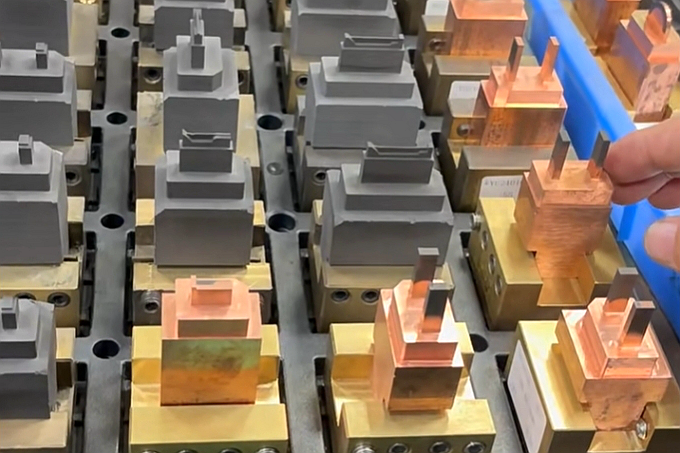
Aperçu de la technologie d'usinage par électro-érosion
Classification de l'usinage par électro-érosion
Procédé EDM | Rugosité de surface (Ra, μm) | Tolérance dimensionnelle (mm) | Rapport d'aspect | Zone affectée thermiquement (ZAT, μm) | Taille minimale de la caractéristique (mm) |
|---|---|---|---|---|---|
Électro-érosion par fil | 0,3–1,2 | ±0,002–±0,01 | Jusqu'à 20:1 | 2–5 μm | ~0,1 |
Électro-érosion par enfonçage | 0,4–2,5 | ±0,005–±0,02 | Jusqu'à 10:1 | 5–10 μm | ~0,2 |
Perçage par électro-érosion | 0,5–3,0 | ±0,02–±0,05 | Jusqu'à 30:1 | 10–15 μm | ~0,1 |
Micro-électro-érosion | 0,1–0,4 | ±0,001–±0,005 | Jusqu'à 15:1 | <2 μm | <0,05 |
La ZAT varie selon le niveau d'énergie, la durée de l'impulsion et la conductivité du matériau.
Stratégie de sélection de l'usinage par électro-érosion
Électro-érosion par fil : Idéale pour l'ébavurage des lignes de joint, les contours serrés et l'enlèvement des masselottes sur les pièces moulées à la cire perdue.
Électro-érosion par enfonçage : Meilleure pour le raffinement des cavités internes, des canaux de refroidissement et des caractéristiques de siège d'électrode basées sur le moulage.
Perçage par électro-érosion : Utilisé pour les passages de refroidissement ou de lubrification dans les aubes de turbine et les anneaux de buses.
Micro-électro-érosion : Permet une finition ultra-fine dans les zones de micro-caractéristiques moulées ou la création d'avant-trous pour des assemblages complexes.
Considérations sur les matériaux
Superalliages typiques pour l'électro-érosion après moulage à la cire perdue
Matériau | Dureté (HRC) | Fatigue thermique | Adaptabilité au moulage | Efficacité de l'EDM | Applications |
|---|---|---|---|---|---|
36–42 | Excellente | Bonne | Élevée | Roues de turbine, aubes directrices | |
38–44 | Élevée | Excellente | Modérée | Segments de chambre de combustion, supports aérospatiaux | |
42–46 | Supérieure | Monocristal uniquement | Faible | Aubes de turbine, profils aérodynamiques haute température | |
30–35 | Bonne | Très bonne | Élevée | Collecteurs d'échappement, traitement chimique | |
40–45 | Excellente | Modérée | Modérée | Tuyères de fusée, sièges de soupape |
Stratégie de sélection des matériaux
Inconel 713C : Idéal pour les aubes directrices nécessitant un usinage de profil serré ; répond bien à l'électro-érosion par fil avec une couche refondue minimale.
Rene 77 : Idéal pour les pièces nécessitant une haute résistance au fluage ; l'EDM est recommandé pour les caractéristiques d'étanchéité et les trous de boulons.
CMSX-4 : Nécessite une EDM à faible énergie ; utilisé uniquement lorsque le meulage est impossible en raison des risques de dommages thermiques.
Hastelloy X : Facilement usinable par électro-érosion par enfonçage ou par fil ; bon choix pour les assemblages soudés moulés.
Nimonic 115 : Utile pour les outillages à cycles élevés ; l'EDM assure la répétabilité dans les zones d'ajustement et critiques pour l'écoulement.
Étude de cas : Finition par EDM d'un anneau de buse de turbine moulé à la cire perdue
Contexte du projet
Un client du secteur de la production d'énergie avait besoin de l'usinage final d'un anneau de buse de turbine en Rene 77 moulé utilisant la technologie de fusion à la cire perdue sous vide. Des tolérances de ±0,005 mm étaient requises sur 22 ports radiaux et des épaulements d'étanchéité.
Flux de travail de fabrication
Moulage : Moulage à la cire perdue en Rene 77, compactage isostatique à chaud post-moulage à 1195 °C, 100 MPa, pendant 4 heures.
Usinage d'ébauche : Interfaces et surface de l'anneau tournées sur CNC, laissant 0,5 mm de matière pour la finition par EDM.
Électro-érosion par fil : Profilage de chaque port de refroidissement radial (Ø1,2 mm) à ±0,003 mm en utilisant un fil en laiton de 0,25 mm.
Électro-érosion par enfonçage : Usinage de trois cavités internes, entrefer de 0,08 mm, profondeur de 10 mm avec une tolérance de ±0,005 mm.
Post-traitement
Relaxation des contraintes à 950 °C pendant 2 heures sous gaz inerte
Compactage isostatique à chaud (HIP) pour sceller la porosité de moulage
Application d'un revêtement barrière thermique (TBC) sur les zones exposées à la chaleur
Finition de surface
Électropolissage jusqu'à Ra ≤ 0,6 μm
Passivation pour la résistance à la corrosion
Ébavurage sous microscope pour éliminer les bavures de bord < 50 μm
Inspection
Inspection par MMT sur 50 points, tous dans les ±2 μm
Vérification des vides par radiographie X révélant zéro cavité de retrait
Analyse par MEB confirmant une surface d'étincelage propre et l'intégrité du grain
Essais par ultrasons en immersion confirmant une intégrité structurelle complète
Résultats et vérification
La finition par EDM a maintenu des tolérances de profil cohérentes de ±0,003 mm sur toutes les entrées de ports et les zones d'étanchéité de l'anneau.
Le post-traitement HIP a résulté en un scellement des pores à 100 %, confirmé par les tests ASTM E192 et l'acceptation de niveau 2 par radiographie.
L'intégrité de surface après électropolissage a dépassé Ra ≤ 0,6 μm, éliminant le risque d'érosion induite par l'écoulement ou de fissuration par fatigue.
L'analyse MEB a montré des zones texturées par étincelage uniformes sans couches refondues ni microfissures aux joints de grains.
L'inspection finale a confirmé une conformité géométrique complète et zéro défaut interne, dépassant les normes d'acceptation des composants de turbines aérospatiales.
FAQ
Quelle finition de surface peut être obtenue en utilisant l'EDM sur des composants en superalliage moulés ?
Comment l'EDM affecte-t-il l'intégrité métallurgique des pièces moulées à la cire perdue ?
Les canaux de refroidissement internes dans les moulages de turbines peuvent-ils être traités par EDM ?
L'EDM convient-il aux composants monocristallins ou à solidification directionnelle ?
Quel post-traitement est requis après l'EDM de pièces moulées aérospatiales ?
