
Fabrication avancée par EDM de pales de turbine en Inconel 718 imprimées en 3D en superalliage
Introduction à la finition par EDM pour les pales de turbine en Inconel 718 imprimées en 3D
Les pales de turbine en Inconel 718 produites par impression 3D nécessitent une finition EDM avancée pour répondre aux normes de géométrie de précision et de résistance à la fatigue thermique. L'usinage par électro-érosion permet le raffinement des micro-caractéristiques, l'accès aux cavités internes et le contrôle des tolérances finales dans les profils aérodynamiques en superalliage fabriqués par additive.
Chez Neway Aerotech, nous combinons l'impression 3D d'Inconel 718 avec un traitement EDM avancé pour fournir des pales de turbine à haute intégrité pour la production d'énergie et les systèmes de propulsion aérospatiale.
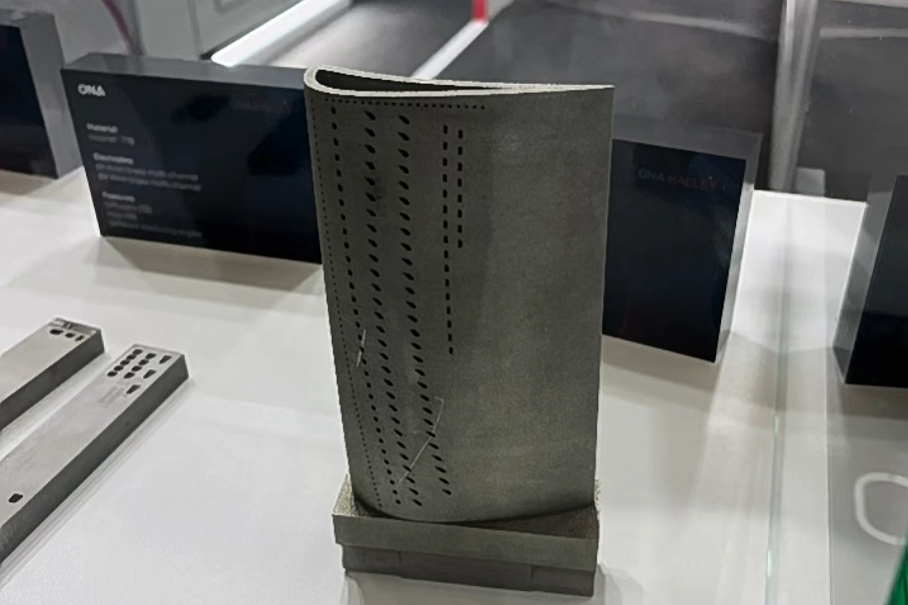
Aperçu de la technologie d'usinage EDM
Classification de l'usinage EDM
Procédé EDM | Rugosité de surface (Ra, μm) | Tolérance dimensionnelle (mm) | Rapport d'aspect | Zone affectée par la chaleur (ZAC, μm) | Taille minimale des caractéristiques (mm) |
|---|---|---|---|---|---|
EDM à fil | 0,3–1,2 | ±0,002–±0,01 | Jusqu'à 20:1 | 2–5 μm | ~0,1 |
EDM par enfonçage | 0,4–2,5 | ±0,005–±0,02 | Jusqu'à 10:1 | 5–10 μm | ~0,2 |
EDM de perçage de trous | 0,5–3,0 | ±0,02–±0,05 | Jusqu'à 30:1 | 10–15 μm | ~0,1 |
Micro-EDM | 0,1–0,4 | ±0,001–±0,005 | Jusqu'à 15:1 | <2 μm | <0,05 |
L'EDM complète la fabrication additive en réalisant des finitions ultra-fines et des géométries de cavités complexes impossibles à obtenir par fusion laser seule.
Stratégie de sélection de l'usinage EDM
EDM à fil : Idéal pour la finition des bords des profils aérodynamiques, l'ébarbage des extrémités et la définition des bords de fuite.
EDM par enfonçage : Utilisé pour les cavités de forme de pied, les rainures de fixation et les éléments de verrouillage.
EDM de perçage de trous : Appliqué aux trous internes de refroidissement par film et aux orifices de sortie.
Micro-EDM : Permet des trous de purge <0,2 mm et des micro-encoches dans les zones de passage de gaz.
Considérations sur les matériaux
Propriétés de l'Inconel 718 dans les pales imprimées en 3D
Propriété | Valeur |
|---|---|
Limite d'élasticité @ 650°C | ~970 MPa |
Dureté (après HIP + vieillissement) | HRC 36–42 |
Température de service maximale | 700–750°C |
Résistance à l'oxydation | Excellente pour les environnements de turbine |
Compatibilité avec l'impression 3D | Prouvée dans les procédés additifs SLM |
Pourquoi l'EDM est critique pour les pales en Inconel 718 imprimées en 3D
Affine la rugosité de surface à l'intérieur des treillis et des passages de refroidissement
Élimine les pièges à poudre résiduelle et les zones de refusion
Permet la personnalisation post-impression de caractéristiques externes complexes
Minimise la ZAC et préserve l'intégrité structurelle dans les sections minces
Étude de cas : Post-traitement par EDM d'une pale de turbine en In718 imprimée en 3D
Contexte du projet
Un client du secteur de la production d'énergie nécessitait un post-traitement de haute précision pour une pale de turbine en Inconel 718 imprimée en 3D, comportant des structures en treillis internes et 54 trous de refroidissement par film.
Flux de travail de fabrication
Impression 3D : Fabrication additive SLM utilisée pour construire la pale couche par couche, épaisseur de 40 μm, densité >99,7 %
Traitement HIP : Compaction isostatique à chaud à 1200°C, 100 MPa pendant 4 heures
EDM à fil : Ébarbage des bords et façonnage des extrémités avec une précision de ±0,005 mm
EDM de trous : Trous de refroidissement par film (Ø0,6 mm) usinés avec un rapport d'aspect de 20:1
EDM par enfonçage : Profondeur de la poche de fixation du pied de 10 mm, tolérance ±0,005 mm
Post-traitement
Traitement thermique de détente des contraintes à 925°C pendant 2 heures
Grenaillage pour améliorer la durée de vie en fatigue (amélioration >25 %)
Passivation finale pour éliminer les débris d'EDM et améliorer la résistance à la corrosion
Finition de surface
Surfaces internes polies à Ra ≤ 0,6 μm aux sorties des trous de film
Rayon de l'extrémité du profil aérodynamique contrôlé à R0,05 mm
Aucune bavure microscopique ou indicateur de fissure après inspection par MEB
Inspection
MMT sur 72 points clés avec un écart <2 μm
END par rayons X confirmant l'intégrité des canaux internes
Tests ultrasonores par immersion vérifiant la fermeture complète des pores
Test de pression sur les trous de film : débit d'air de 0,8 MPa, variation <2 % sur tous les orifices
Résultats et vérification
La finition par EDM a fourni une précision dimensionnelle de ±0,003 mm et une géométrie cohérente sur les profils complexes de pales de turbine imprimées en 3D.
Tous les 54 trous de refroidissement par film ont répondu aux exigences d'uniformité du flux et de Ra ≤ 0,6 μm, permettant une gestion thermique optimisée.
Les résultats du MEB et de la MMT ont montré zéro fissuration, déformation ou dérive dimensionnelle par rapport au CAO original après le post-traitement par EDM.
La pale finale a réussi une simulation d'endurance thermique de 1000 heures et plus de 3000 cycles marche-arrêt sans défaillances liées à la fatigue.
Le client a approuvé la combinaison EDM + impression 3D pour la production en série de pales de turbine après ce pilote réussi.
FAQ
L'EDM peut-il affiner les passages de refroidissement internes dans les pales de turbine imprimées en 3D ?
Quelles tolérances dimensionnelles sont réalistes avec l'EDM après l'impression métallique ?
L'EDM est-il compatible avec les structures de pales en treillis et sans supports ?
Comment l'EDM affecte-t-il la résistance à la fatigue de surface dans les pièces additives ?
Quelles sont les étapes de post-traitement idéales après l'EDM sur des pales en In718 imprimées ?
