Quels défis surviennent lors de l'utilisation du WAAM pour les pièces en alliages hautes performance...
Apport thermique excessif et contraintes résiduelles
Le défi le plus important est l'apport thermique élevé inhérent au procédé. L'arc électrique génère une chaleur intense et localisée, entraînant des contraintes résiduelles substantielles, une distorsion sévère et une large Zone Affectée par la Chaleur (ZAC). Pour les alliages hautes performances comme l'Inconel 718 ou les alliages de titane, cela peut provoquer du gauchissement, de la fissuration (notamment la fissuration par solidification ou par liquation) et des transformations de phase indésirables qui dégradent les propriétés mécaniques. Gérer cela nécessite un préchauffage sophistiqué, une surveillance thermique en cours de processus et un bridage robuste, mais cela reste une limitation fondamentale par rapport aux procédés à plus faible énergie comme la DED laser.
Hétérogénéité microstructurale et contrôle des propriétés
Le WAAM produit une microstructure grossière et anisotrope avec des grains colonnaires épitaxiés qui suivent souvent la direction de construction. Cela se traduit par des propriétés mécaniques directionnelles et une faiblesse potentielle aux joints de grains. Obtenir une microstructure homogène et à grains fins adaptée aux applications hautes performances est difficile. Le réchauffage cyclique des couches suivantes crée également des histoires thermiques complexes, conduisant à des distributions de phases incohérentes. Pour les alliages qui reposent sur un durcissement structural précis (par exemple, la phase γ' dans les superalliages à base de nickel), un traitement thermique ultérieur est obligatoire mais peut ne pas entièrement rectifier ces hétérogénéités inhérentes, compromettant potentiellement la résistance à la fatigue et au fluage.
Mauvaise finition de surface et précision géométrique
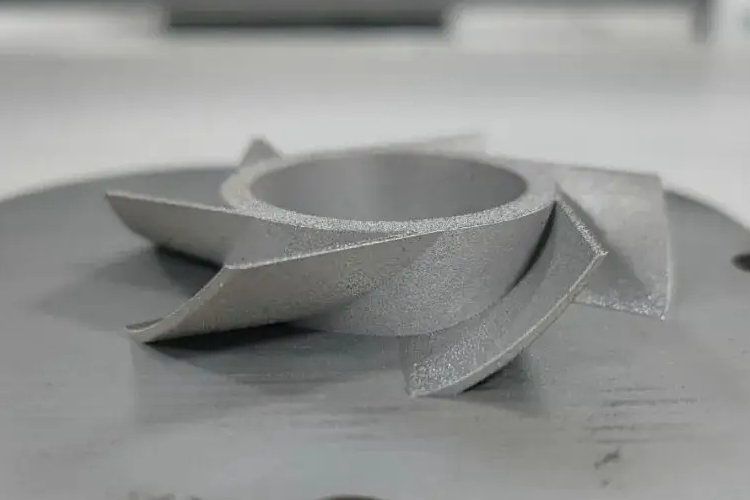
Le WAAM souffre d'une précision géométrique relativement faible et d'une mauvaise finition de surface. Le dépôt est caractérisé par un aspect ondulé et stratifié avec un effet d'escalier important sur les surfaces courbes et un effet de vague important du bain de fusion. Cela nécessite une "surépaisseur d'usinage" substantielle, souvent de plusieurs millimètres, nécessitant un usinage CNC étendu et coûteux pour atteindre les dimensions et tolérances finales. Cela rend le WAAM inadapté pour les pièces avec des caractéristiques internes complexes ou des parois minces, limitant son utilisation à des préformes de forme proche du net ou à des réparations de grandes pièces à géométrie simple.
Disponibilité des matériaux et défauts induits par le procédé
Ce ne sont pas tous les alliages hautes performances qui sont facilement disponibles sous forme de fil bobinalbe adapté au WAAM. De plus, le procédé est sujet à des défauts spécifiques comme le manque de fusion, la porosité et les inclusions. Le taux de dépôt élevé et le bain de fusion turbulent peuvent piéger des gaz ou des inclusions d'oxyde, conduisant à des vides internes. Assurer un dépôt constant et sans défaut, en particulier pour les applications critiques dans l'aérospatiale et l'aviation, nécessite une optimisation rigoureuse des paramètres et souvent un post-traitement par Compression Isostatique à Chaud (CIC) pour atteindre la densité, ajoutant du temps et des coûts.
Intégration et qualification pour une utilisation critique
Qualifier une pièce en alliage haute performance traitée par WAAM pour des applications critiques en matière de sécurité est un obstacle majeur. La variabilité inhérente du procédé à l'arc et la microstructure grossière rendent difficile la garantie de propriétés constantes et reproductibles répondant aux normes strictes d'industries comme l'aérospatiale ou le nucléaire. Des essais et analyses de matériaux approfondis, y compris des essais mécaniques dans différentes orientations et une évaluation non destructive complète, sont requis pour chaque nouvelle géométrie de composant et combinaison d'alliage. Ce processus de qualification est complexe, coûteux et limite l'adoption généralisée pour les pièces structurelles primaires.