
Protecteurs Thermiques en Alliage Hastelloy Imprimés en 3D pour une Résistance Thermique Avancée
Introduction
Les alliages Hastelloy sont conçus pour une résistance supérieure à la corrosion, une stabilité thermique et une résistance mécanique, ce qui les rend très adaptés à la fabrication de systèmes avancés de protection thermique. Chez Neway AeroTech, nous sommes spécialisés dans les services d'impression 3D pour les alliages Hastelloy. Nous fournissons des protecteurs thermiques hautes performances avec des géométries complexes, d'excellentes propriétés mécaniques et une résistance exceptionnelle aux environnements thermiques et chimiques extrêmes.
En utilisant la technologie avancée de Fusion Sélective par Laser (SLM), nous créons des écrans thermiques légers et très fiables en Hastelloy pour les secteurs aérospatial, énergétique et industriel.
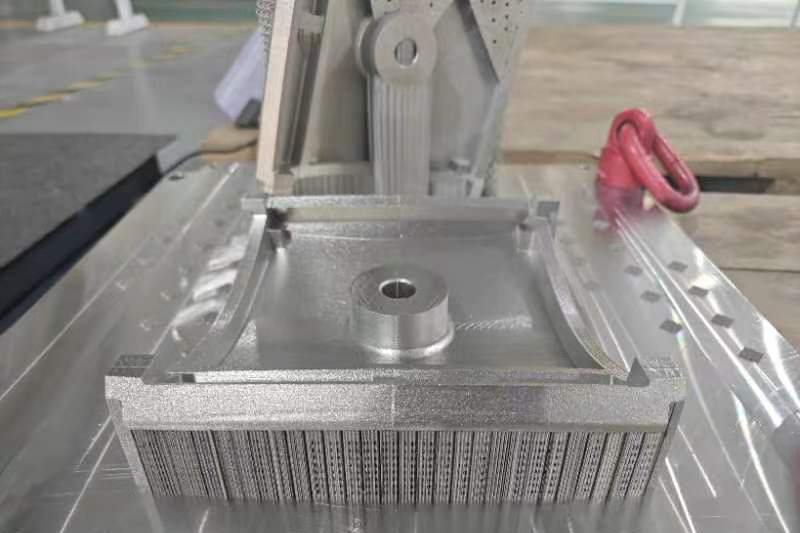
Défis de Fabrication Principaux pour les Protecteurs Thermiques en Hastelloy
La production de protecteurs thermiques imprimés en 3D à partir d'Hastelloy X et d'Hastelloy C-22 implique de surmonter des défis techniques significatifs :
Gestion des contraintes résiduelles et des déformations pendant l'impression 3D en raison des gradients thermiques élevés.
Atteindre des densités de construction supérieures à 99,5 % pour garantir l'intégrité thermique et structurelle.
Maintenir les tolérances dimensionnelles à ±0,05 mm pour les surfaces complexes et détaillées.
Atteindre une rugosité de surface Ra ≤5 µm est crucial pour améliorer l'efficacité de la protection thermique et réduire le risque d'oxydation.
Processus d'Impression 3D d'Alliage Hastelloy pour Protecteurs Thermiques
Notre processus de fabrication additive pour les écrans thermiques en Hastelloy comprend :
Préparation de la Poudre : Utilisation de poudres Hastelloy de haute pureté atomisées sous gaz, avec une distribution contrôlée de la taille des particules.
Fusion Sélective par Laser (SLM) : Fusion couche par couche sous atmosphère inerte d'argon pour prévenir l'oxydation.
Optimisation du Processus : Contrôle précis de la puissance du laser, de la vitesse de balayage et de l'espacement des hachures pour maximiser la densité et minimiser les contraintes résiduelles.
Suppression des Supports et HIP : Suppression post-construction des structures de support et Pressage Isostatique à Chaud (HIP) pour éliminer la porosité interne et améliorer les propriétés mécaniques.
Usinage CNC de Précision : Usinage final pour atteindre les tolérances dimensionnelles (±0,01 mm) et les surfaces lisses (Ra ≤1,6 µm) si nécessaire.
Traitement Thermique : Détente des contraintes et recuit de mise en solution pour optimiser la résistance, la ductilité et la résistance à la fatigue.
Comparaison des Méthodes de Fabrication pour les Protecteurs Thermiques en Hastelloy
Méthode de Fabrication | Précision Dimensionnelle | État de Surface (Ra) | Résistance Thermique | Résistance à la Corrosion | Rentabilité |
|---|---|---|---|---|---|
Impression 3D (SLM) | ±0,05 mm | ≤5 µm | Supérieure | Supérieure | Moyenne |
Moulage à la Cire Perdue sous Vide | ±0,1 mm | ≤3,2 µm | Bonne | Bonne | Moyenne |
Usinage CNC (à partir de la masse) | ±0,01 mm | ≤0,8 µm | Excellente | Bonne | Élevée |
Stratégie de Sélection de la Méthode de Fabrication
Le choix de la méthode de production optimale pour les protecteurs thermiques en Hastelloy dépend de la complexité de la conception et des exigences opérationnelles :
Impression 3D (SLM) : Idéale pour les protecteurs thermiques légers et complexes avec des canaux de refroidissement, des treillis internes et des géométries optimisées que les méthodes conventionnelles ne peuvent pas réaliser.
Moulage à la Cire Perdue sous Vide : Adapté pour les pièces moins complexes géométriquement où des performances mécaniques et thermiques modérées sont acceptables.
Usinage CNC (à partir de la masse) : Approprié pour les écrans thermiques ultra-précis où la complexité de conception est limitée, mais où la plus grande précision d'usinage est requise.
Matrice de Performance des Alliages Hastelloy
Matériau d'Alliage | Température de Service Max (°C) | Résistance à la Traction (MPa) | Résistance à la Corrosion | Stabilité Thermique | Applications Typiques |
|---|---|---|---|---|---|
900 | 860 | Excellente | Supérieure | Écrans thermiques aérospatiaux, conduits de turbines à gaz | |
800 | 690 | Exceptionnelle | Bonne | Écrans thermiques résistants aux produits chimiques | |
850 | 790 | Exceptionnelle | Bonne | Écrans thermiques d'échappement, applications industrielles | |
815 | 750 | Excellente | Bonne | Écrans pour environnements à haute corrosion |
Stratégie de Sélection d'Alliage pour Protecteurs Thermiques
Une sélection appropriée de l'alliage garantit une protection et une durée de vie maximales :
Hastelloy X : Le mieux adapté pour les protecteurs thermiques aérospatiaux à haute température jusqu'à 900°C, nécessitant une résistance thermique et à l'oxydation.
Hastelloy C-22 : Idéal pour les environnements de traitement chimique où une résistance supérieure à la corrosion est critique, ainsi qu'une performance thermique modérée.
Hastelloy C-276 : Choisi pour les applications exposées à des atmosphères corrosives agressives et à des températures élevées (~850°C).
Hastelloy C-2000 : Optimal pour les applications complexes d'écrans thermiques industriels où une combinaison de résistance à la corrosion et de résistance thermique modérée est essentielle.
Techniques Clés de Post-traitement
Un post-traitement essentiel améliore les performances :
Pressage Isostatique à Chaud (HIP) : Augmente la densité, élimine la porosité interne et améliore la durée de vie en fatigue.
Traitement Thermique : Détend les contraintes internes et améliore les propriétés mécaniques.
Finition CNC de Précision : Atteint la précision dimensionnelle finale (±0,01 mm) et une qualité de surface supérieure.
Revêtements de Surface Protecteurs : Appliqués pour étendre la résistance à l'oxydation et protéger contre les environnements extrêmes.
Méthodes de Test et Assurance Qualité
Tous les protecteurs thermiques en Hastelloy subissent des tests stricts de qualité aérospatiale :
Machine à Mesurer Tridimensionnelle (MMT) : Vérification des tolérances dimensionnelles à ±0,005 mm.
Contrôle Non Destructif par Rayons X : Inspection des défauts internes.
Microscopie Métallographique : Vérification microstructurale de la densité et de la distribution des phases.
Essai de Traction : Validation de la résistance mécanique et de la ductilité.
Nous opérons sous des systèmes de management de la qualité aérospatiale certifiés AS9100.
Étude de Cas : Écrans Thermiques en Hastelloy X Imprimés en 3D
Neway AeroTech a fabriqué avec succès des écrans thermiques imprimés en 3D en Hastelloy X pour moteurs aérospatiaux :
Température de Service : Fonctionnement continu à 900°C
Précision Dimensionnelle : ±0,05 mm atteint sur les surfaces complexes
État de Surface : Ra ≤4,5 µm après finition
Certification : Conformité totale à la qualité aérospatiale AS9100
FAQ
Pourquoi les alliages Hastelloy sont-ils choisis pour les protecteurs thermiques imprimés en 3D ?
Quelles tolérances dimensionnelles peuvent être atteintes pour les composants Hastelloy imprimés en 3D ?
Comment le Pressage Isostatique à Chaud (HIP) améliore-t-il les pièces Hastelloy imprimées en 3D ?
Quels états de surface peuvent être atteints pour les écrans thermiques Hastelloy imprimés en 3D ?
Quelles certifications de qualité s'appliquent à votre fabrication de protecteurs thermiques en Hastelloy ?
