
Ti-6Al-4V TC4 Turboladerräder 3D-Druck Hersteller
Einführung
Ti-6Al-4V (TC4) ist eine Titanlegierung, die eine überragende Kombination aus hoher Festigkeit (~900 MPa), geringer Dichte (4,43 g/cm³), ausgezeichneter Korrosionsbeständigkeit und herausragender Ermüdungsleistung bietet. Sie wird weithin als das führende Material für Hochgeschwindigkeits-, Hochtemperatur-Turboladerräder in der Automobil-, Luft- und Raumfahrt- und Industrieturbomaschinenbranche angesehen.
Bei Neway AeroTech sind wir spezialisiert auf 3D-Druck von Ti-6Al-4V Turboladerrädern mittels Selective Laser Melting (SLM)-Technologie und liefern nahezu endkonturnahe Bauteile mit exzellenten mechanischen Eigenschaften, präzisen Geometrien und verbesserter Designflexibilität für maximale Turboladereffizienz.
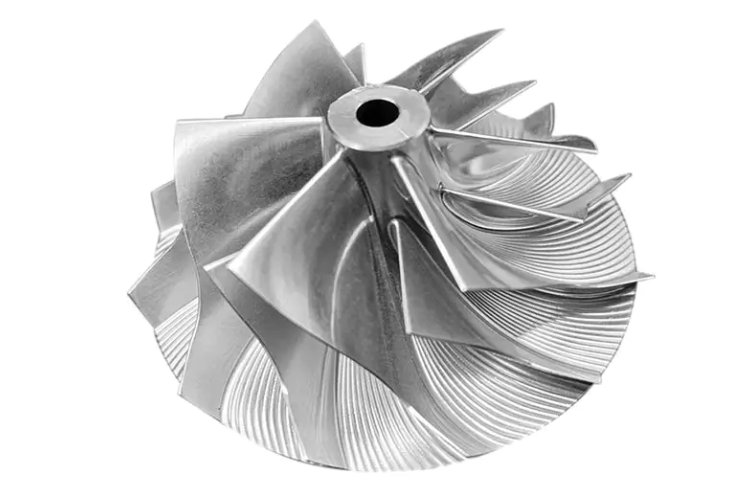
Wesentliche Fertigungsherausforderungen für Ti-6Al-4V Turboladerräder
Beibehaltung der chemischen Zusammensetzung (Al 5,5–6,75 %, V 3,5–4,5 %) für optimale mechanische Leistung.
Steuerung der Mikrostruktur, um vollständig dichte Teile mit feinen α+β-Phasen für die Ermüdungsfestigkeit zu erreichen.
Erreichen von Maßtoleranzen innerhalb von ±0,05 mm für den Hochgeschwindigkeitsrotorausgleich.
Sicherstellung der Oberflächengüte (Ra ≤5 µm im as-built-Zustand, Ra ≤1,6 µm nach der Nachbearbeitung) für die aerodynamische Leistung.
3D-Druckprozess für Ti-6Al-4V Turboladerräder
Der fortschrittliche SLM-Fertigungsprozess umfasst:
CAD-Modellierung und Simulation: Entwurf von hocheffizienten Radgeometrien mit Leichtbauoptimierung.
Pulverschichtung und Laserschmelzen: Schichtweises Aufschmelzen von Ti-6Al-4V-Pulver bei ~1600°C unter Inertgasatmosphäre.
Entfernung der Stützstrukturen: Entfernung der Stützen nach dem Bau, um innere Spannungen zu minimieren.
Wärmebehandlung (Glühen): Durchgeführt bei ~800°C–950°C, um die Mikrostruktur zu verfeinern und Eigenspannungen abzubauen.
Präzisions-CNC-Bearbeitung: Endgültige kritische Oberflächenbearbeitung, um enge Toleranzen und glatte aerodynamische Oberflächen zu erreichen.
Vergleichende Analyse von Fertigungsmethoden für Turboräder
Prozess | Oberflächengüte | Maßgenauigkeit | Mechanische Eigenschaften | Designflexibilität | Kosteneffizienz |
|---|---|---|---|---|---|
SLM 3D-Druck + Bearbeitung | Gut bis Hervorragend (Ra ≤1,6 µm) | Sehr hoch (±0,05 mm) | Hervorragend (~900 MPa) | Außergewöhnlich | Hoch für kleine Serien |
Feinguss | Gut (Ra ~3–5 µm) | Mäßig (±0,2 mm) | Sehr gut (~860 MPa) | Begrenzt | Niedrig für große Serien |
Schmieden + Bearbeitung | Hervorragend (Ra ≤0,8 µm) | Sehr hoch (±0,01 mm) | Überlegen (~950 MPa) | Niedrig | Hoch |
Optimale Fertigungsstrategie für Ti-6Al-4V Turboräder
SLM 3D-Druck: Am besten geeignet für hochkomplexe, leistungsoptimierte Turboladerrad-Designs, die enge Toleranzen und überlegene Leistung erfordern.
Feinguss: Geeignet für einfachere, dickwandige Geometrien in der Großserienproduktion.
Schmieden + CNC-Bearbeitung: Am besten geeignet für Anwendungen, die extrem hohe mechanische Festigkeit, aber weniger Designflexibilität erfordern.
Ti-6Al-4V (TC4) Legierungsleistungsübersicht
Eigenschaft | Wert | Anwendungsrelevanz |
|---|---|---|
Zugfestigkeit | ~900 MPa | Haltbarkeit von Hochgeschwindigkeitsturbinenrädern |
Streckgrenze | ~830 MPa | Erhält Festigkeit unter hohen Zentrifugalkräften |
Dichte | 4,43 g/cm³ | Leichtbaudesign, verbessert das Ansprechverhalten |
Ermüdungsfestigkeit | ~510 MPa | Kritisch für langfristige Hochgeschwindigkeitsrotation |
Maximale Betriebstemperatur | ~400°C | Widersteht erhöhten Temperaturen in Turbo-Umgebungen |
Vorteile der Verwendung von Ti-6Al-4V für Turboladerräder
Hohes Festigkeits-Gewichts-Verhältnis verbessert die Turboladerbeschleunigung und reduziert die Trägheit.
Ausgezeichnete Korrosionsbeständigkeit schützt vor heißen Gasen und Verbrennungsnebenprodukten.
Hervorragende Ermüdungsbeständigkeit verlängert die Lebensdauer unter extremen zyklischen Belastungen.
Überlegene Designfreiheit ermöglicht die Fertigung von optimierten, hohlen oder integrierten Geometrien.
Nachbearbeitungstechniken für Ti-6Al-4V Turboladerräder
Heißisostatisches Pressen (HIP): Verdichtet die Struktur durch Beseitigung von Restporosität, verbessert die Ermüdungslebensdauer um 20–30 %.
Wärmebehandlung (Glühen): Verfeinert die α+β-Phasenmikrostruktur für ausgewogene Festigkeit und Duktilität.
Präzisions-CNC-Bearbeitung: Erreicht endgültige Toleranzen innerhalb von ±0,01 mm und aerodynamische Oberflächenglätte (Ra ≤0,8 µm).
Oberflächenbearbeitung (Polieren/Kugelstrahlen): Verbessert die Ermüdungslebensdauer und reduziert die Oberflächenrauheit für verbesserten Gasfluss.
Prüfung und Qualitätssicherung für Turboladerräder
Koordinatenmessmaschine (CMM): Misst kritische aerodynamische Profile mit einer Genauigkeit von ±0,01 mm.
Computertomographie (CT)-Scanning: Erkennt interne Porosität oder Defekte zerstörungsfrei.
Ultraschallprüfung (UT): Bewertet die interne Qualität nach Luft- und Raumfahrtstandards.
Eindringprüfung (PT): Identifiziert feine Oberflächenrisse bis zu 0,002 mm.
Branchenanwendungen und Fallstudie
Ti-6Al-4V Turboladerräder, hergestellt von Neway AeroTech, werden weit verbreitet in Hochleistungs-Automotivturboladern, Hilfskraftanlagen (APUs) in der Luft- und Raumfahrt und industriellen Hochgeschwindigkeits-Turbokompressoren eingesetzt. In einem wettbewerbsorientierten Motorsportprogramm verbesserten unsere 3D-gedruckten Ti-6Al-4V Räder die Ansprechzeiten um 18 % und zeigten eine um 25 % höhere Ermüdungslebensdauer im Vergleich zu herkömmlichen Aluminiumturbinenrädern.
FAQs
Welche Maßtoleranzen kann Neway AeroTech für Ti-6Al-4V Turboladerräder erreichen?
Warum wird SLM 3D-Druck für komplexe Turboladerrad-Designs bevorzugt?
Wie schneidet Ti-6Al-4V im Vergleich zu Aluminiumlegierungen für Turboladeranwendungen ab?
Welche Nachbearbeitungsschritte sind für Ti-6Al-4V Turboräder kritisch?
Wie stellt Neway AeroTech die Qualität und Haltbarkeit von 3D-gedruckten Turboladerrädern sicher?
