
Inconel 738 Superlegierung Richtungsguss Turbinenschaufel
Einführung
Turbinenschaufeln in Hochleistungstriebwerken arbeiten unter extremen Bedingungen – hohen Temperaturen, zyklischen Belastungen und korrosiven Umgebungen. Um diesen Herausforderungen zu begegnen, wird Inconel 738 aufgrund seiner überlegenen Kriechbeständigkeit, Oxidationsstabilität und Ermüdungsfestigkeit häufig für Turbinenschaufeln verwendet. Bei der Herstellung mittels Richtungsguss erhalten diese Schaufeln eine verbesserte Kornausrichtung, was ihre Lebensdauer und mechanische Zuverlässigkeit in heißen Turbinenbereichen erhöht.
Neway AeroTech ist spezialisiert auf die Vakuumpräzisionsguss von Inconel 738 Turbinenschaufeln unter Verwendung von gerichteter Erstarrung und liefert präzisionsgefertigte Komponenten für Luft- und Raumfahrt, Energieerzeugung und Marine Anwendungen.
Kerntechnologie des Richtungsgusses für Inconel 738 Schaufeln
Wachsmodellherstellung Wachsmodelle werden mit engen Toleranzen (±0,05 mm) spritzgegossen, um die Schaufelprofile, -füße und -bänder detailliert zu reproduzieren.
Schalengussformbildung Feuerfeste keramische Schalengussformen werden in Schichten (6–8 mm) aufgebaut, um thermischen Gradienten und Abzugskräften standzuhalten.
Starterblock- und Selektorintegration Ein Starterblock und ein Kornselektor (z.B. spiralförmig oder Bridgman-Typ) leiten die Bildung gerichtet erstarrter säulenförmiger Körner entlang der [001]-Achse.
Vakuuminduktionsschmelzen Die Inconel 738 Legierung wird unter Hochvakuum (≤10⁻³ Pa) bei ~1450°C geschmolzen, um chemische Reinheit sicherzustellen und Gasporosität zu reduzieren.
Gerichtete Erstarrung Die Form wird langsam aus der Heizzone (2–5 mm/min) zurückgezogen, sodass Körner von unten zur Spitze hin gerichtet wachsen und Quergrenzen minimiert werden.
Schalenentfernung und Reinigung Die Schalen werden nach dem Guss mittels Hochdruckstrahlen und Säurelaugung entfernt, wobei die Integrität der Schaufelkante und der Kühlmerkmale erhalten bleibt.
Heißisostatisches Pressen (HIP) HIP bei 1150°C und 150 MPa beseitigt verbleibende Porosität und verbessert die Ermüdungsbeständigkeit.
Wärmebehandlung Lösungs- und Auslagerungswärmebehandlung stabilisiert die γ′-Phase und steigert die Hochtemperaturfestigkeit und Mikrostrukturhomogenität.
Materialeigenschaften von Inconel 738 Schaufeln
Betriebstemperatur: Bis zu 1050°C
Zugfestigkeit: ≥1000 MPa bei Raumtemperatur
Kriechbruchfestigkeit: ≥200 MPa bei 850°C für 1000 Stunden
Dehnung: ≥5%
Kornstruktur: Säulenförmig, in [001]-Richtung ausgerichtet
Oxidationsbeständigkeit: Hervorragend bei Langzeitexposition gegenüber Verbrennungsgasen
Fallstudie: Gerichtet gegossene Inconel 738 Schaufel für HPT-Stufe
Projekthintergrund
Ein Gasturbinenhersteller beauftragte Neway AeroTech mit der Herstellung von Hochdruckturbinen (HPT)-Schaufeln aus Inconel 738 mittels Richtungsguss. Das Projekt erforderte hohe Kriechbeständigkeit, Maßhaltigkeit und geringe Porosität für den Dauerbetrieb in 1050°C-Umgebungen.
Schaufelanwendungen
Flugzeugtriebwerke (z.B. PW4000, CFM56): Turbinenschaufeln der ersten Stufe, die extremen Schubzyklen und hohen thermischen Gradienten ausgesetzt sind.
Bodenstehende Gasturbinen (z.B. Siemens SGT, GE 6FA): HPT-Schaufeln für Dauerbetrieb, die bei hohem Druck und Temperatur mit minimaler Kühlung arbeiten.
Marineturbinen (z.B. LM2500): Korrosions- und ermüdungsbeständige Turbinenschaufeln für Marineantrieb und maritime Gasturbinen.
Schaufelkonstruktionsmerkmale
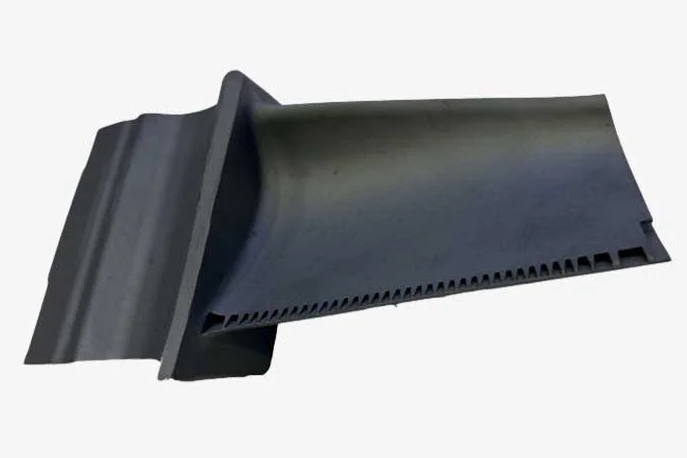
Innere Kühlkanäle, gebildet durch Keramikkern
Tannenbaumfuß für Rotorintegration
Spitzenbänder und Squealer-Ränder für Gasabdichtung
Toleranzen innerhalb ±0,03 mm erreicht an Profil- und Befestigungsflächen
Fertigungslösung für gerichtet gegossene Inconel 738 Schaufeln
Form- und Angusssystemkonstruktion Guss- und Angusssysteme werden unter Verwendung von CFD-Analyse optimiert, um den Metallfluss zu steuern und Seigerungen zu minimieren.
Vakuumgussdurchführung Der Guss wird unter Vakuum durchgeführt, wobei der gerichtete Abzug durch programmierbare Öfen gesteuert wird.
HIP und Wärmebehandlung HIP beseitigt eventuelle Schwindungsporosität; Wärmebehandlung verbessert die mechanische Festigkeit und Mikrostrukturhomogenität.
Präzisionsbearbeitung und EDM Kritische Toleranzen, Kühlbohrungen und Schnittstellen werden mittels CNC-Bearbeitung und EDM fertiggestellt.
Prüfung und Validierung Metallografische Analyse, CMM und Röntgenprüfung stellen Kornausrichtung, Maßhaltigkeit und fehlerfreie Struktur sicher.
Kernherausforderungen beim Richtungsschaufelguss
Vermeidung von Streukornbildung in dünnwandigen und komplexen Schaufelgeometrien
Steuerung thermischer Gradienten zur Reduzierung des Heißrissrisikos
Sicherstellung einer konsistenten [001]-Kornorientierung über gekrümmte Profile hinweg
Beibehaltung von Toleranz und Balance bei Schaufeln mit hohem Streckungsverhältnis
Ergebnisse und Verifizierung
[001]-Kornorientierung mittels EBSD innerhalb <2° Abweichung bestätigt
ASTM 6 Kornstruktur über die gesamte Schaufelhöhe beibehalten
Keine kritischen Defekte nach HIP und zerstörungsfreier Prüfung beobachtet
Mechanische Tests bestätigten Kriechfestigkeit von über 200 MPa bei 850°C
Maßgenauigkeit innerhalb ±0,03 mm nach Bearbeitung und Endbearbeitung
FAQs
Was sind die Vorteile des Richtungsgusses für Turbinenschaufeln?
Wie verhält sich Inconel 738 unter Kriech- und Ermüdungsbedingungen?
Welche Branchen verwenden üblicherweise gerichtet gegossene Inconel 738 Schaufeln?
Wie verhindert man Streukörner während der gerichteten Erstarrung?
Welche zerstörungsfreie Prüfung wird zur Validierung der Gussintegrität angewendet?
