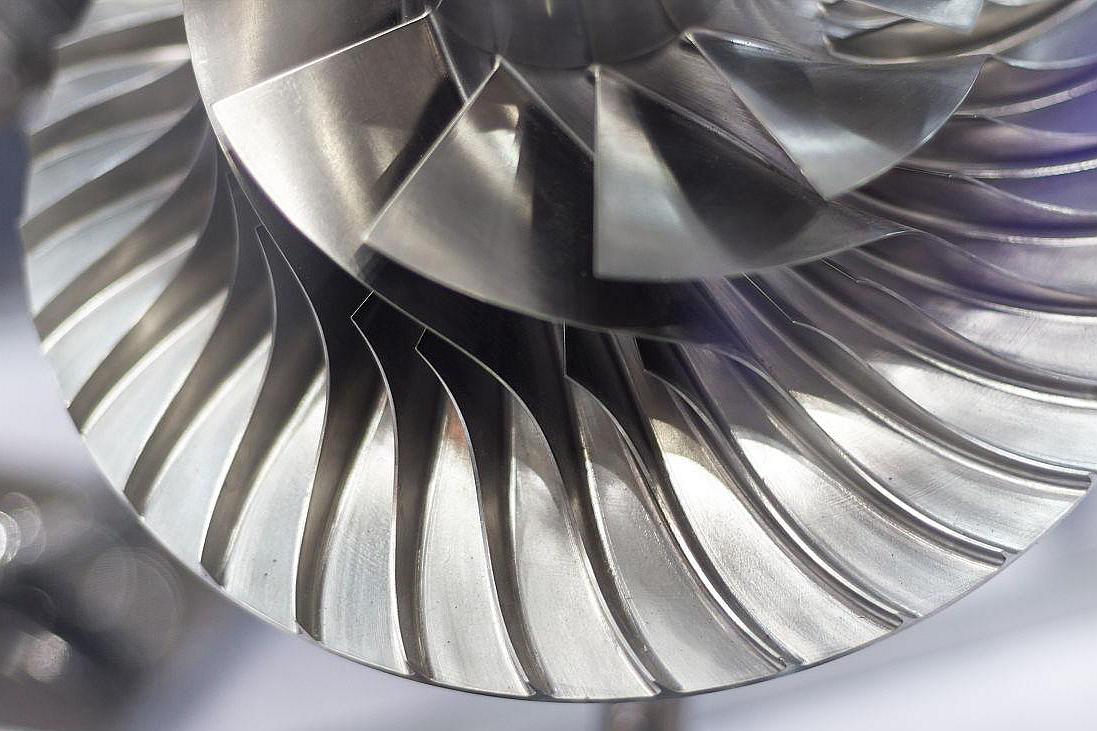
Turbocharger components made from high-temperature superalloys require precision machining to maintain dimensional stability, thermal resistance, and aerodynamic efficiency under extreme operating conditions. These parts—such as impellers, turbine wheels, diffusers, and housings—often feature complex curved geometries, thin-wall structures, and deep cavities that demand simultaneous multi-axis machining with micron-level accuracy.
Neway AeroTech specializes in 5-axis CNC machining of complex turbocharger parts using high-performance superalloys including Inconel 625, Rene 88, and Hastelloy X.
Turbocharger components with deep pockets, compound curves, and radial symmetry require synchronized motion and real-time precision control.
5-axis simultaneous milling for undercuts, impeller vanes, and internal surfaces
Toolpath optimization for radial symmetry and thin-wall stability
High-speed spindle machining up to 30,000 rpm for fine edge details
In-process probing for positional correction and repeatable tolerance control within ±0.005 mm
All machining operations comply with AS9100D standards and turbocharger industry tolerances.
Alloy | Max Temp (°C) | Yield Strength (MPa) | Applications |
|---|---|---|---|
980 | 827 | Exhaust housings, compressor diffusers | |
980 | 1450 | Turbine wheels, rotor blades | |
1175 | 790 | Combustor transitions, turbo shrouds |
These materials offer thermal fatigue resistance, oxidation protection, and structural integrity under high rotational speeds.
A turbocharger OEM required high-precision machining of an Inconel 625 diffuser with internal curvature and spiral airflow paths. Tolerances: ±0.006 mm on vane spacing, Ra ≤ 0.4 μm surface finish, and runout <0.01 mm across mounting flange.
Component | Material | Accuracy | Industry |
|---|---|---|---|
Impeller Rotor | Rene 88 | ±0.005 mm | |
Diffuser Housing | Inconel 625 | ±0.006 mm | |
Exhaust Guide Vane | Hastelloy X | ±0.010 mm | |
Shaft Coupling | Inconel 718 | ±0.004 mm |
All components are validated for mechanical strength, vibration tolerance, and gas flow optimization.
Maintaining ±0.005 mm tolerance across large curved surfaces with multi-entry cutting paths
Tool deflection control in thin-walled turbo casings under high cutting pressure
Burr-free finish on trailing edges of impeller vanes and internal blades
Runout limitation <0.01 mm on rotating interfaces
Heat control during roughing in alloys with low thermal conductivity
Dynamic toolpath simulation to prevent overcutting and edge deformation on 3D contours
Coolant-through high-rigidity tooling maintains dimensional stability in high-strength materials
Barrel tools and bull-nose end mills for sculpting impeller blade fillets and vane transitions
In-process CMM and probing verifies bore alignment and runout across all mounting faces
Stress relief heat treatment prior to finish milling to reduce warping
All parts were produced from vacuum investment castings or forged blanks. Final machining used 5-axis high-speed CNCs with cutting feed rates of 200–400 mm/min and stepdowns of 0.2 mm.
Critical flow surfaces were polished to Ra ≤ 0.4 μm. Edge fillets held radii under 0.2 mm with ±0.005 mm tolerance using adaptive toolpath strategies.
After machining, parts were treated with HIP and heat treatment. Optional TBC coatings applied to internal surfaces for enhanced thermal durability.
CMM inspection ensured profile tolerance within ±0.006 mm. X-ray inspection confirmed structural integrity. SEM analysis verified surface quality and microstructure post-machining.
What is the maximum complexity you can achieve in turbocharger impeller machining?
How do you manage heat and distortion in Hastelloy or Inconel parts?
Can you machine both flow channels and mounting features in a single setup?
What tolerances can you hold on rotating components like shafts and rotors?
Do you offer coating or EDM integration for turbocharger parts?