
Anillos de tobera de flujo de gas de Stellite 6B mecanizados por CNC para una resistencia y precisió...
Introducción
Stellite 6B es una aleación de cobalto-cromo-tungsteno diseñada para ofrecer una resistencia excepcional al desgaste, una alta resistencia a temperaturas de hasta 870°C y una resistencia sobresaliente a la corrosión y la erosión. Con una dureza de 38–43 HRC y una resistencia a la tracción de aproximadamente 965 MPa, es ideal para anillos de tobera de flujo de gas sometidos a entornos operativos severos.
En Neway AeroTech, fabricamos anillos de tobera de flujo de gas de Stellite 6B utilizando mecanizado de precisión por CNC, logrando tolerancias dimensionales dentro de ±0,01 mm y acabados superficiales de hasta Ra ≤0,8 µm para un rendimiento y longevidad máximos.
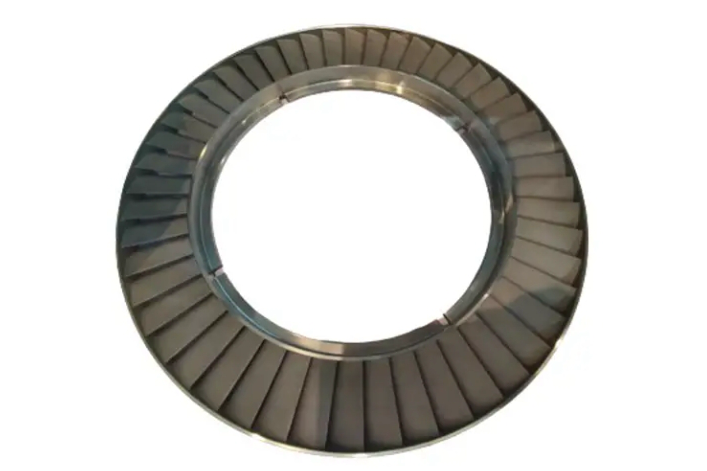
Desafíos técnicos en el mecanizado de anillos de tobera de gas de Stellite 6B
Mantener tolerancias dimensionales estrechas dentro de ±0,01 mm para la precisión del flujo de gas.
Mecanizar material altamente resistente al desgaste sin inducir microfisuras térmicas.
Lograr acabados superficiales suaves (Ra ≤0,8 µm) para una dinámica de gas eficiente.
Mantener la resistencia y la resistencia a la erosión bajo exposición continua a gas de alta velocidad.
Proceso de mecanizado de precisión para anillos de tobera de flujo de gas
El proceso de fabricación de anillos de tobera de flujo de gas de Stellite 6B incluye:
Preparación del material: Fundición a la cera perdida al vacío o forjado de desbastes de Stellite 6B inspeccionados para garantizar la calidad.
Mecanizado en bruto: Se utilizan herramientas de PCBN o cerámica bajo parámetros controlados para minimizar las tensiones residuales.
Tratamiento térmico: Aplicado según sea necesario para aliviar las tensiones del mecanizado y estabilizar las propiedades mecánicas.
Acabado semi-final: Contorneado por CNC para preparar el dimensionado final.
Acabado de precisión: Fresado, torneado y rectificado por CNC para lograr las tolerancias y acabados finales.
Control de calidad: Inspecciones dimensionales con CMM y ensayos no destructivos.
Análisis comparativo de métodos de mecanizado para anillos de tobera
Método de mecanizado | Calidad del acabado superficial | Precisión dimensional | Vida útil de la herramienta | Adecuado para Stellite 6B | Eficiencia de producción |
|---|---|---|---|---|---|
Mecanizado de precisión por CNC | Excelente (Ra ≤0,8 µm) | Muy alta (±0,01 mm) | Moderada | Sí | Alta |
EDM | Buena (Ra ~2 µm) | Alta (±0,02 mm) | Alta | Limitado | Baja |
Rectificado y pulido | Excelente (Ra ≤0,4 µm) | Muy alta (±0,005 mm) | Alta | Sí | Moderada |
Mecanizado convencional | Pobre (Ra ~8–12 µm) | Baja (±0,1 mm) | Baja | No | Baja |
Estrategias óptimas de fabricación para anillos de tobera de flujo de gas
Mecanizado de precisión por CNC: Logra Ra ≤0,8 µm, tolerancias de ±0,01 mm para eficiencia aerodinámica.
Rectificado y pulido: Refina superficies a Ra ≤0,4 µm para rendimiento en flujo de gas de alta velocidad.
Mecanizado por EDM: Da forma a pequeñas características complejas donde sea necesario con una precisión de ±0,02 mm.
[Mecanizado convencional]: No recomendado debido al desgaste excesivo de la herramienta en Stellite 6B.
Resumen del rendimiento de la aleación Stellite 6B
Propiedad | Valor | Relevancia de la aplicación |
|---|---|---|
Dureza | 38–43 HRC | Resistencia superior al desgaste y la erosión |
Temperatura máxima de operación | ~870°C | Retención de alta resistencia bajo ciclado térmico |
Resistencia a la corrosión | Excelente | Resiste la oxidación y productos químicos agresivos |
Resistencia a la tracción | ~965 MPa | Alta capacidad de soporte de carga mecánica |
Coeficiente de expansión térmica | ~13,7 µm/m·°C | Comportamiento dimensional estable a temperaturas elevadas |
Ventajas de usar Stellite 6B para anillos de tobera de gas
Resistencia excepcional al desgaste garantiza una mayor vida útil de la tobera bajo corrientes de gas abrasivas.
Alta estabilidad térmica mantiene la consistencia del flujo de gas hasta ~870°C.
Resistencia superior a la corrosión protege contra la oxidación y medios gaseosos erosivos.
Fiabilidad dimensional mantiene el perfil aerodinámico en secciones de turbina de alta velocidad.
Técnicas de postprocesamiento para anillos de tobera de flujo de gas
Prensado isostático en caliente (HIP): Densifica el material, eliminando huecos internos a ~1160°C, 100 MPa.
Revestimiento de barrera térmica (TBC): Reduce las temperaturas superficiales de la tobera, mejorando la resistencia a la erosión.
Ensayo no destructivo (NDT): Detecta microdefectos garantizando la fiabilidad estructural.
Acabado de precisión por CNC: Logra perfiles aerodinámicos finales con una precisión de ±0,01 mm.
Inspección y garantía de calidad para anillos de tobera
Máquina de medición por coordenadas (CMM): Garantiza una precisión de ±0,01 mm para dimensiones aerodinámicas críticas.
Ensayo por ultrasonidos (UT): Detecta defectos internos sin dañar las piezas.
Ensayo por líquidos penetrantes (PT): Identifica grietas superficiales finas de hasta 0,002 mm de ancho.
Análisis metalográfico: Confirma que la estructura granular cumple con los estándares ASTM y aeroespaciales.
Aplicaciones industriales y caso de estudio
Los anillos de tobera de flujo de gas de Stellite 6B fabricados por Neway AeroTech se aplican ampliamente en turbinas aeroespaciales, compresores de gas industriales y sistemas de generación de energía. En un proyecto aeroespacial reciente, los anillos de tobera de Stellite 6B mantuvieron el rendimiento aerodinámico después de más de 5.000 horas de servicio continuo, logrando una extensión del 30% en la vida útil en comparación con los materiales convencionales.
Preguntas frecuentes
¿Qué tolerancias dimensionales puede lograr Neway AeroTech para los anillos de tobera de flujo de gas de Stellite 6B?
¿Por qué es Stellite 6B ideal para aplicaciones de toberas de turbina de alta temperatura?
¿Cómo mejora el mecanizado por CNC el rendimiento de los anillos de tobera de Stellite 6B?
¿Qué industrias utilizan extensivamente los anillos de tobera de Stellite 6B?
¿Cómo garantiza Neway AeroTech la integridad estructural y el rendimiento de los anillos de tobera de Stellite 6B?
