Benefits of Superalloy Friction Welding Service
Superalloy friction welding service is an advanced joining solution for manufacturers that require high integrity, high temperature resistance, and long service life in demanding applications. Compared with conventional fusion welding, friction welding uses mechanical energy and pressure to create a solid-state bond, making it especially suitable for nickel-based, cobalt-based, and other difficult-to-weld alloys. For industries such as Aerospace and Aviation, Power Generation, Oil and Gas, and Energy, friction welding offers a reliable path to stronger, cleaner, and more consistent joints.
When paired with complementary processes such as Heat Treatment, Hot Isostatic Pressing (HIP), Superalloy CNC Machining, and Material Testing and Analysis, friction welding can support the production of critical rotating parts, shafts, rings, blisks, turbine hardware, and repair assemblies. It is particularly valuable wherever high mechanical loading, thermal cycling, and dimensional consistency are essential.
What Is Superalloy Friction Welding?
Superalloy friction welding is a solid-state joining process in which two components are pressed together while one part rotates or oscillates relative to the other. The friction generated at the interface produces localized heat, softening the material without melting it. Once the correct temperature and plastic condition are reached, axial force is applied to forge the joint together. The result is a dense, metallurgically bonded interface with minimal defects compared with many traditional welding methods.
This process is highly suitable for joining parts made from Inconel alloy, Hastelloy alloy, Nimonic alloy, Rene Alloys, and selected Titanium alloy grades. It is also widely used in component manufacturing chains that begin with Vacuum Investment Casting, Single Crystal Casting, Equiaxed Crystal casting, Superalloy Directional Casting, or Powder Metallurgy Turbine Disc production.
Why Friction Welding Is Valuable for Superalloys
Superalloys are engineered for extreme environments, but those same properties also make them difficult to process. Their high hot strength, oxidation resistance, and complex microstructures can complicate traditional fusion welding and increase the risk of cracking, segregation, heat-affected zone damage, and distortion. Friction welding helps overcome many of these issues by reducing the need for melting and limiting thermal exposure to a narrow region.
For high-value components used in gas turbines, aero engines, energy systems, and critical industrial assemblies, this means manufacturers can achieve more stable joints while preserving as much of the original material performance as possible. It also supports a more controlled manufacturing route when joining near-net-shape cast, forged, machined, or repaired parts.
Key Benefits of Superalloy Friction Welding Service
1. High Joint Strength and Integrity
One of the most important benefits of friction welding is the ability to produce joints with excellent mechanical strength. Because the bond is formed in the solid state, the welded interface can achieve a refined microstructure and strong metallurgical continuity. This is critical for load-bearing parts exposed to vibration, pressure, creep, or thermal fatigue.
For applications such as turbine shafts, compressor rotors, and high-temperature assemblies, friction welding can help maintain structural reliability while reducing the risk of defects associated with molten weld pools. When followed by Heat Treatment, the joint properties can be further stabilized for service in demanding environments.
2. Lower Distortion Compared with Fusion Welding
Because friction welding concentrates heat only at the interface and avoids full melting, thermal distortion is usually much lower than with many conventional welding methods. This is especially important for precision parts that require strict alignment, concentricity, or dimensional accuracy before final finishing.
Reduced distortion can also shorten downstream machining time. After welding, manufacturers can use Superalloy CNC Machining or Electrical Discharge Machining (EDM) more efficiently to achieve final tolerances with less material removal and lower rework risk.
3. Minimized Heat-Affected Zone
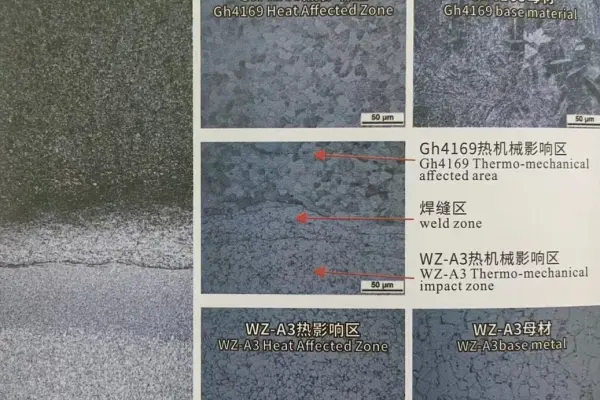
Superalloys depend heavily on carefully controlled microstructures to deliver creep strength, oxidation resistance, and fatigue performance. A large heat-affected zone can weaken local properties and increase metallurgical risk. Friction welding helps minimize this issue by limiting thermal input and shortening exposure time.
This is particularly useful when working with advanced alloys used in turbine engine parts or high-temperature hardware in gas turbine component manufacturing. A smaller heat-affected zone supports better property retention near the joint and contributes to more consistent long-term service performance.
4. Suitable for Dissimilar or Optimized Material Combinations
Friction welding can be an effective option for joining different but compatible alloys in one component, allowing engineers to place high-cost, high-performance material only where it is truly needed. This supports more efficient material use and can help balance thermal, mechanical, and economic requirements.
For example, a part may combine a high-temperature working section with a more cost-effective support section, or a forged hub with a cast or machined ring. In complex assemblies, this kind of design flexibility can improve manufacturability and reduce total part cost without sacrificing performance where it matters most.
5. Improved Material Efficiency
Superalloys are expensive materials, so reducing scrap and maximizing usable yield is a major advantage. Friction welding allows near-net-shape subcomponents to be joined into a final configuration, helping manufacturers avoid machining an entire complex part from a large billet or forging.
This approach is especially beneficial in manufacturing routes that integrate Superalloy Precision Forging, Powder Metallurgy Turbine Disc, or 3D printing Service. By welding optimized preforms together, material waste can be reduced and production efficiency can improve.
6. High Repeatability for Critical Production
Friction welding is a highly controllable process. Parameters such as rotational speed, axial pressure, upset distance, and cycle timing can be tightly managed, which supports consistent joint quality from part to part. For industries with strict qualification requirements, repeatability is essential.
In production programs serving Aerospace and Aviation, Nuclear, and Marine, repeatable joining performance helps simplify process validation, inspection planning, and quality documentation.
7. Good Foundation for Repair and Life Extension
In some high-value systems, replacing an entire component may be far more expensive than refurbishing or rebuilding a worn section. Friction welding can support component recovery strategies by joining replacement sections to salvageable parent parts, especially when integrated with other repair technologies.
Combined with Post Process, Superalloy Welding, and Thermal Barrier Coating (TBC), friction welding can become part of a broader life-extension strategy for hot-section and rotating hardware.
Common Applications of Superalloy Friction Welding
Superalloy friction welding is commonly applied where parts face elevated temperatures, cyclic loads, corrosion, or complex service environments. Typical applications include shafts, rotor assemblies, turbine rings, compressor components, nozzle hardware, pressure-containing joints, and repairable subassemblies.
It is particularly relevant to sectors such as:
Aerospace and aviation: turbine engine hardware, rotating parts, structural thermal assemblies, and high-performance propulsion components. Related manufacturing environments are discussed in rocket engine modules and superalloy jet engine components.
Power generation: gas turbine and steam turbine hardware requiring strong joints, stable microstructure, and long service life. See also steam turbine parts and high-temperature alloy gas turbine assemblies.
Oil and gas: downhole tools, drilling hardware, valve systems, and corrosive-service fittings. Related examples include downhole drilling assemblies and subsea valve components.
Nuclear and energy systems: reactor-related components, critical containment structures, and high-reliability thermal hardware where joint quality and inspection traceability are essential.
How Friction Welding Fits Into a Complete Manufacturing Route
Friction welding is often not a standalone process. Its greatest value appears when it is integrated into a complete production chain. A typical workflow may begin with Vacuum Investment Casting, Superalloy Precision Forging, or 3D printing Service, followed by friction welding to create the main assembly geometry. The joined part can then proceed to Heat Treatment, HIP, machining, and inspection.
For highly complex internal features or final detailing, additional operations such as Superalloy Deep Hole Drilling and EDM may be used. Where thermal protection is required, the part may then receive Thermal Barrier Coating (TBC). This integrated route is especially useful for advanced turbine and hot-section products.
Importance of Testing After Friction Welding
Even though friction welding can produce very high-quality joints, testing remains essential. High-performance applications require verification of joint integrity, dimensional control, and metallurgical consistency. A strong quality plan typically includes visual inspection, dimensional verification, microstructural analysis, and mechanical testing based on the part’s function.
Material Testing and Analysis can include methods such as tensile testing, metallographic microscopy, SEM, X-ray inspection, and other non-destructive evaluations depending on the component requirements. For mission-critical assemblies, this testing is often what turns a good process into a qualified production capability.
How Post-Processing Enhances Friction-Welded Superalloy Parts
Post-processing is often the key to unlocking the full performance of a friction-welded component. While the joint itself may already be strong, heat treatment can optimize the final microstructure, relieve residual stresses, and improve creep or fatigue behavior. HIP may be introduced when densification or defect healing is beneficial in related cast sections.
For components used in severe thermal environments, surface engineering can further improve durability. Processes such as Post Process and TBC support longer service life, better oxidation resistance, and more stable performance in hot gas or corrosive conditions.
When to Choose Superalloy Friction Welding Service
Superalloy friction welding is a strong choice when a component requires high-strength joining with low distortion, when material costs must be controlled through optimized preforms, or when the service environment is too severe for weaker joint solutions. It is also valuable when repeatability, metallurgical cleanliness, and downstream machining efficiency are priorities.
If a project involves turbine hardware, hot-section systems, rotating assemblies, or advanced repairable structures, friction welding can offer a highly competitive manufacturing advantage. It is especially effective when supported by integrated capabilities in casting, forging, machining, testing, and post-processing.
Conclusion
The benefits of superalloy friction welding service go far beyond simple part joining. It provides high joint strength, reduced distortion, improved material utilization, and excellent repeatability for critical industries. When incorporated into a full manufacturing route with Heat Treatment, HIP, CNC Machining, and Material Testing and Analysis, it becomes a powerful solution for manufacturing reliable superalloy components.
For manufacturers working in aerospace, power generation, oil and gas, nuclear, or other high-temperature sectors, friction welding is an efficient and technically robust option for building stronger, longer-lasting assemblies from advanced alloys.