
Why Vacuum Casting, CNC, and EDM Are Combined for SGT5-4000F Inconel 738LC MHS Tiles
SGT5-4000F Inconel 738LC MHS tiles are typical hot-section components that cannot be judged by one manufacturing process alone. They are not simple machined plates, and they are not only cast blanks. In most practical projects, metallic heat shield tiles require a combined manufacturing route: vacuum casting for the near-net-shape body, CNC machining for assembly interfaces, EDM for local complex features, TBC coating for thermal protection, and inspection for final quality control.
This process combination is especially important when customers are evaluating replacement gas turbine heat shields from old parts, drawings, 3D scan data, or reverse engineering models. For SGT5-4000F and other F-class heavy-duty gas turbine platforms, the correct manufacturing route directly affects cost, lead time, fit-up, coating reliability, and long-term service risk.
For Inconel 738LC MHS tiles, the goal is not to use the most advanced process everywhere. The goal is to use each process where it provides the most engineering value: casting for shape, CNC for precision, EDM for difficult features, coating for thermal protection, and inspection for risk control.
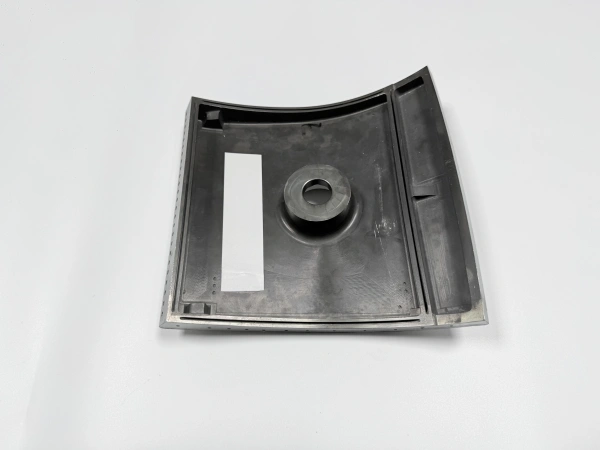
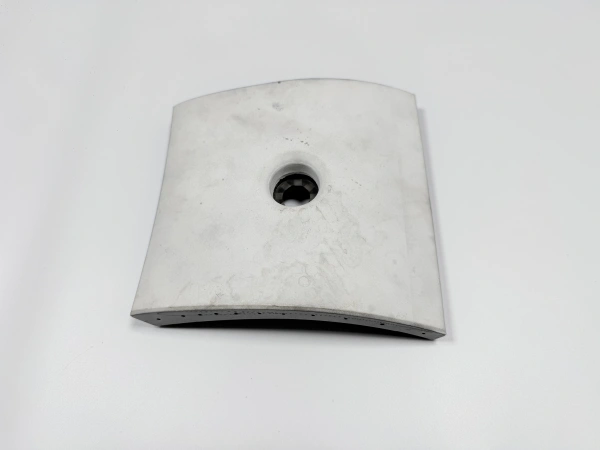
Why MHS Tiles Need a Combined Manufacturing Route
Metallic heat shield tiles are engineered hot-section protection components. Their geometry often includes curved gas-facing surfaces, backside ribs, mounting structures, sealing edges, local holes, narrow slots, and coating-controlled regions. At the same time, they must fit correctly into the turbine assembly and survive high-temperature thermal cycling.
This makes MHS tiles different from simple CNC parts. A complete process route must handle both complex cast geometry and precision assembly requirements. Vacuum casting creates the main near-net shape. CNC machining corrects and finishes the critical interfaces. EDM completes features that are difficult or unstable for conventional tools. TBC coating reduces heat transfer into the IN738LC base metal.
Because the base material is a high-temperature nickel-based Inconel alloy, process selection must also consider material cost, tool wear, casting behavior, heat treatment response, coating compatibility, and inspection requirements.
Applicable Turbine Platforms
The SGT5-4000F is an F-class heavy-duty gas turbine platform used in large-scale power generation and combined-cycle power plants. In this operating environment, hot-section parts are exposed to high gas temperature, oxidation, pressure fluctuation, vibration, thermal gradients, and repeated start-stop cycles.
MHS tiles are used as protective hot-section components. Their function is to shield the parent structure from direct hot gas exposure and reduce the thermal load transferred to combustion or gas path hardware. Similar manufacturing logic can also apply to other F-class gas turbine heat shield tiles, combustion protection parts, and static hot gas path components.
For maintenance teams and spare parts buyers, the key question is often not whether the part can be made, but which process route can achieve the correct balance between geometry, material performance, dimensional accuracy, coating quality, and project cost.
Part Function and Geometry of SGT5-4000F MHS Tiles
SGT5-4000F MHS tiles must protect hot-section structures while maintaining accurate installation and controlled thermal expansion gaps. The part may appear like a tile from the outside, but its engineering features are more complex than a simple protective plate.
Typical MHS tile features may include:
Curved hot-face surfaces that follow the turbine gas path geometry
Backside ribs or support structures for stiffness and positioning
Mounting holes, local bosses, or fixing features
Sealing edges and controlled boundary gaps
Narrow slots, small holes, or local airflow-related features
Coating-controlled surfaces that require masking or allowance planning
Critical datum areas for assembly and inspection
These features explain why a combined manufacturing route is usually more practical than relying only on CNC machining or only on casting.
Why Direct CNC Machining Is Not Ideal for IN738LC MHS Tiles
Direct CNC machining from solid IN738LC stock may seem attractive because CNC offers high accuracy. However, for SGT5-4000F MHS tiles, full CNC machining is usually not the most efficient route.
There are several reasons:
IN738LC raw material is expensive, especially when large billet stock is required
Material removal volume can be very high for curved tile geometry
Nickel-based superalloys cause high tool wear and long machining time
Backside ribs, bosses, and curved surfaces increase programming and fixture complexity
Thin-wall structures may deform under machining force
Some slots, small holes, and sharp local boundaries are not suitable for standard cutting tools
For these reasons, full CNC machining can increase cost and lead time without providing the best manufacturing efficiency. Superalloy CNC Machining is still essential, but it should usually be used for precision interfaces and final fit-up areas rather than the entire heat shield body.
Why Vacuum Casting Fits MHS Tile Manufacturing
Vacuum casting is suitable for IN738LC MHS tiles because it can create a near-net-shape blank that already includes the main curved profile, backside support structure, ribs, bosses, and local wall geometry. This reduces material waste and avoids unnecessary machining of the entire part from solid stock.
For nickel-based Superalloys, vacuum casting also helps control oxidation and material quality during molten metal processing. For gas turbine hot-section components, this is important because base material integrity directly affects downstream machining, coating, and service reliability.
NewayAeroTech provides Special Alloy Casting for high-temperature alloy parts where geometry, alloy behavior, and final inspection requirements must be evaluated together. For MHS tiles, casting planning should consider wax pattern accuracy, shell stability, shrinkage, wall thickness, rib geometry, machining allowance, and final coating allowance.
Why Equiaxed Crystal Casting Is Practical for Static Heat Shields
SGT5-4000F MHS tiles are static protective hot-section components rather than rotating turbine blades. Therefore, they usually do not require the same crystal orientation strategy used for advanced single crystal turbine blades.
Equiaxed Crystal Casting is often practical for static cast superalloy components such as heat shields, seal structures, and other non-rotating hot-section parts. It can support complex geometry while keeping the casting route suitable for protective components that require thermal resistance, dimensional control, and post-casting machining.
For IN738LC MHS tiles, the casting stage should be designed around the final assembly requirement. The casting blank does not need to be perfect in every dimension, but it must provide enough stability, material integrity, and machining allowance for final processing.
Why CNC Machining Is Still Needed After Casting
Vacuum casting creates the near-net-shape heat shield blank, but casting alone cannot usually deliver all final functional dimensions. CNC machining is still required for surfaces and features that control assembly fit, sealing, positioning, and repeatability.
Typical CNC-machined areas include:
Datum faces used for inspection and assembly alignment
Mounting surfaces and contact areas
Positioning holes and fixing features
Sealing edges or controlled boundary surfaces
Thickness-controlled regions
Local flatness or parallelism-controlled interfaces
In this route, CNC machining is not used to replace casting. It is used to convert the cast blank into a precise functional component. This is the main reason why cast-and-machined IN738LC heat shields can be more efficient than fully machined heat shields for complex turbine tile geometry.
Why EDM Is Added for Local Complex Features
EDM is added when the part includes features that are difficult to produce with conventional cutting tools. IN738LC is hard, heat resistant, and difficult to machine, especially in narrow or tool-access-limited areas. EDM can process local features without relying on high cutting force.
Superalloy Electrical Discharge Machining EDM is useful for features such as:
Small holes
Narrow slots
Sharp internal corners
Local recesses
Tool-access-limited edges
Complex boundaries near ribs or curved surfaces
If the MHS tile includes airflow-related features, cooling-related holes, or deeper passage-style geometry, Superalloy Deep Hole Drilling may also be reviewed as part of the manufacturing plan. The final choice between EDM, drilling, or combined processing depends on hole diameter, depth, location, tolerance, surface requirement, and access direction.
Coating Allowance Strategy for TBC-Coated MHS Tiles
TBC coating is not only a final surface treatment. It must be considered from the beginning of process planning because coating thickness affects final dimensions, gaps, hole sizes, sealing edges, and assembly clearance.
For SGT5-4000F MHS tiles, coating allowance strategy should define:
Which surfaces receive bond coat and ceramic top coat
Which machined surfaces must remain uncoated
Required masking areas for holes, sealing edges, and mounting interfaces
Final coating thickness range
Whether holes or slots need post-coating cleaning or re-checking
How coating buildup affects thermal expansion gaps and installation clearance
If coating allowance is ignored, the part may pass machining inspection before coating but fail final assembly after TBC. This is why casting allowance, CNC machining dimensions, EDM features, and coating thickness must be planned together.
Manufacturing Risk Control for Cast and Machined IN738LC Tiles
A combined route also requires combined risk control. Each process has its own risks, and those risks can affect the next operation. Casting defects may affect machining. Machining distortion may affect coating. EDM surface condition may affect fatigue-sensitive edges or coating behavior. Coating buildup may affect final assembly.
Key manufacturing risks include:
Casting shrinkage, porosity, cracks, or local deformation
Mismatch between casting datum and machining datum
Thin-wall distortion during heat treatment or machining
EDM recast layer or edge quality issues
Hole and slot deviation after EDM or coating
TBC delamination, uneven thickness, masking error, or edge spalling
Final fit-up issues caused by coating allowance or thermal expansion gap errors
For cast IN738LC parts where internal density is a concern, Superalloy Hot Isostatic Pressing HIP may be reviewed depending on the drawing requirement, defect acceptance level, and service condition. HIP can be considered when internal porosity reduction and casting reliability improvement are required by the customer or application.
Inspection and Defect Analysis for MHS Manufacturing
Inspection should not be left until the end. For SGT5-4000F MHS tiles, inspection points should be planned after casting, after machining, after EDM, after coating, and before delivery.
Superalloy Material Testing and Analysis helps verify material quality, defect condition, and process stability. Depending on the project requirement, inspection may include dimensional inspection, visual inspection, FPI, X-ray, CT, coating thickness measurement, adhesion testing, and material certification review.
Process Stage | Main Risk | Control Method |
|---|---|---|
Vacuum casting | Shrinkage, porosity, cracks, deformation | Casting simulation, shell control, visual inspection, X-ray or CT when required |
CNC machining | Datum shift, thin-wall distortion, interface error | Fixture planning, staged machining, CMM inspection, datum control |
EDM | Recast layer, edge damage, hole or slot deviation | EDM parameter control, edge inspection, post-EDM cleaning, dimensional checks |
TBC coating | Uneven thickness, masking error, poor adhesion, spalling | Surface preparation, masking control, thickness inspection, coating quality review |
Final inspection | Fit-up error, documentation gap, unverified critical features | Final dimensional report, coating check, material records, FAI when required |
RFQ Decision Guide for Replacement MHS Tiles
When customers look for an alternative supplier for SGT5-4000F MHS tiles, the quotation should not be based only on part size or weight. The supplier must understand the turbine model, material, casting route, machining interfaces, EDM features, coating requirement, and inspection standard.
A complete RFQ should include:
Turbine platform, such as SGT5-4000F or another F-class gas turbine model
Part name, part number, and drawing revision
Old part condition, sample availability, or 3D scan data if reverse engineering is needed
3D CAD model and 2D drawing with tolerances and datum references
Material standard for IN738LC or acceptable equivalent
Casting quality requirements and internal defect acceptance criteria
CNC-machined interfaces, holes, sealing edges, and critical dimensions
EDM features such as slots, small holes, sharp corners, or tool-access-limited areas
TBC coating thickness, masking areas, surface preparation, and inspection requirements
Required quantity for sample, trial batch, spare parts inventory, or outage maintenance
If the customer only has a used tile or scan model, the first engineering step should be to define the inspection baseline, functional surfaces, coating allowance, and reverse-engineered tolerances. Without this step, a copied shape may not guarantee correct assembly or service performance.
FAQ
What Gas Turbine Models Use Metallic Heat Shields Like SGT5-4000F MHS Tiles?
What Is the Function of Metallic Heat Shields in SGT5-4000F Gas Turbines?
Why Is Inconel 738LC Used for SGT5-4000F Metallic Heat Shield Tiles?
How Are SGT5-4000F Metallic Heat Shields Manufactured from Casting Blank to Finished Tile?
What Should Be Controlled Before Applying TBC Coating to Inconel 738LC Metallic Heat Shield Tiles?
