
Superalloy In718 Mold Core Parts Wire EDM Processing
Introduction to Wire EDM for In718 Mold Core Parts
Wire EDM is the optimal solution for machining Inconel 718 mold core parts with intricate geometries and tight tolerances. This non-contact technique enables precise cutting of hardened superalloys without inducing stress or deformation, critical for thermal-cycle mold applications.
At Neway Aerotech, we specialize in wire EDM machining of Inconel 718, enabling production of precision mold cores for injection, die-casting, and high-temperature tooling environments.
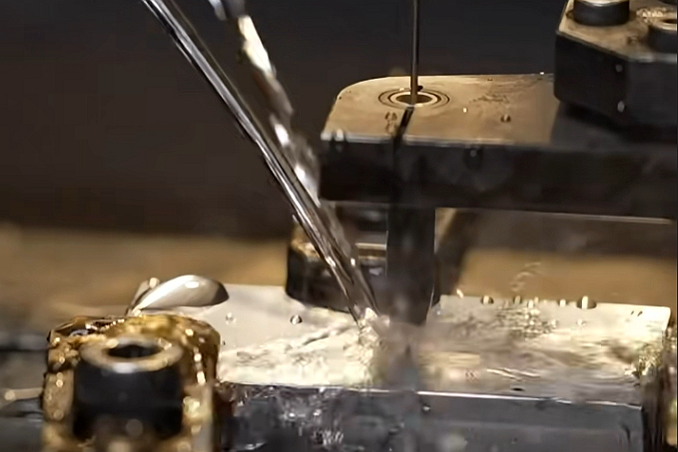
EDM Machining Technology Overview
Classification of EDM Machining
EDM Process | Surface Roughness (Ra, μm) | Dimensional Tolerance (mm) | Aspect Ratio | Heat Affected Zone (HAZ, μm) | Min. Feature Size (mm) |
|---|---|---|---|---|---|
Wire EDM | 0.3–1.2 | ±0.002–±0.01 | Up to 20:1 | 2–5 μm | ~0.1 |
Sinker EDM | 0.4–2.5 | ±0.005–±0.02 | Up to 10:1 | 5–10 μm | ~0.2 |
Hole Drilling EDM | 0.5–3.0 | ±0.02–±0.05 | Up to 30:1 | 10–15 μm | ~0.1 |
Micro-EDM | 0.1–0.4 | ±0.001–±0.005 | Up to 15:1 | <2 μm | <0.05 |
HAZ is minimized in low-energy multi-pass wire EDM, preserving metallurgical stability of In718 components.
EDM Machining Selection Strategy
Wire EDM: Best suited for trimming mold cores, ejector insert profiles, and precision parting surfaces.
Sinker EDM: Used where complex 3D cavities or blind features are required in In718 tool inserts.
Hole Drilling EDM: Applied for deep venting or cooling holes in large mold blocks.
Micro-EDM: Used for micro-textures, vents, and microfeatures <0.1 mm in thermal molding tools.
Material Considerations
Inconel 718 Material Profile for Mold Applications
Property | Value |
|---|---|
Tensile Strength @ 650°C | ~980 MPa |
Hardness (after aging) | HRC 36–42 |
Max Operating Temperature | 700–750°C |
Corrosion Resistance | Excellent in thermal and oxidizing environments |
Thermal Fatigue Performance | High resistance to crack propagation |
Why Inconel 718 for Mold Cores?
Maintains dimensional stability up to 700°C for injection and die casting cycles
Excellent oxidation and scale resistance under thermal cycling
Suitable for high-load cores with low wear over long tool life
Compatible with vacuum investment casting and EDM post-processing
Case Study: EDM Machining of In718 Precision Mold Core
Project Background
A client in the automotive tooling industry required a precision mold core made of Inconel 718 for thermoset compression molding. The core had to withstand 650°C operating temperatures with ±0.005 mm dimensional tolerance over 120 mm length.
Manufacturing Work Flow
Material: In718 block, forged, solution treated at 980°C, aged at 720°C for 8 hours
Pre-machining: CNC roughing to leave 0.3 mm allowance for EDM finishing
Wire EDM: Ø0.25 mm brass wire used in 3-pass trim cut; ±0.003 mm profile accuracy achieved
Micro-EDM: Added 0.2 mm venting slits with 10:1 aspect ratio, <2 μm HAZ
Post Process
Stress relief heat treatment at 870°C for 2 hours
Shot peening for 150% coverage, improving fatigue resistance
Optional TBC coating applied to external hot-face surfaces
Surface Finishing
Fine polishing to Ra ≤ 0.6 μm on parting faces
Passivation to enhance corrosion resistance
No dimensional shift detected post-polish per 3D scan
Inspection
CMM with ±2 μm accuracy confirmed profile accuracy
X-ray testing validated zero shrinkage or casting voids
SEM confirmed uniform EDM discharge surface
Ultrasonic immersion testing found no internal flaws
Results and Verification
Wire EDM achieved consistent tolerances within ±0.003 mm across the full profile of the In718 core. Edge sharpness was maintained within ±0.01 mm on sealing features.
Stress relief and shot peening ensured thermal fatigue performance exceeding 50,000 molding cycles without visible degradation.
Final surface roughness Ra ≤ 0.6 μm ensured high mold release performance, while passivation provided corrosion protection during storage and use.
3D scanning and CMM confirmed full geometric compliance to CAD with <2 μm profile variance.
The core passed all dimensional and integrity checks, meeting Class A tooling standards for thermoset molding.
FAQs
What tolerance levels are achievable with wire EDM on Inconel 718 mold parts?
Does In718 experience microcracking during EDM, and how is it mitigated?
What finishing steps are required post-EDM on mold cores?
Can In718 mold parts be post-coated with TBC or nitriding layers?
What is the typical tool life of an EDM-finished Inconel 718 mold core?
