
Superalloy Equiaxed Crystal casting guide Vanes
Introduction
Superalloy equiaxed crystal casting is a proven method for manufacturing turbine guide vanes that operate under moderate to high thermal and mechanical stress. At Neway AeroTech, we produce equiaxed guide vanes using Inconel 713LC, Rene 80, and Hastelloy X for use in aerospace, power generation, and industrial gas turbines. These vanes provide a cost-effective balance of thermal fatigue resistance, oxidation protection, and dimensional stability at temperatures up to 1050°C.
Equiaxed crystal structures are ideal for complex-cored guide vanes where directional casting is not feasible. Our process ensures high surface finish, tight tolerances, and structural reliability across large batches.
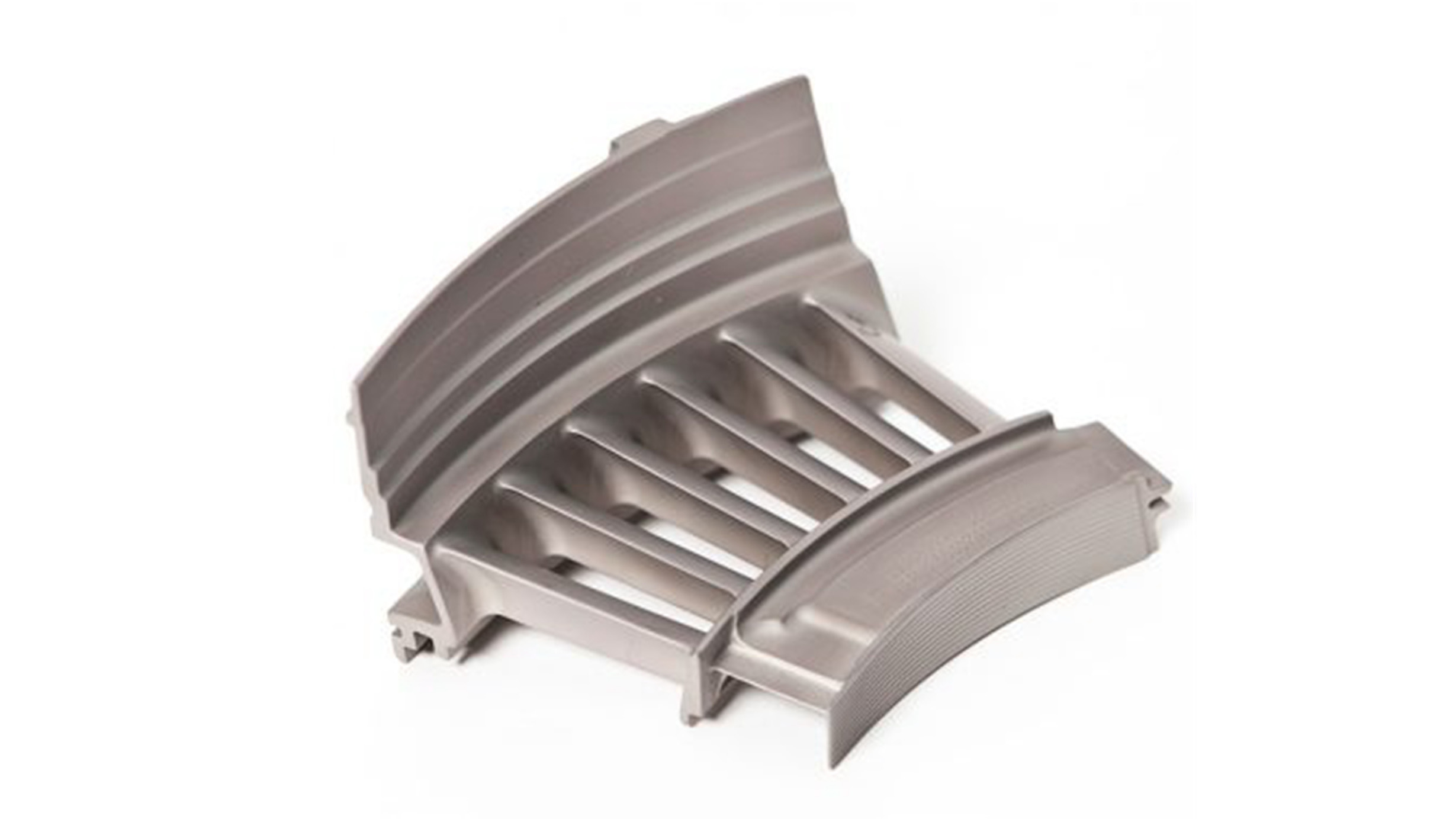
Core Technology of Equiaxed Crystal Casting
Wax Pattern Production: Precision injection molds create high-fidelity wax patterns of guide vane geometry within ±0.05 mm tolerance.
Ceramic Shell Building: Vane patterns are coated with multiple ceramic layers, producing shell molds of 7–10 mm thickness for structural integrity.
Vacuum Investment Casting: Alloys such as Inconel 713LC and Rene 80 are melted and poured under vacuum to reduce oxidation and shrinkage defects.
Controlled Solidification: Cooling rate optimized to produce equiaxed grains, typically ASTM 4–6 grain size, for uniform thermal fatigue resistance.
Post-Casting Heat Treatment: Solution and aging treatment stabilizes microstructure and improves creep strength and oxidation resistance.
Precision CNC Machining: Flow path finishes and mounting flanges are machined with ±0.02 mm tolerance using 5-axis CNC machining.
Optional Coating: Thermal Barrier Coatings (TBC) can be applied for improved thermal cycling performance.
Material Characteristics of Equiaxed Superalloys for Guide Vanes
Alloy | Max Temp (°C) | UTS (MPa) | Creep Resistance | Oxidation Resistance | Common Use |
|---|---|---|---|---|---|
Inconel 713LC | 980 | 875 | Moderate | Good | Aero & industrial turbines |
Rene 80 | 1050 | 1040 | High | Excellent | High-duty gas turbines |
Hastelloy X | 1100 | 750 | Moderate | Excellent | Combustion liners, vanes |
Case Study: Equiaxed Guide Vanes for Mid-Size Industrial Gas Turbines
Project Background
A power plant turbine manufacturer required cost-effective guide vanes for a 30 MW-class gas turbine. The vanes needed to withstand 950°C hot gas flow, 20,000-hour service life, and compatibility with standard TBC systems. Inconel 713LC was selected due to its castability and mechanical performance.
Typical Applications of Equiaxed Guide Vanes
Siemens SGT-300 Nozzle Guide Vanes (713LC): Mid-range gas turbines using equiaxed vanes for stable performance and cost-effective production.
GE LM1600 Turbine Vanes (Rene 80): Designed for moderate-duty operation, offering good oxidation resistance and fatigue life.
Solar Turbines Taurus 60 Guide Vanes (713LC): Supporting energy and industrial applications, balancing mechanical performance and manufacturability.
Combustor Transition Vanes (Hastelloy X): Used in power turbines to bridge between combustor and nozzle sections, requiring thermal fatigue resistance and complex geometry.
Manufacturing Solution for Equiaxed Guide Vanes
Pattern Assembly: Wax vanes assembled into clusters with consistent airfoil alignment and trailing edge positioning.
Shell Formation and Drying: 8–10 ceramic layers applied and dried under controlled humidity to avoid cracking.
Vacuum Casting: Metal poured at 1550–1600°C under <10⁻² torr to minimize inclusions and promote uniform microstructure.
Knockout and Cleaning: Ceramic removed via vibration and grit blasting; vanes inspected for surface integrity.
Heat Treatment: Standard cycles at 1180°C solution and 870°C aging enhance γ′ precipitation and tensile strength.
Machining and Finishing: Root platforms and bolt holes machined using CNC equipment; critical surfaces polished to Ra ≤1.6 µm.
Coating Application: TBC applied using air plasma spray, improving resistance to oxidation and thermal shock.
Inspection and Verification: Internal quality verified using X-ray inspection; final geometry validated via CMM.
Results and Validation
Microstructural Integrity: All castings met ASTM E112 grain size 4–6, with low segregation and no interdendritic cracking.
Mechanical Strength: 713LC vanes achieved 875 MPa UTS at 980°C; Rene 80 vanes exceeded 1000 MPa.
Thermal Cycle Life: TBC-coated vanes passed >10,000 thermal cycles between 200°C and 950°C without spallation or cracking.
Dimensional Accuracy: Post-machining tolerance control within ±0.02 mm for all flow path and mounting features.
Oxidation Resistance: Cyclic oxidation testing confirmed surface stability after 1000 hours at 1000°C.
FAQs
What are the advantages of equiaxed crystal casting for guide vanes?
How does Inconel 713LC compare to directionally solidified alloys?
Can equiaxed vanes be coated with TBC for higher temperature use?
What dimensional tolerances can be achieved with equiaxed vanes?
Are equiaxed castings suitable for aerospace high-cycle turbine stages?
