
Rene 41 Nickel-Based Superalloy Directional Casting Gas Turbine Blades
Introduction
Gas turbine blades in high-pressure and high-temperature environments must endure extreme mechanical loads, oxidation, and prolonged thermal cycling. These critical rotating components demand materials with excellent creep resistance, fatigue strength, and phase stability. Rene 41, a precipitation-hardened nickel-based superalloy, offers outstanding high-temperature strength and oxidation resistance up to 980°C, making it suitable for gas turbine blade applications.
Although traditionally used in equiaxed form, directional casting of Rene 41 aligns grains along the [001] axis, minimizing grain boundaries and improving creep life and fatigue resistance. At Neway AeroTech, we manufacture Rene 41 gas turbine blades using advanced vacuum investment casting and directional solidification techniques, supporting high-performance aerospace, power generation, and marine gas turbines.
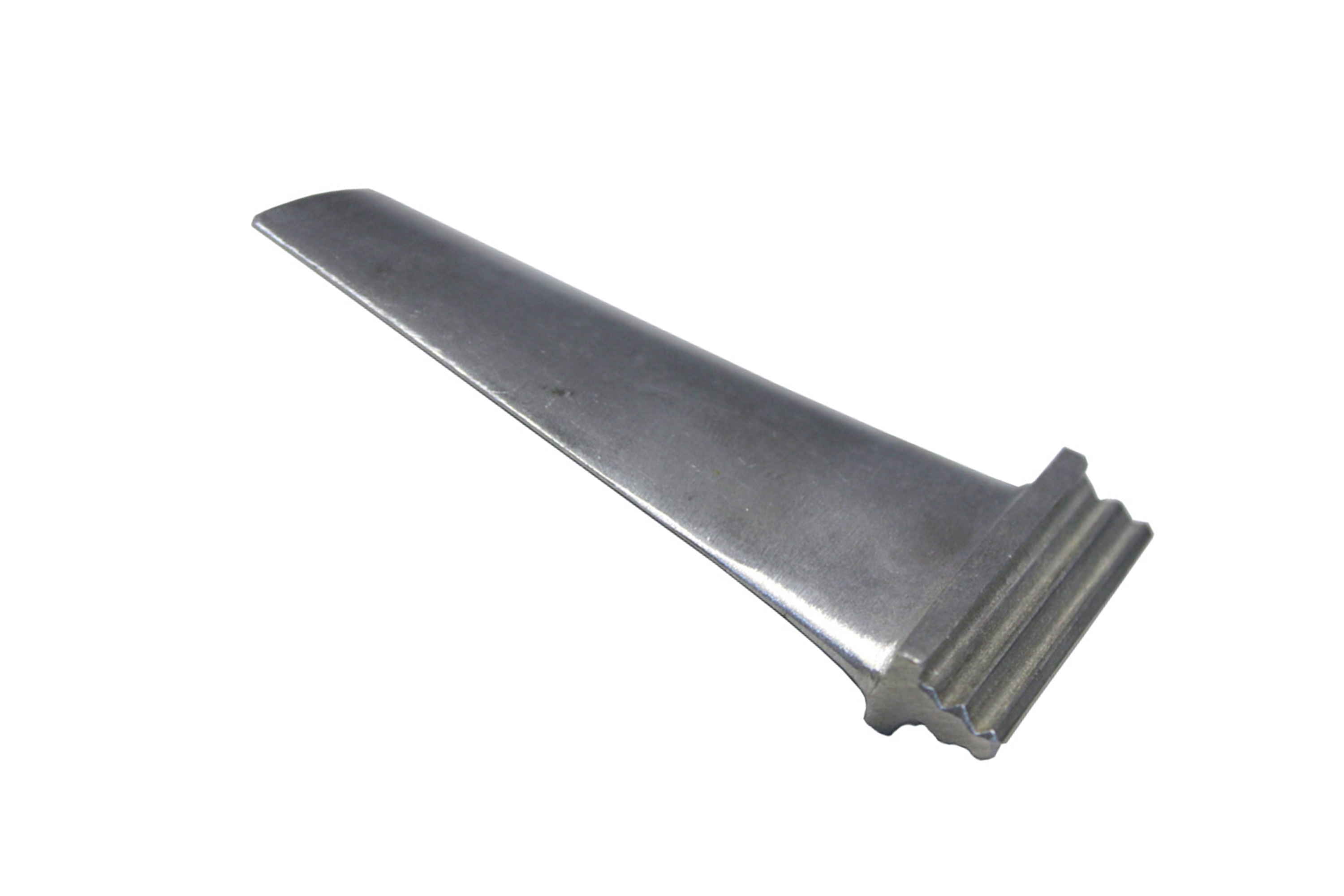
Core Technology of Directional Casting for Rene 41 Turbine Blades
Wax Pattern Production Precision wax patterns are molded with ±0.05 mm accuracy to replicate complex blade profiles, roots, and shrouds.
Shell Mold Fabrication Ceramic shell molds (6–10 mm thick) are constructed layer-by-layer to support directional solidification and withstand casting temperatures.
Grain Selector Integration Spiral grain selectors are added at the mold base to initiate controlled [001] grain growth, eliminating transverse grain boundaries.
Vacuum Induction Melting Rene 41 is melted at ~1380–1400°C in a vacuum environment (≤10⁻³ Pa) to minimize inclusions and gas porosity.
Directional Solidification Molds are withdrawn from the furnace at a controlled rate (2–4 mm/min), promoting columnar [001] grain alignment along the blade’s load-bearing axis.
Shell Removal and Cleaning Shells are removed with blasting and leaching, preserving airfoil surface quality and thin-edge details.
Heat Treatment and Aging Solution and aging cycles are used to stabilize γ′ precipitates, improving creep and fatigue properties.
Final Machining and Inspection EDM, CNC machining, CMM, and X-ray inspection ensure structural integrity and dimensional accuracy.
Rene 41 Material Properties for Directionally Cast Blades
Max Operating Temperature: ~980°C
Tensile Strength: ≥1240 MPa at room temperature
Creep Rupture Strength: ≥170 MPa at 871°C (1000 hrs)
Yield Strength: ≥1030 MPa
Oxidation Resistance: Excellent in hot combustion gas environments
Microstructure: Directionally solidified [001] columnar grains with <2° deviation
Phase Control: High γ′ phase volume for precipitation hardening
Case Study: Directional Rene 41 Blades for Industrial Gas Turbine
Project Background
Neway AeroTech was tasked with manufacturing first-stage turbine blades from Rene 41 for a 60 MW industrial gas turbine operating continuously at 950°C. The client required blades with high creep strength, fatigue resistance, and directional grain structure to extend component life and reduce maintenance.
Typical Applications
Aeroengine Turbine Blades: Designed for high thrust and long flight cycles under thermal cycling and vibrational stress.
Power Generation HPT Blades: Operate at high base-load temperatures with extended duty cycles and minimal downtime.
Marine Gas Turbine Blades: Require strong oxidation resistance and long-term thermal fatigue performance in corrosive environments.
Manufacturing Workflow for Rene 41 Directional Blades
Mold and Casting System Design Using CFD simulation, gating and chill placement are optimized for defect-free solidification.
Vacuum Directional Casting Execution Casting is performed under vacuum with precise mold withdrawal control to produce [001] columnar grains.
Heat Treatment and Aging Heat treatment cycles promote uniform γ′ precipitation, enhancing phase stability and mechanical strength.
CNC and EDM Machining Blade roots, shrouds, and cooling holes are finished using CNC machining and EDM.
Final Inspection and Quality Control Blades are validated with X-ray, ultrasonic, and CMM inspection to confirm internal and external conformity.
Key Manufacturing Challenges
Managing grain orientation in complex airfoil geometries
Preventing stray grains during transition from root to airfoil
Achieving phase uniformity without over-aging
Maintaining dimensional precision during post-processing
Results and Verification
[001] grain orientation confirmed via EBSD with <2° deviation
ASTM 6–7 grain structure verified across casting cross-sections
No porosity detected post-casting using X-ray and ultrasonic NDT
Mechanical testing validated >170 MPa creep rupture strength at 871°C
Final blade dimensions held within ±0.03 mm across root and tip features
FAQs
Why use directional casting for Rene 41 turbine blades?
What are the advantages of [001] grain structure in turbine applications?
What temperature limits can Rene 41 blades endure?
How is quality controlled during directional casting?
Can Rene 41 turbine blades be repaired or refurbished?
