
Titanium Turbocharger Vacuum Investment Casting Foundry
Introduction
Titanium alloys such as Ti-6Al-4V (TC4) offer an exceptional combination of low density (4.43 g/cm³), high tensile strength (~900 MPa), superior corrosion resistance, and outstanding fatigue resistance. These properties make titanium alloys ideal for manufacturing turbocharger components, ensuring lightweight, high-speed performance, and excellent durability.
At Neway AeroTech, we specialize in vacuum investment casting of titanium turbocharger components, producing complex, high-precision parts with minimal defects, fine surface finishes, and optimal mechanical performance for motorsport, aerospace, and industrial applications.
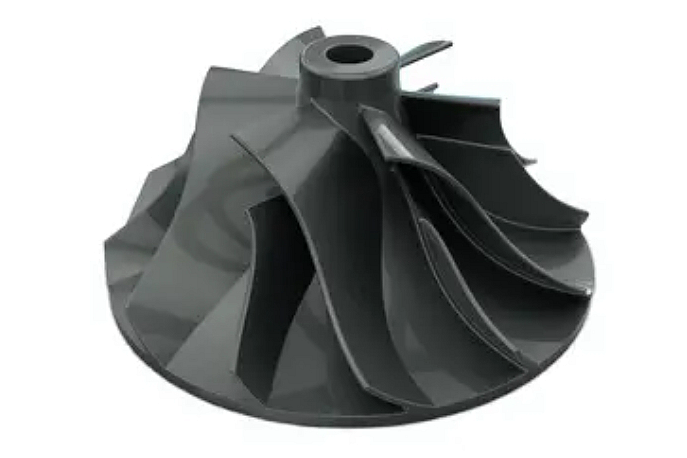
Key Manufacturing Challenges for Titanium Turbocharger Components
Strict control of chemical composition to maintain strength and corrosion resistance.
Prevent oxidation during melting and casting using full vacuum (<10⁻³ Pa) environments.
Achieving tight dimensional tolerances (±0.05 mm) for high-speed balance and aerodynamic efficiency.
Ensuring fine surface finishes (Ra ≤1.6 µm) reduces flow losses and improves turbine response.
Vacuum Investment Casting Process for Titanium Turbocharger Components
The production process includes:
Wax Pattern Fabrication: Injection molding of precision wax models with ±0.1% dimensional control.
Shell Building: Ceramic shell constructed using yttria-stabilized zirconia slurry to withstand high casting temperatures.
Dewaxing: Steam autoclaving at ~150°C to remove wax without shell cracking cleanly.
Vacuum Melting and Pouring: Titanium alloy melted in a water-cooled copper crucible and poured under high vacuum to prevent oxygen contamination.
Controlled Solidification: Uniform cooling to minimize internal stresses and promote fine microstructures.
Shell Removal and Finishing: Shell removal, precision CNC machining, and final surface treatments to achieve exacting aerodynamic profiles.
Comparative Analysis of Manufacturing Methods for Turbocharger Components
Process | Surface Finish | Dimensional Precision | Mechanical Properties | Oxidation Control | Cost Level |
|---|---|---|---|---|---|
Vacuum Investment Casting | Excellent (Ra ≤1.6 µm) | High (±0.05 mm) | Superior (~900 MPa) | Excellent | Moderate |
Conventional Investment Casting | Good (Ra ~3 µm) | Moderate (±0.2 mm) | Good (~850 MPa) | Moderate | Low |
CNC Machining from Billet | Excellent (Ra ≤0.8 µm) | Very High (±0.01 mm) | Excellent (~900 MPa) | Good | High |
Optimal Manufacturing Strategy for Titanium Turbocharger Components
Vacuum investment casting: Best suited for lightweight, complex turbocharger components requiring high mechanical performance and oxidation-free surfaces.
CNC machining from billet: Used for small volume, highly customized parts where extreme dimensional control (±0.01 mm) is required.
Titanium Alloy Performance Overview
Property | Value | Application Relevance |
|---|---|---|
Tensile Strength | ~900 MPa | Supports high centrifugal stresses in turbo operation |
Yield Strength | ~830 MPa | Prevents permanent deformation under peak load |
Density | 4.43 g/cm³ | Lightweight for faster turbocharger spool-up |
Fatigue Strength | ~510 MPa | Critical for durability under high-speed cyclic loading |
Maximum Operating Temperature | ~400°C | Reliable performance under elevated exhaust gas temperatures |
Advantages of Using Titanium for Turbocharger Components
Superior strength-to-weight ratio reduces rotational inertia, enhancing turbocharger response.
High fatigue strength extends service life in demanding cyclic environments.
Excellent corrosion resistance protects against oxidation and high-temperature gas attack.
Outstanding design flexibility allows complex aerodynamic shapes with minimal wall thickness.
Post-processing Techniques for Titanium Turbocharger Components
Hot Isostatic Pressing (HIP): Eliminates internal porosity, enhancing fatigue and creep resistance.
Heat Treatment (Annealing): Optimizes the α+β phase structure to enhance mechanical properties.
Precision CNC Machining: Finalizes critical surfaces to ±0.01 mm tolerance and Ra ≤0.8 µm surface finishes.
Surface Finishing (Polishing/Shot Peening): Improves surface hardness, fatigue resistance, and aerodynamic performance.
Inspection and Quality Assurance for Turbocharger Components
Coordinate Measuring Machine (CMM): Ensures tight dimensional tolerances (±0.05 mm) for critical aerodynamic profiles.
Ultrasonic Testing (UT): Detects internal voids or defects without damaging parts.
Dye Penetrant Testing (PT): Reveals fine surface discontinuities critical for fatigue-prone parts.
Metallographic Analysis: Confirms microstructure integrity and compliance with aerospace material standards.
Industry Applications and Case Study
Titanium turbocharger components manufactured by Neway AeroTech are widely used in high-performance automotive turbos, aerospace APUs, and industrial high-efficiency turbo machinery. In a recent motorsport application, titanium turbocharger wheels improved spool-up times by 22% and increased fatigue life by 30% compared to traditional aluminum alloy alternatives, boosting engine performance and durability.
FAQs
What dimensional tolerances can Neway AeroTech achieve for titanium turbocharger components?
Why is vacuum investment casting critical for producing titanium turbo parts?
How does titanium compare to aluminum alloys for turbocharger applications?
What post-processing steps are essential for titanium turbocharger components?
How does Neway AeroTech ensure surface quality and fatigue resistance in titanium turbo parts?
