
Ti-13V-11Cr-3Al TC11 Turbocharger Blades CNC Machining Company
Introduction
Ti-13V-11Cr-3Al (TC11) is a metastable beta titanium alloy offering outstanding strength-to-weight ratio, excellent fatigue resistance, and superior corrosion resistance. With a tensile strength of ~1030 MPa and excellent high-speed fatigue properties, it is ideal for manufacturing high-performance turbocharger blades operating under extreme rotational stresses and elevated temperatures.
At Neway AeroTech, we specialize in precision CNC machining of TC11 turbocharger blades, achieving high dimensional accuracy, fine aerodynamic profiles, and optimized mechanical performance for motorsport, aerospace, and industrial turbo applications.
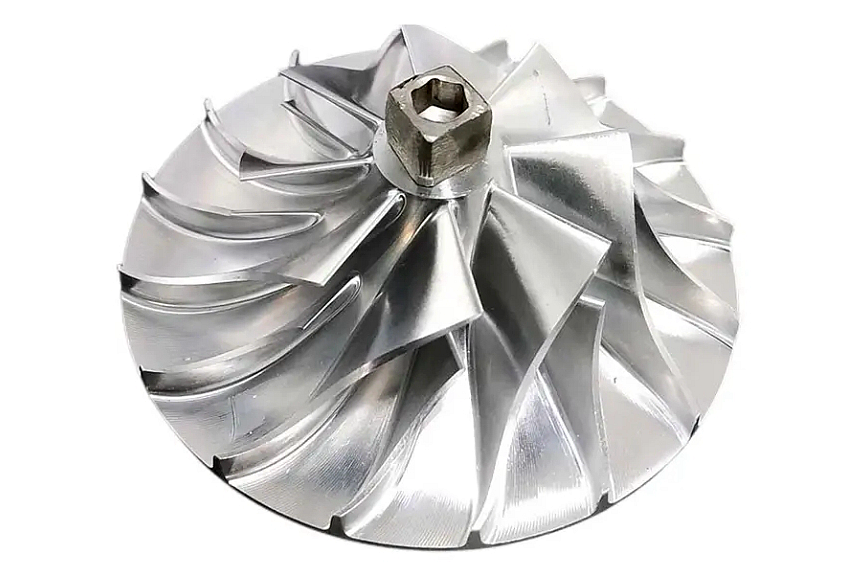
Key Manufacturing Challenges for TC11 Turbocharger Blades
Maintaining alloy composition (Ti base, V ~13%, Cr ~11%, Al ~3%) for mechanical stability.
Controlling microstructure to achieve fine β-phase dominant structures enhancing fatigue strength.
Achieving tight dimensional tolerances (±0.01 mm) critical for aerodynamic efficiency.
Producing smooth surface finishes (Ra ≤0.8 µm) to optimize gas flow and reduce drag.
Precision CNC Machining Process for TC11 Turbocharger Blades
The production process includes:
Billet Preparation: Forged TC11 blanks with fine microstructure selected for consistency.
Rough Machining: High-rigidity 5-axis CNC equipment with carbide or CBN tooling to rough contour geometry.
Heat Treatment: β annealing at ~800°C–900°C to stabilize microstructure and optimize ductility and strength.
Precision Finishing: Fine CNC contouring to achieve aerodynamic profiles and critical dimensions.
Surface Polishing: Post-machining polishing to achieve Ra ≤0.8 µm for maximum airflow efficiency.
Comparative Analysis of Manufacturing Methods for Turbocharger Blades
Process | Surface Finish | Dimensional Precision | Mechanical Strength | Fatigue Resistance | Cost Level |
|---|---|---|---|---|---|
Precision CNC Machining | Excellent (Ra ≤0.8 µm) | Very High (±0.01 mm) | Outstanding (~1030 MPa) | Superior | Moderate |
Investment Casting + Machining | Good (Ra ~3 µm) | High (±0.05 mm) | Very Good (~950 MPa) | Very Good | Moderate |
Forging + CNC Machining | Excellent (Ra ≤0.8 µm) | Very High (±0.01 mm) | Outstanding (~1030 MPa) | Superior | High |
Optimal Manufacturing Strategy for TC11 Turbocharger Blades
Precision CNC machining: Best suited for achieving lightweight, high-speed aerodynamic blade designs with excellent surface finishes.
Forging + CNC machining: Used where maximum mechanical strength and fatigue resistance are required for extreme conditions.
Investment casting + machining: Suitable for simpler or high-volume blade production with moderate mechanical demands.
Ti-13V-11Cr-3Al (TC11) Alloy Performance Overview
Property | Value | Application Relevance |
|---|---|---|
Tensile Strength | ~1030 MPa | High-speed turbocharger blade mechanical stability |
Yield Strength | ~960 MPa | Withstands extreme centrifugal stresses |
Fatigue Strength | ~550 MPa | Excellent durability under cyclic loads |
Density | 4.65 g/cm³ | Reduces rotor inertia and improves acceleration |
Maximum Operating Temperature | ~450°C | Maintains strength and fatigue resistance at elevated temperatures |
Advantages of Using TC11 for Turbocharger Blades
High strength-to-weight ratio enhances turbocharger response and reduces spool-up time.
Superior fatigue resistance extends blade service life under high-speed cycling.
Outstanding corrosion resistance ensures durability against hot gases and oxidizing environments.
Excellent machinability allows production of highly optimized aerodynamic geometries.
Post-processing Techniques for TC11 Turbocharger Blades
Hot Isostatic Pressing (HIP): Enhances density and eliminates residual porosity for improved fatigue resistance.
Solution Treatment and Aging (STA): Refines β-phase stability to enhance high-temperature strength.
Precision CNC Finishing: Achieves Ra ≤0.8 µm surface finishes for aerodynamic efficiency.
Surface Shot Peening or Polishing: Improves surface hardness and fatigue life by inducing beneficial compressive stresses.
Inspection and Quality Assurance for Turbocharger Blades
Coordinate Measuring Machine (CMM): Verifies ±0.01 mm dimensional precision for aerodynamic and balance-critical features.
Ultrasonic Testing (UT): Non-destructive detection of internal defects.
Dye Penetrant Testing (PT): Reveals surface cracks as small as 0.002 mm.
Metallographic Analysis: Confirms microstructure consistency and grain size control.
Industry Applications and Case Study
TC11 turbocharger blades manufactured by Neway AeroTech are widely used in motorsport turbo systems, aerospace APUs, and high-efficiency industrial gas turbines. In a recent high-performance automotive turbo project, CNC-machined TC11 blades achieved a 20% reduction in rotational inertia and extended fatigue life by 30% compared to conventional forged aluminum blades, significantly improving engine response and reliability.
FAQs
What dimensional tolerances can Neway AeroTech achieve for TC11 turbocharger blades?
Why is CNC machining ideal for manufacturing Ti-13V-11Cr-3Al turbocharger blades?
How does TC11 compare to traditional aluminum alloys in turbo applications?
What industries benefit most from TC11 turbocharger blades?
How does Neway AeroTech ensure fatigue strength and surface quality in TC11 blades?
