
TA10 Turbocharger Components Isothermal Forging Factory
Introduction
TA10 is an advanced titanium alloy (Ti-6Al-2Sn-4Zr-2Mo) designed for excellent high-temperature strength, creep resistance, and fatigue durability. With a tensile strength of ~940 MPa and exceptional thermal stability up to 500°C, TA10 is highly suited for high-speed turbocharger components subjected to extreme thermal cycling and centrifugal forces.
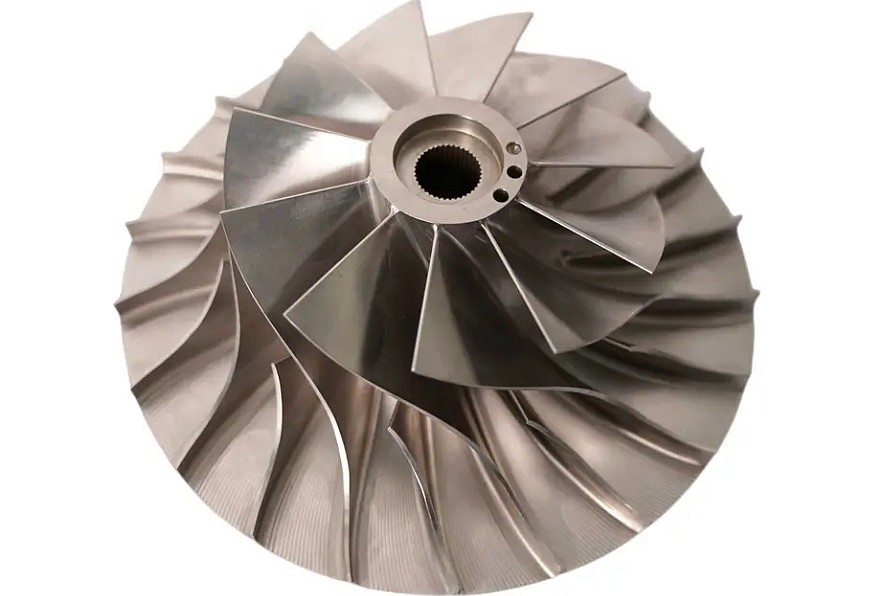
At Neway AeroTech, we specialize in isothermal forging of TA10 turbocharger components, achieving fine-grain microstructures, superior mechanical properties, and precise dimensional tolerances for demanding automotive, aerospace, and industrial turbo systems.
Key Manufacturing Challenges for TA10 Turbocharger Components
Maintaining chemical composition (Ti base, Al ~6%, Sn ~2%, Zr ~4%, Mo ~2%) for mechanical and thermal stability.
Controlling grain refinement through isothermal forging at ~950–980°C to optimize fatigue and creep resistance.
Achieving tight dimensional tolerances (±0.02 mm) is critical for aerodynamic balance and turbocharger efficiency.
Ensuring superior surface finishes (Ra ≤1.6 µm) reduces drag and improves performance.
Isothermal Forging Process for TA10 Turbocharger Components
The production process includes:
Billet Preparation: High-purity VAR TA10 billets selected for chemical homogeneity.
Isothermal Forging: Precision forging at ~950–980°C under constant die and billet temperatures to minimize residual stresses and achieve uniform fine-grain microstructure.
Controlled Cooling: Slow cooling to stabilize microstructure and prevent beta grain coarsening.
Solution Treatment and Aging (STA): Heat treatment cycle optimizes α+β phase distribution for strength and toughness.
Precision CNC Machining: Final machining achieves aerodynamic profiles and tight tolerances critical for rotor balance.
Surface Finishing: Polishing or shot peening improves fatigue resistance and surface integrity.
Comparative Analysis of Manufacturing Methods for Turbo Components
Process | Surface Finish Quality | Dimensional Precision | Mechanical Properties | High-Temp Resistance | Cost Level |
|---|---|---|---|---|---|
Isothermal Forging + CNC | Excellent (Ra ≤1.6 µm) | Very High (±0.02 mm) | Outstanding (~940 MPa) | High (~500°C) | Moderate |
Conventional Forging | Good (Ra ~3 µm) | High (±0.05 mm) | Very Good (~900 MPa) | High (~450°C) | Moderate |
Investment Casting + Machining | Moderate (Ra ~5 µm) | Moderate (±0.1 mm) | Good (~850 MPa) | Moderate (~400°C) | Low |
CNC Machining from Billet | Excellent (Ra ≤0.8 µm) | Very High (±0.01 mm) | Excellent (~940 MPa) | High (~500°C) | High |
Optimal Manufacturing Strategy for TA10 Turbocharger Components
Isothermal forging: Best for producing lightweight, fine-grained, high-strength turbocharger wheels and blades with superior fatigue and thermal resistance.
Conventional forging: Suitable for general components where slightly lower performance is acceptable.
Investment casting: Applied to less critical or thick-section components.
CNC machining from billet: Used for highly customized, extremely high-tolerance low-volume production.
TA10 Alloy Performance Overview
Property | Value | Application Relevance |
|---|---|---|
Tensile Strength | ~940 MPa | High-load, high-speed turbocharger component durability |
Yield Strength | ~880 MPa | Resists deformation under centrifugal stresses |
Maximum Operating Temperature | ~500°C | Suitable for elevated temperature turbo operation |
Fatigue Strength | ~510 MPa | Extends component life under cyclic loading |
Density | 4.55 g/cm³ | Lightweight for improved acceleration and response |
Advantages of Using TA10 for Turbocharger Components
Exceptional strength-to-weight ratio improves turbocharger spool-up and reduces inertia.
High-temperature resistance maintains mechanical properties up to 500°C under sustained load.
Superior fatigue and creep resistance ensures longer operational lifespans.
Excellent corrosion resistance withstands hot exhaust gases and harsh environments.
Post-processing Techniques for TA10 Turbocharger Components
Hot Isostatic Pressing (HIP): Densifies forged parts, eliminating residual micro-porosity and enhancing fatigue life.
Solution Treatment and Aging (STA): Refines microstructure to maximize strength and ductility.
Precision CNC Machining: Finalizes aerodynamic profiles and critical fit features with ±0.01 mm precision.
Surface Polishing or Shot Peening: Improves fatigue resistance and aerodynamic surface smoothness.
Inspection and Quality Assurance for Turbocharger Components
Coordinate Measuring Machine (CMM): Ensures dimensional tolerances within ±0.02 mm for critical surfaces.
Ultrasonic Testing (UT): Detects internal flaws and discontinuities.
Dye Penetrant Testing (PT): Identifies surface cracks as small as 0.002 mm.
Metallographic Analysis: Confirms grain size and microstructure compliance with aerospace standards.
Industry Applications and Case Study
TA10 turbocharger components manufactured by Neway AeroTech are widely used in high-performance automotive turbochargers, aerospace auxiliary power units (APUs), and advanced industrial turbo systems. In a recent aerospace project, forged TA10 turbine wheels achieved a 20% increase in service life compared to conventional Ti-6Al-4V parts under continuous operation at 480°C, significantly improving system reliability and reducing maintenance intervals.
FAQs
What dimensional precision does Neway AeroTech achieve for TA10 turbocharger components?
Why is isothermal forging ideal for manufacturing TA10 turbocharger wheels?
How does TA10 compare to traditional titanium alloys under turbocharger conditions?
What industries benefit most from TA10 turbocharger components?
How does Neway AeroTech ensure fatigue strength and thermal resistance in TA10 forged parts?
