
PWA 1480 Turbomachine Blade Monocrystalline Casting Manufacturer
Introduction
PWA 1480 is a first-generation nickel-based single crystal superalloy specifically engineered for superior creep resistance, high-temperature stability, and exceptional fatigue performance at temperatures up to 1090°C. With tensile strength around 1350 MPa and outstanding oxidation resistance, PWA 1480 is the material of choice for manufacturing critical turbomachine blades operating under extreme thermal and mechanical loads.
At Neway AeroTech, we specialize in manufacturing PWA 1480 turbomachine blades through precision monocrystalline (single crystal) vacuum investment casting, delivering defect-free structures, exceptional high-temperature mechanical properties, and precise aerodynamic profiles.
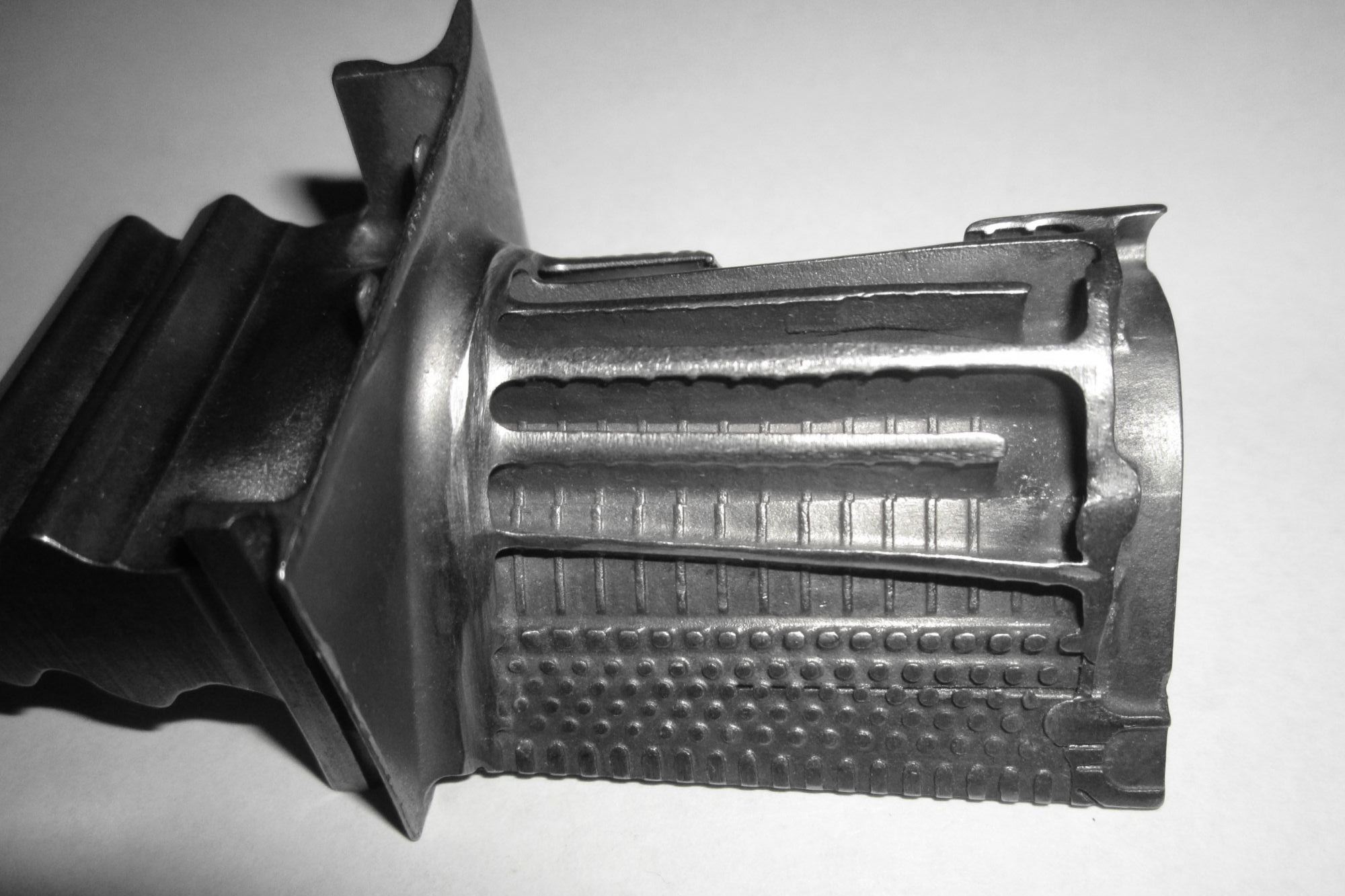
Key Manufacturing Challenges for PWA 1480 Turbomachine Blades
Maintaining strict alloy composition (Ni base, Al ~5%, Cr ~10%, Co ~10%, Ta ~5%, W ~5%) to ensure stable γ' phase distribution.
Achieving perfect single crystal growth through controlled directional solidification without grain boundaries.
Maintaining tight dimensional tolerances (±0.03 mm) for optimal aerodynamic and mechanical performance.
Ensuring surface finishes (Ra ≤1.6 µm) critical for reducing drag and improving fatigue life.
Monocrystalline Casting Process for PWA 1480 Turbomachine Blades
The manufacturing process includes:
Wax Pattern Fabrication: High-precision wax models ensuring ±0.1% dimensional consistency for complex blade geometries.
Shell Building: Ceramic shells using yttria-stabilized zirconia layers for high-temperature resistance during crystal growth.
Dewaxing: Steam autoclaving at ~150°C ensures defect-free cavity formation.
Vacuum Melting and Pouring: Alloy melted at ~1450°C under vacuum (<10⁻³ Pa) to maintain cleanliness and prevent oxidation.
Single Crystal Growth: Controlled withdrawal (~3–6 mm/min) across thermal gradients to ensure single [001] crystallographic orientation.
Shell Removal and CNC Finishing: Shell removal, precision machining, and polishing to achieve aerodynamic contours and critical dimensions.
Comparative Analysis of Manufacturing Methods for Turbomachine Blades
Process | Grain Structure | Surface Finish | Dimensional Precision | Mechanical Strength | Max Temp Resistance |
|---|---|---|---|---|---|
Single Crystal Investment Casting | Single crystal | Excellent (Ra ≤1.6 µm) | Very High (±0.03 mm) | Superior (~1350 MPa) | Outstanding (~1090°C) |
Directional Solidification | Columnar grains | Good (Ra ~3 µm) | High (±0.05 mm) | Excellent (~1270 MPa) | Excellent (~1020°C) |
Equiaxed Casting | Random fine grains | Moderate (Ra ~3–5 µm) | Moderate (±0.1 mm) | Very Good (~1240 MPa) | High (~980°C) |
Optimal Manufacturing Strategy for PWA 1480 Turbomachine Blades
Single crystal casting achieves Ra ≤1.6 µm surface, ±0.03 mm dimensional precision, and eliminates grain boundary creep for primary turbine blades.
Directional solidification achieves columnar grain structures with excellent creep strength but lower fatigue resistance compared to monocrystalline parts.
Equiaxed casting provides cost-effective production but is limited by grain boundary creep and lower high-temperature fatigue performance.
PWA 1480 Alloy Performance Overview
Property | Value | Application Relevance |
|---|---|---|
Tensile Strength | ~1350 MPa | Supports extreme centrifugal and thermal loads |
Yield Strength | ~1200 MPa | High dimensional stability under continuous load |
Maximum Operating Temperature | ~1090°C | Maintains mechanical integrity at turbine inlet temperatures |
Creep Resistance | Outstanding | Extends operational life at prolonged high-stress conditions |
Fatigue Strength | ~680 MPa | Resists crack initiation under cyclic loading |
Advantages of Using PWA 1480 for Turbomachine Blades
Superior creep and fatigue resistance ensures durability at turbine inlet temperatures (~1090°C).
Outstanding oxidation resistance preserves blade surface integrity under high-velocity hot gas streams.
Single crystal structure eliminates grain boundary failure mechanisms, maximizing service life.
High mechanical strength ensures minimal deformation under high centrifugal and thermal loads.
Post-processing Techniques for PWA 1480 Turbomachine Blades
Hot Isostatic Pressing (HIP): Densifies castings, eliminates microporosity, and enhances fatigue and creep properties.
Solution and Aging Heat Treatment: Develops optimal γ' phase strengthening for high-temperature strength and creep resistance.
Precision CNC Machining: Achieves aerodynamic profiles within ±0.01 mm tolerance and Ra ≤0.8 µm finish.
Surface Finishing (Polishing/Shot Peening): Improves fatigue life and enhances aerodynamic performance.
Inspection and Quality Assurance for Turbomachine Blades
Coordinate Measuring Machine (CMM): Inspects critical dimensions to ±0.03 mm tolerance.
Ultrasonic Testing (UT): Detects internal defects ensuring casting integrity.
Dye Penetrant Testing (PT): Locates surface discontinuities as small as 0.002 mm.
Metallographic Analysis: Verifies single crystal orientation and γ' phase distribution.
Industry Applications and Case Study
PWA 1480 turbomachine blades manufactured by Neway AeroTech are widely deployed in high-performance aerospace engines and industrial gas turbines. In a recent aerospace engine program, PWA 1480 blades provided over 16,000 flight hours at turbine entry temperatures exceeding 1060°C, increasing service life by 35% compared to conventional polycrystalline blades.
FAQs
What dimensional tolerances can Neway AeroTech achieve for PWA 1480 turbomachine blades?
Why is single crystal casting essential for PWA 1480 turbine blade manufacturing?
How does PWA 1480 compare to other superalloys under turbine inlet conditions?
What industries commonly use PWA 1480 turbine blades?
How does Neway AeroTech ensure metallurgical integrity and quality in PWA 1480 castings?
