
Power Generation Nimonic Superalloy Parts Custom Nozzle Rings Company
Introduction to Nimonic Superalloys for Turbine Nozzle Rings
Nimonic superalloys are renowned for their exceptional high-temperature strength, superior oxidation resistance, and outstanding creep resistance, making them essential materials for nozzle rings in power generation turbines. At Neway AeroTech, we specialize in manufacturing custom Nimonic nozzle rings utilizing state-of-the-art processes, including vacuum investment casting and superalloy directional casting.
Leveraging extensive expertise tailored specifically for power generation applications, our components meet stringent operational requirements, significantly enhancing turbine performance, efficiency, and reliability.
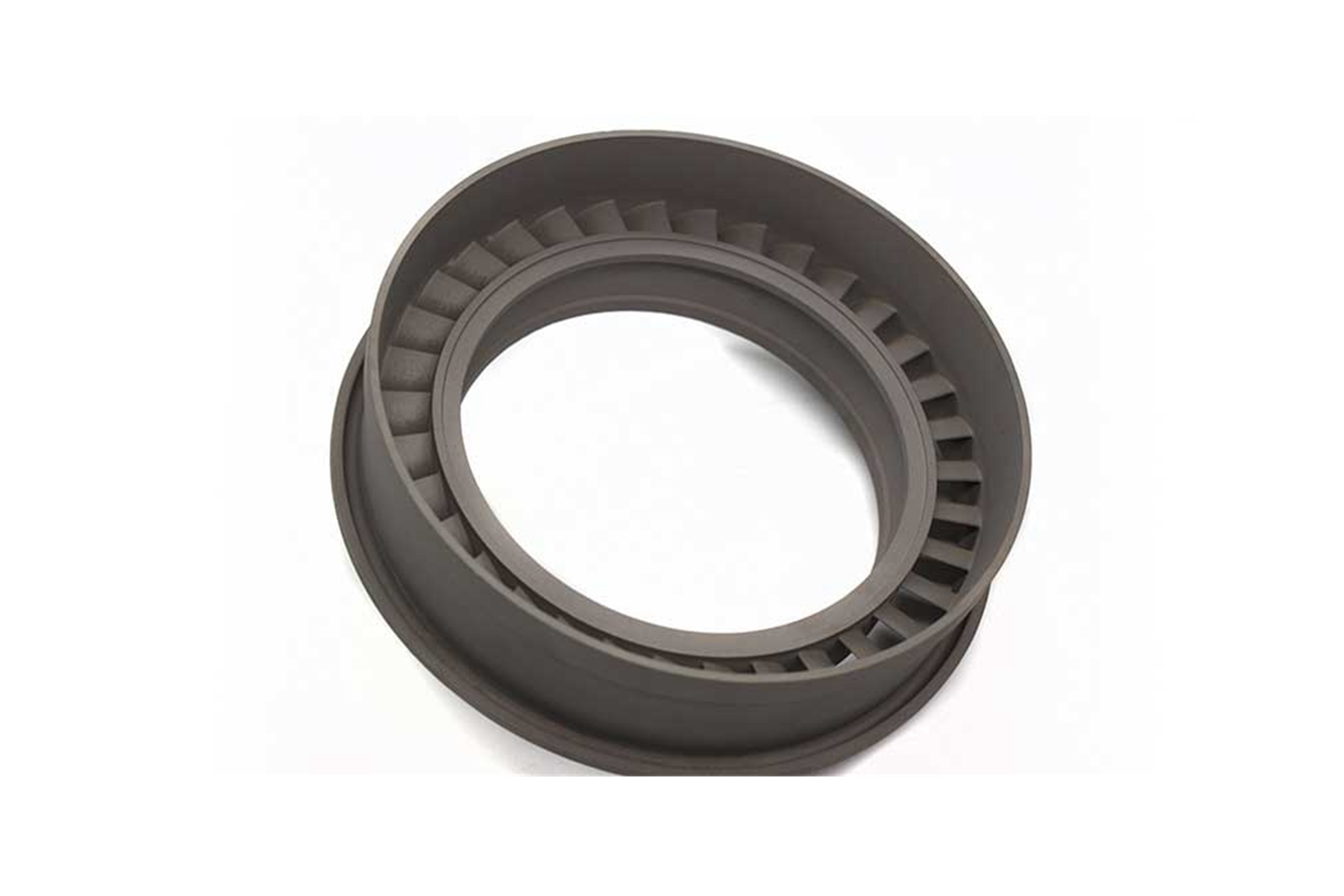
Key Manufacturing Challenges for Nimonic Nozzle Rings
The production of Nimonic nozzle rings involves overcoming key technical challenges:
High-Temperature Creep: Ensuring structural integrity at temperatures reaching up to 1050°C.
Precision Casting: Achieving dimensional accuracy within ±0.15 mm for intricate nozzle geometries and internal cooling channels.
Machinability: Addressing the rapid work-hardening and low thermal conductivity of Nimonic alloys.
Corrosion and Oxidation Resistance: Guaranteeing long-term component stability under harsh, corrosive combustion environments.
Detailed Nimonic Nozzle Ring Manufacturing Processes
Vacuum Investment Casting
Wax patterns precisely replicate complex nozzle ring geometries.
Ceramic molds formed by multiple refractory layers; wax removal via autoclaving (~180°C).
Nimonic alloy casting under high vacuum conditions (<0.01 Pa) eliminates contaminants.
Controlled cooling (~40°C/hour) minimizes internal stresses, preserving dimensional stability.
Directional Casting
Precisely controlled temperature gradients (~20–50°C/cm) enable directional grain solidification.
Grain alignment significantly enhances creep resistance and fatigue life.
Solidification rates managed (20–40°C/hour) to reduce porosity and improve internal structural integrity.
Comparative Overview of Nimonic Manufacturing Processes
Process | Dimensional Accuracy | Surface Finish | Production Efficiency | Complexity Capability |
|---|---|---|---|---|
Vacuum Investment Casting | ±0.15 mm | Ra 3.2–6.3 µm | Moderate | High |
Directional Casting | ±0.20 mm | Ra 6.3–12.5 µm | Moderate | Moderate |
CNC Machining | ±0.01 mm | Ra 0.8–3.2 µm | Moderate | Moderate |
SLM 3D Printing | ±0.05 mm | Ra 6.3–12.5 µm | High | Very High |
Manufacturing Process Selection Strategy for Nimonic Nozzle Rings
Vacuum Investment Casting: Optimal for intricate nozzle geometries, achieving precise tolerances (±0.15 mm) with cost-effectiveness for medium-volume production.
Directional Casting: Recommended for components demanding aligned grains and superior creep strength, maintaining ±0.20 mm accuracy.
CNC Machining: Ideal for final finishing operations requiring exceptional dimensional accuracy (±0.01 mm) and surface smoothness.
SLM 3D Printing: Suitable for rapid prototyping and internal cooling channels with precision (±0.05 mm).
Nimonic Material Performance Matrix for Turbine Nozzle Rings
Material | Tensile Strength (MPa) | Yield Strength (MPa) | Max Service Temp (°C) | Oxidation Resistance | Application |
|---|---|---|---|---|---|
750 | 275 | 1050 | Excellent | High-temp nozzle components | |
1000 | 620 | 815 | Superior | Turbine blades & nozzle rings | |
1160 | 815 | 920 | Exceptional | High-performance nozzle vanes | |
1200 | 850 | 950 | Outstanding | Advanced turbine nozzle rings | |
1300 | 900 | 1000 | Exceptional | High-temp turbine stages | |
1150 | 800 | 950 | Superior | Combustion liners & nozzle parts |
Material Selection Strategy for Nimonic Nozzle Rings
Nimonic 75: Ideal for nozzle components needing excellent oxidation resistance at very high temperatures (1050°C).
Nimonic 80A: Recommended for turbine blades and nozzle rings due to balanced strength (1000 MPa) and service temperatures up to 815°C.
Nimonic 90: Optimal for nozzle vanes requiring exceptional tensile strength (1160 MPa) and superior creep resistance up to 920°C.
Nimonic 105: Best suited for advanced turbine nozzle rings demanding maximum performance (1200 MPa tensile) at 950°C.
Nimonic 115: Preferred for critical turbine stages due to high creep strength (1300 MPa) and exceptional stability at 1000°C.
Nimonic 263: Selected for combustion liners and nozzle segments, providing excellent strength (1150 MPa) and oxidation resistance at 950°C.
Key Post-processing Technologies for Nimonic Nozzle Rings
Hot Isostatic Pressing (HIP): Minimizes porosity, improving fatigue and creep resistance under pressures (~150 MPa) and temperatures (~1200°C).
Thermal Barrier Coating (TBC): Essential for lowering surface temperatures by approximately 200°C, enhancing lifespan and performance.
Electrical Discharge Machining (EDM): Accurately fabricates intricate internal cooling passages, maintaining tight tolerances of ±0.005 mm.
Heat Treatment: Crucial for optimizing mechanical properties, oxidation resistance, and microstructural stability at elevated temperatures.
Industry Case Study: Nimonic 105 Nozzle Rings for Gas Turbines
Neway AeroTech manufactured custom Nimonic 105 turbine nozzle rings using directional casting and HIP. This approach provided superior dimensional accuracy (±0.20 mm), excellent creep strength, and sustained performance at operating temperatures up to 950°C.
Our stringent quality control and deep industry expertise ensure components meet or exceed rigorous power-generation standards, significantly enhancing turbine efficiency and durability.
FAQs on Nimonic Turbine Nozzle Ring Manufacturing
What lead times can you offer for custom Nimonic nozzle ring orders?
Do you accommodate small-batch production or prototyping for Nimonic parts?
Which quality standards and certifications apply to your Nimonic nozzle rings?
What specialized post-processing technologies enhance Nimonic component performance?
Can you provide technical assistance for Nimonic material selection and nozzle ring design?
