
UAV and Small Turbine Parts Manufacturing for Prototype Propulsion Systems
NewayAeroTech manufactures custom UAV and small turbine parts for prototype propulsion systems, micro turbine engines, small turbojet engines, small turbofan programs, engineering validation, and small-batch test projects. These components include micro turbine blades, nozzle guide vanes, impellers, compressor wheels, combustion parts, heat shields, housings, brackets, and other prototype engine components.
Compared with large aircraft engine hot section parts, UAV and small turbine components are usually smaller, more compact, and more sensitive to manufacturability, assembly accuracy, and fast design iteration. The main challenges are small airfoil geometry, micro NGV throat area, thin-wall combustion structures, impeller precision, cooling features, material selection, and repeatable inspection during prototype validation.
NewayAeroTech supports aerospace and aviation parts manufacturing through vacuum investment casting, CNC machining, EDM, deep hole drilling, heat treatment, post-processing, material verification, CMM inspection, FPI, X-ray, and final documentation for UAV turbine and small propulsion system projects.
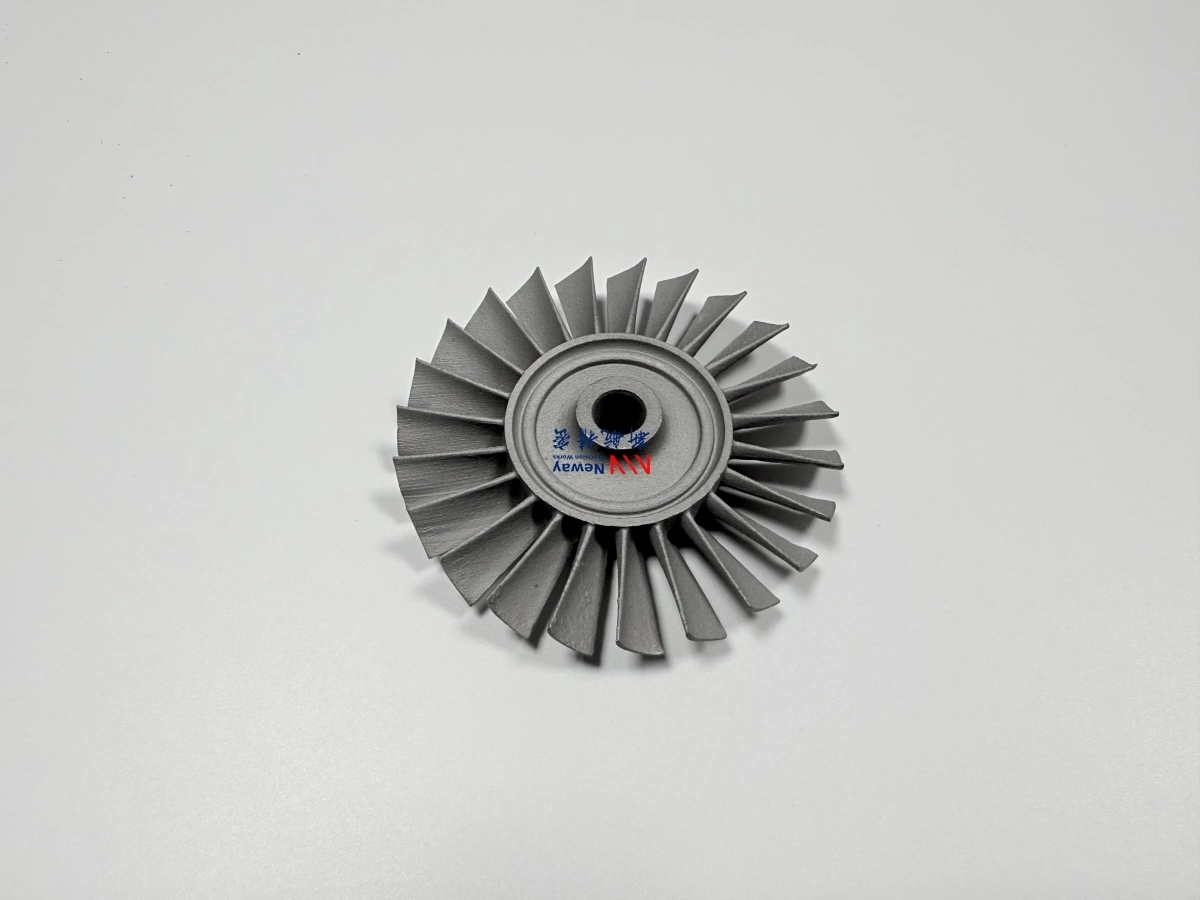
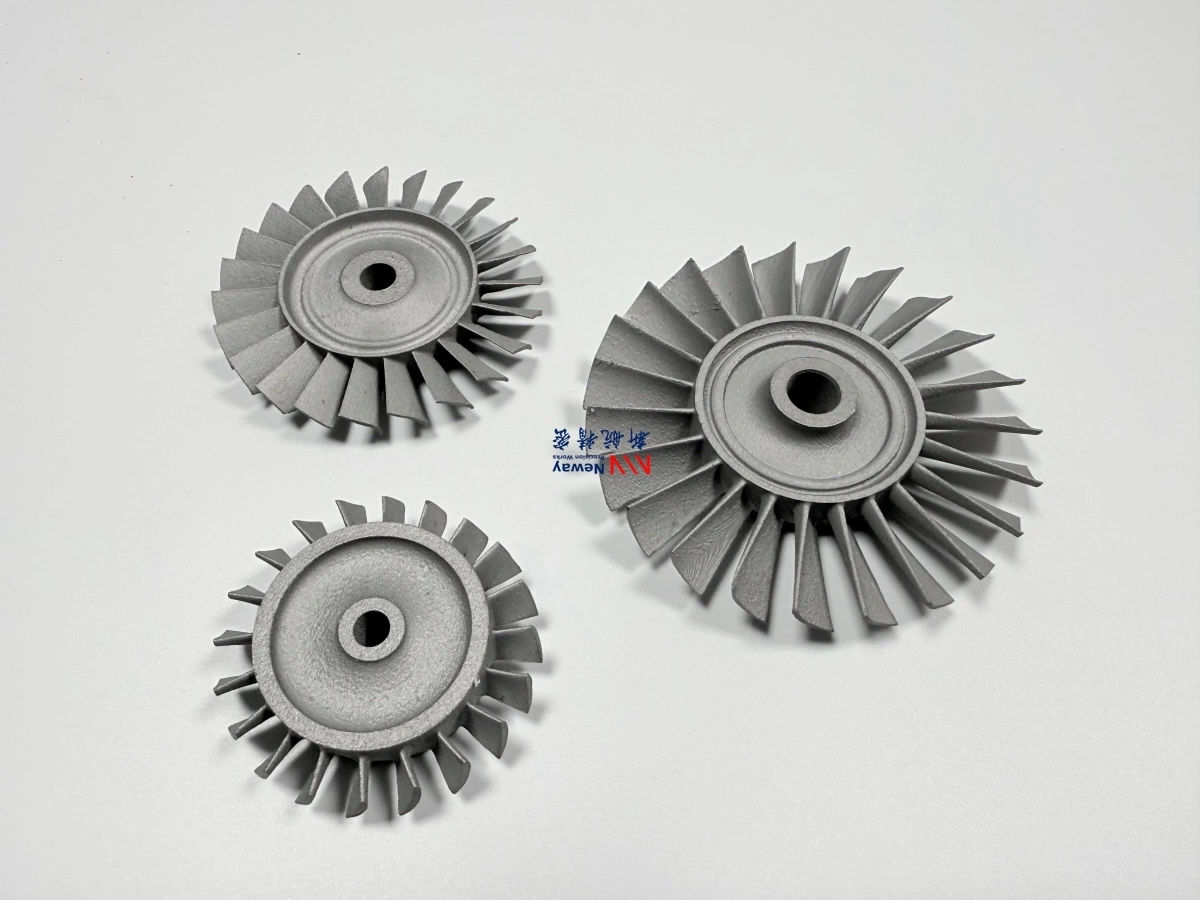
Direct Answer: UAV and Small Turbine Parts Manufacturing
NewayAeroTech manufactures UAV and small turbine parts for prototype propulsion systems and engineering validation. Depending on the component type, material grade, geometry, size, tolerance, and test requirement, the manufacturing route may include vacuum investment casting, CNC machining, EDM, deep hole drilling, heat treatment, surface finishing, post-processing, and inspection.
Our UAV turbine parts manufacturing support can cover:
Micro turbine blades for prototype engines
Small nozzle guide vanes and stator vane components
Impellers, compressor wheels, and rotating parts
Combustion liners, flame tubes, and small combustion chamber parts
Heat shields, exhaust parts, ducts, and thermal protection components
Prototype engine housings, brackets, supports, and precision assembly parts
Small-batch propulsion parts for test rigs, bench tests, and validation programs
The goal is to help customers move from 3D CAD, drawings, samples, or early prototype concepts to manufacturable engine components with controlled geometry, material condition, surface quality, and inspection documentation.
Typical UAV and Small Turbine Components
UAV turbine engines, micro turbines, and small propulsion systems include both hot-section and mechanical assembly components. These parts are often compact, difficult to fixture, and sensitive to small dimensional deviations.
Typical components include:
Micro turbine blades with small airfoil geometry and root features
Nozzle guide vanes with controlled throat area and platform dimensions
Impellers and compressor wheels requiring profile accuracy and runout control
Combustion liners, flame tubes, and small thin-wall combustion structures
Heat shields, exhaust cones, ducts, and thermal protection parts
Rotating rings, sleeves, spacers, shafts, and shaft-related components
Lightweight brackets, housings, supports, and precision assembly structures
For prototype propulsion systems, these parts are often used for airflow testing, combustion validation, material testing, thermal evaluation, assembly fit-up, and performance iteration.
Development Scenarios for UAV Propulsion and Small Turbines
UAV and small turbine parts are commonly required during early engineering development rather than stable mass production. Customers may need one part for a test rig, several sets for engine validation, or small batches after the first prototype has been approved.
Typical development scenarios include:
UAV propulsion system development
Small turbojet and small turbofan prototype programs
Micro turbine research and engineering validation
Bench testing and test rig component manufacturing
Combustion chamber validation and thermal testing
Impeller, compressor wheel, and rotating assembly testing
Material substitution, heat treatment, and coating trial programs
In these projects, fast manufacturability review is valuable because design changes are frequent. NewayAeroTech can help review whether a part is suitable for casting, CNC machining, EDM, drilling, forming, or combined manufacturing.
Manufacturing Challenges for Small Turbine Prototype Parts
Small turbine components can be more difficult than larger parts in some areas because the geometry is compact and the features are small. A small airfoil deviation, hole shift, surface defect, or runout issue can affect test results.
Main manufacturing challenges include:
Small airfoil profiles on micro turbine blades
Micro NGV throat area and vane-to-vane consistency
Thin-wall combustion liners and small flame tubes
Cooling holes, dilution holes, slots, and airflow windows
Impeller profile accuracy, central bore accuracy, and runout control
Small mounting faces, datum references, holes, and assembly interfaces
Rapid prototype iteration while keeping repeatable inspection records
For UAV turbine components, manufacturability should be reviewed before production. A geometry that looks correct in CAD may require design adjustment for casting allowance, tool access, EDM access, wall thickness, fixture stability, or inspection feasibility.
Process Routes for UAV Turbine Parts
The correct process route depends on the part type, material, geometry, tolerance, quantity, and testing purpose. Some small turbine parts are best made by CNC machining from qualified stock. Some complex superalloy hot-section components may require vacuum investment casting followed by machining and post-processing. Some cooling or airflow features may require EDM or deep hole drilling.
Vacuum investment casting can support complex superalloy components such as small blades, NGVs, nozzles, shrouds, and selected hot-section parts. Superalloy CNC machining is used for final dimensions, datums, platforms, roots, bores, impeller features, and assembly surfaces. Superalloy deep hole drilling can support selected cooling and airflow features where hole quality and position are important.
A typical process route may include:
Review CAD files, 2D drawings, material requirements, and prototype test goals
Evaluate casting, CNC machining, EDM, drilling, forming, or combined route
Produce prototype blanks or machine parts from qualified material
Machine critical datum faces, bores, platforms, roots, holes, and interfaces
Process cooling holes, slots, grooves, and airflow features where required
Apply heat treatment, stress relief, surface finishing, or cleaning when required
Inspect small features, profiles, runout, surface condition, and material records
Use inspection feedback to support the next design iteration or small-batch production
Material Strategy for UAV and Small Turbine Components
Material selection for UAV turbine parts depends on operating temperature, speed, strength requirement, weight target, oxidation environment, cooling design, and prototype budget. Small engines may use nickel-based superalloys, titanium alloys, stainless steels, and selected heat-resistant alloys depending on component function.
Common material options include Inconel 713LC, Inconel 718, Hastelloy X, titanium alloys, and stainless steel. NewayAeroTech supports Inconel alloy vacuum investment casting for nickel-based turbine hot-section parts, Hastelloy alloy vacuum investment casting for high-temperature combustion and oxidation-resistant components, and Titanium alloy vacuum investment casting for selected lightweight aerospace components.
Material | Typical Use in Small Turbine Systems | Selection Consideration |
|---|---|---|
Inconel 713LC | Cast micro turbine blades, NGVs, and hot-section components | Useful for cast high-temperature turbine parts |
Inconel 718 | High-strength turbine hardware, rotating parts, and structural components | Suitable where strength, machinability, and moderate high-temperature performance are required |
Hastelloy X | Combustion liners, flame tubes, ducts, and high-temperature combustion components | Good oxidation resistance and fabricability for combustion environments |
Titanium alloys | Lightweight brackets, supports, housings, and selected compressor-side parts | Useful where weight reduction and strength-to-weight ratio are important |
Stainless steel | Prototype housings, brackets, supports, and low-to-medium temperature structures | Practical for cost-controlled prototypes and structural validation parts |
For prototype programs, material selection should be confirmed based on test temperature, expected operating time, cost target, machining route, and final inspection needs.
Micro Blades, NGVs, and Impeller Manufacturing
Micro turbine blades, NGVs, and impellers are common critical components in UAV turbine systems. These parts have different manufacturing priorities and should not be treated as the same type of component.
Micro turbine blades require airfoil accuracy, root control, high-temperature material strength, and surface quality. NGVs require airfoil profile, throat area, platform geometry, and gas-flow consistency. Impellers and compressor wheels require central bore accuracy, profile machining, runout control, and balance review.
Component | Main Function | Manufacturing Focus |
|---|---|---|
Micro turbine blades | Extract energy from hot gas flow | Airfoil profile, root geometry, material strength, surface condition |
NGVs | Control gas direction, speed, pressure, and throat area | Throat area, airfoil profile, platform dimensions, vane consistency |
Impellers | Support compression or rotating flow movement | Bore accuracy, profile machining, runout, surface finish, balance requirement |
Because UAV turbine components are small, feature control and inspection strategy are important. Small deviations can affect airflow, engine speed stability, temperature distribution, and prototype test results.
Post Process and Surface Control for Prototype Parts
After casting, CNC machining, EDM, or drilling, UAV turbine parts may require heat treatment, stress relief, deburring, polishing, cleaning, coating preparation, and final inspection. These steps help control material condition, surface quality, and test readiness.
NewayAeroTech supports superalloy post process for high-temperature turbine and prototype aerospace components.
Post-processing may include:
Heat treatment according to alloy and test requirements
Stress relief after machining or casting where required
Deburring small holes, slots, airfoil edges, and impeller features
Surface finishing for flow-path and fatigue-sensitive areas
Cleaning of cooling holes and airflow passages
Coating preparation for high-temperature validation parts
Final dimensional and surface inspection before testing
For prototype engines, post-processing feedback can also help guide the next design revision. If a slot is difficult to deburr, a wall is too thin, or a feature creates inspection difficulty, the design can be improved before small-batch production.
Inspection Focus for UAV and Small Turbine Parts
Inspection for UAV and small turbine parts should verify small feature accuracy, flow-path geometry, material condition, surface quality, rotating stability, and assembly fit. The inspection plan should match the test goal and component function.
Inspection Item | What to Check | Why It Matters |
|---|---|---|
Small feature accuracy | Holes, slots, grooves, thin edges, small mounting features | Controls manufacturability, fit-up, and prototype repeatability |
Airfoil profile | Micro blades, vanes, pressure side, suction side, leading and trailing edges | Supports airflow behavior and turbine efficiency |
Throat area | NGV passage size and vane-to-vane consistency | Affects gas velocity, pressure distribution, and engine response |
Runout | Impellers, compressor wheels, rotating rings, shaft-related components | Reduces vibration and supports stable high-speed operation |
Surface quality | Flow surfaces, cooling holes, airfoil edges, impeller profiles, combustion surfaces | Supports airflow, thermal behavior, fatigue resistance, and coating readiness |
Material verification | Alloy grade, chemical composition, certificate, heat treatment condition | Confirms material compliance for prototype testing |
Depending on the component, additional inspection may include CMM reports, FPI, X-ray, surface roughness reports, cooling hole inspection, balance review, hardness testing, and first article documentation.
Rapid Iteration and Small-Batch Manufacturing Support
Prototype propulsion systems often require multiple design iterations. Customers may test one design, revise the airfoil, change the impeller profile, modify cooling holes, adjust combustion liner geometry, or change material after thermal testing.
NewayAeroTech can support rapid iteration by reviewing:
CAD manufacturability before production
Tool access and fixture feasibility for small features
Casting feasibility for compact superalloy components
CNC machining risk for thin walls, small holes, and tight datums
EDM or drilling feasibility for cooling features
Heat treatment and surface finishing effects on small parts
Inspection method suitability for prototype validation
After prototype approval, the same process route can be refined for small-batch manufacturing, helping customers improve repeatability and reduce development risk.
RFQ Checklist for UAV and Small Turbine Parts
To quote UAV turbine and small turbine parts accurately, customers should provide technical information related to design, material, test goal, tolerance, inspection, and schedule.
A complete RFQ should include:
Engine type, component name, assembly position, part number, and revision level if available
2D drawings with tolerances, datums, wall thickness, material notes, and inspection requirements
3D CAD files for blades, NGVs, impellers, combustion parts, housings, brackets, or ducts
Material grade, such as Inconel 713LC, Inconel 718, Hastelloy X, titanium alloy, or stainless steel
Manufacturing route preference, such as casting, CNC machining, EDM, drilling, heat treatment, or post-processing
Cooling holes, throat area, airfoil profile, impeller profile, runout, or assembly interface requirements
Prototype test goals, temperature range, speed requirement, or bench test condition if available
Inspection requirements such as CMM, FPI, X-ray, material report, runout report, or surface roughness report
Quantity for prototype, validation batch, design iteration, or small-batch production
Delivery schedule, packaging, and documentation requirements
If the project is based on an existing sample, customers should also provide photos, 3D scan data, material information, wear condition, test history, and functional assembly notes.
Conclusion
UAV and small turbine parts manufacturing for prototype propulsion systems requires fast manufacturability review, small-feature control, flexible process selection, and reliable inspection. These parts include micro turbine blades, NGVs, impellers, compressor wheels, combustion parts, heat shields, prototype engine components, and small propulsion system structures.
NewayAeroTech supports custom UAV turbine parts manufacturing for prototype engines, small turbojet programs, micro turbine components, test rigs, bench tests, and engineering validation. Our capabilities include vacuum investment casting, superalloy CNC machining, EDM, deep hole drilling, heat treatment, post-processing, Inconel, Hastelloy, titanium alloy manufacturing, small feature inspection, airfoil profile inspection, throat area inspection, runout checks, material verification, and final documentation.
For UAV turbine parts quotation, please send CAD files, prototype drawings, material requirements, test goals, operating conditions, inspection standards, quantities, and delivery targets. NewayAeroTech can review the most suitable manufacturing route for your prototype propulsion system project.
