
Custom Aircraft Engine Blades Manufacturer for High-Temperature Aerospace Turbine Applications
NewayAeroTech manufactures custom aircraft engine blades for high-temperature aerospace turbine applications, including prototype blades, small-batch aero engine blades, UAV turbine blades, and superalloy turbine blade components for development, testing, and replacement projects.
Aircraft engine blades operate under high temperature, centrifugal load, oxidation, vibration, thermal fatigue, and complex gas flow conditions. For aerospace turbine applications, blade manufacturing must control superalloy material performance, crystal structure, airfoil geometry, blade root accuracy, platform dimensions, cooling features, surface condition, heat treatment, coating preparation, and final inspection.
NewayAeroTech supports aerospace and aviation parts manufacturing through superalloy casting, CNC machining, EDM, heat treatment, post-processing, coating preparation, and inspection for custom aircraft turbine blade projects.
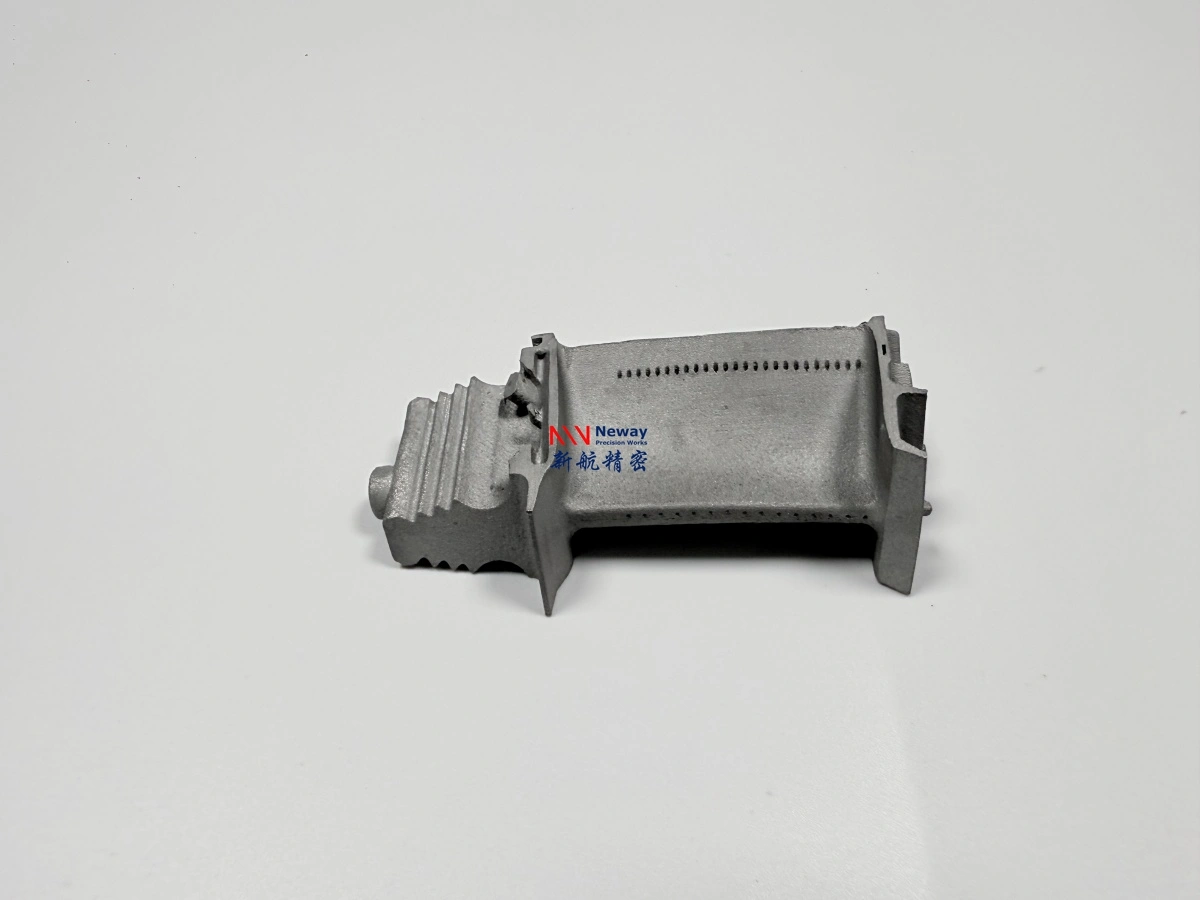
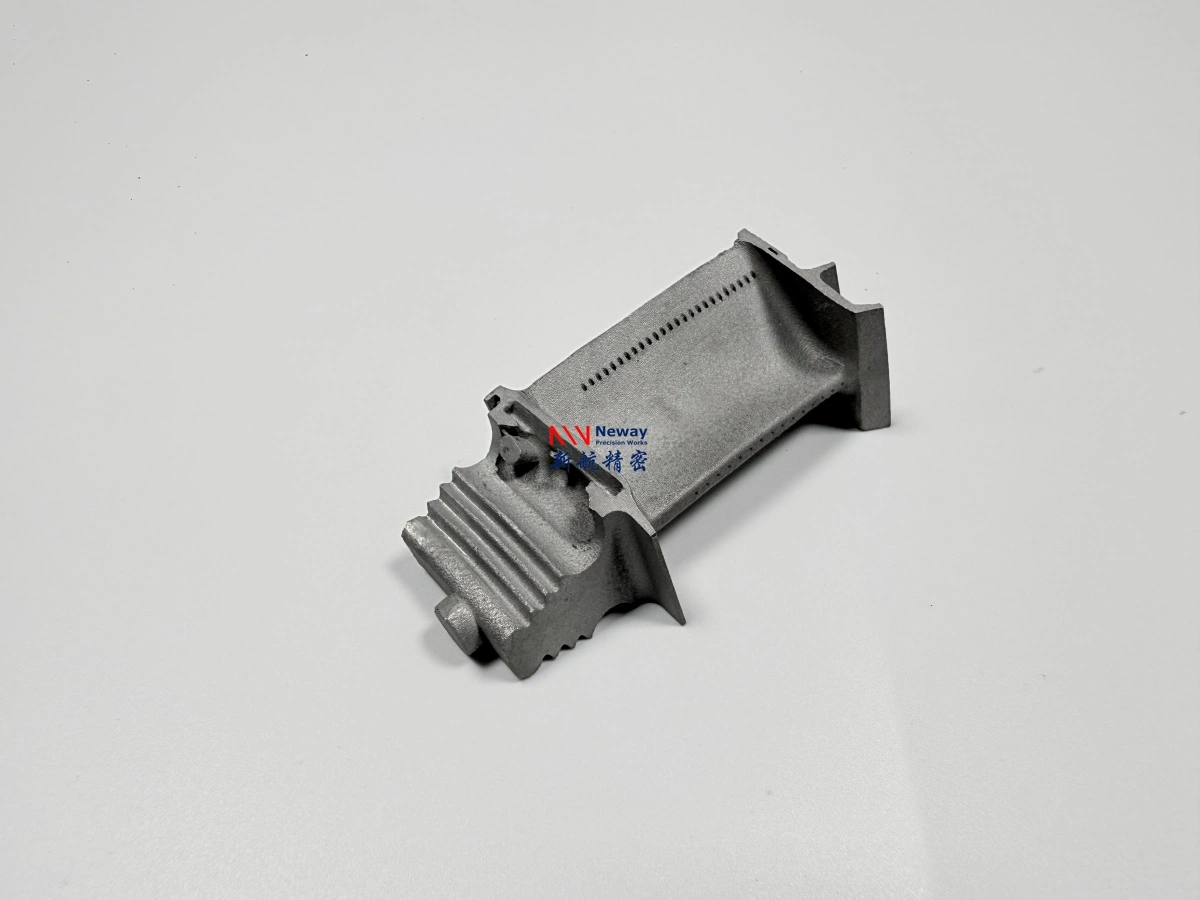
Direct Answer: Custom Aircraft Engine Blades Manufacturer
NewayAeroTech manufactures custom aircraft engine blades using superalloy casting, CNC machining, EDM, heat treatment, coating preparation, and inspection. Depending on the blade design, operating temperature, material requirement, and inspection standard, the manufacturing route may include single crystal casting, directional casting, vacuum investment casting, precision CNC machining, EDM cooling feature processing, and post-processing.
Our custom aircraft engine blade manufacturing support can cover:
Aerospace turbine blades for prototype and validation projects
Custom turbine blades for UAV and small turbine engines
Single crystal turbine blade manufacturing support
Directional casting aerospace turbine blades
Superalloy turbine blade blanks and finished blade components
CNC-machined blade roots, platforms, datum faces, and assembly interfaces
EDM-processed cooling holes, slots, and local blade features
The goal is to deliver aircraft engine blades with controlled airfoil shape, blade root accuracy, material consistency, surface quality, and inspection documentation.
Aerospace Blade Requirements
Aerospace turbine blades are among the most demanding high-temperature components in an aircraft engine. They must maintain strength and geometry while exposed to hot gas, high rotational speed, vibration, thermal cycling, oxidation, and complex aerodynamic loading.
Key aerospace blade requirements include:
High-temperature strength under turbine operating conditions
Creep resistance for long-term dimensional stability
Oxidation and hot corrosion resistance in combustion gas environments
Fatigue resistance under vibration and repeated engine cycles
Stable airfoil profile for aerodynamic performance
Accurate blade root geometry for safe load transfer
Controlled cooling holes and internal or external cooling features when required
Surface condition suitable for coating preparation and final inspection
Because these requirements are connected, aircraft engine blade manufacturing must be planned as a complete process route rather than a single casting or machining operation.
Suitable Manufacturing Routes for Aircraft Engine Blades
The correct manufacturing route depends on the blade stage, operating temperature, alloy grade, crystal structure requirement, cooling design, and customer inspection standard. Aerospace turbine blades may require single crystal casting, directional casting, vacuum investment casting, CNC machining, EDM, heat treatment, and final inspection.
Single crystal casting is used when the blade requires improved high-temperature creep resistance and grain boundary elimination. Directional casting is suitable for selected turbine blades that require controlled grain growth along the main stress direction. Vacuum investment casting can support complex superalloy blade blanks with near-net-shape airfoil and platform geometry.
Manufacturing Route | Typical Use | Key Manufacturing Value |
|---|---|---|
Single crystal casting | Advanced high-temperature turbine blades | Supports severe turbine service where crystal orientation is critical |
Directional casting | Creep-resistant aerospace turbine blades | Controls grain structure along the main loading direction |
Vacuum investment casting | Complex superalloy blade blanks and prototype blades | Forms near-net-shape airfoil, platform, and blade geometry |
CNC machining | Blade roots, platforms, datums, and assembly interfaces | Controls final dimensional accuracy and fit-up features |
EDM processing | Cooling holes, slots, and tool-access-limited features | Processes difficult local features in high-temperature alloys |
Material Options for Aerospace Turbine Blades
Aircraft engine blades are usually manufactured from advanced nickel-based superalloys, single crystal alloys, and other high-temperature materials. Material selection depends on blade stage, turbine inlet temperature, stress level, cooling design, coating system, and original specification.
NewayAeroTech supports CMSX Series vacuum investment casting for selected single crystal blade applications, Rene Alloys vacuum investment casting for advanced aerospace hot-section components, and Inconel alloy vacuum investment casting for nickel-based turbine blade and hot-section projects.
Typical material families include:
CMSX series alloys for single crystal turbine blade applications
Rene alloys for advanced high-temperature aerospace turbine components
Inconel alloys for nickel-based cast and machined turbine parts
Customer-specified single crystal alloys for high-temperature blade programs
Equivalent superalloys reviewed according to operating temperature and inspection requirements
For aerospace turbine blade projects, material selection should be confirmed from drawings, specifications, test requirements, or customer engineering data. A visually similar alloy should not be used as a substitute without technical review.
Single Crystal and Directional Casting for High-Temperature Blades
High-temperature aircraft engine blades may require controlled crystal structure because creep strength and fatigue performance are critical in turbine service. Single crystal and directional casting are used when conventional equiaxed casting cannot meet the blade’s operating requirements.
Single crystal casting eliminates grain boundaries in the blade structure, which can improve high-temperature creep resistance for advanced turbine blade applications. Directional casting controls grain growth in a preferred direction, helping the blade resist high-temperature loading along the main stress path.
Selection between single crystal, directional, and conventional vacuum investment casting depends on:
Blade stage and engine operating temperature
Rotational speed and centrifugal load
Creep life and fatigue life requirements
Original drawing or customer specification
Material grade and crystal structure requirement
Inspection standard and acceptance criteria
For replacement, prototype, or validation blades, the crystal structure requirement should be confirmed before tooling and casting begin.
CNC Machining for Blade Roots, Platforms, and Interfaces
Casting forms the main blade geometry, but CNC machining is required for final functional accuracy. Blade roots, platforms, mounting datums, sealing surfaces, and assembly interfaces usually require tighter tolerances than the cast airfoil body.
NewayAeroTech provides superalloy CNC machining for aerospace turbine blades and high-temperature alloy components. Machining difficult-to-cut superalloys requires suitable tooling, rigid fixturing, controlled parameters, and careful inspection.
Critical CNC-machined blade features include:
Fir tree roots, dovetail roots, or customer-specific root forms
Blade platforms and sealing contact surfaces
Datum faces used for inspection and assembly
Tip-related surfaces and clearance-control areas
Mounting interfaces and local positioning features
Airfoil edge blending when specified by drawing
Blade root machining is especially important because the root transfers centrifugal load into the turbine disk. Dimensional deviation, machining marks, sharp transitions, or surface defects in this area can affect blade reliability.
EDM and Cooling Feature Control for Aircraft Engine Blades
Some aerospace turbine blades include cooling holes, slots, and local features that are difficult to process by conventional machining. Because superalloys and single crystal alloys are hard and heat resistant, EDM is often used for small, precise, and tool-access-limited blade features.
EDM processing can support:
Cooling holes and local airflow features
Slots, grooves, and thin local boundaries
Sharp features that are difficult to machine mechanically
Small local openings in hard superalloy blade sections
Features near airfoil, platform, or root transition areas
EDM feature control should include hole position, hole diameter, edge quality, recast layer, surface condition, post-EDM cleaning, and compatibility with coating preparation. Cooling features must be inspected carefully because they affect local blade temperature and service life.
Post-Processing: Heat Treatment, HIP, and Coating Preparation
Post-processing is essential for aircraft engine blades because final performance depends on both material condition and surface quality. After casting and machining, turbine blades may require heat treatment, HIP review, stress relief, surface finishing, cleaning, and coating preparation.
NewayAeroTech supports superalloy post process for high-temperature aerospace turbine components.
Post-processing may include:
Solution and aging heat treatment according to alloy requirements
Stress relief after casting, CNC machining, or EDM when required
HIP review for selected blade castings with internal density requirements
Deburring and edge finishing around roots, platforms, and cooling features
Surface cleaning before inspection or coating
Coating preparation for oxidation-resistant or thermal barrier coating systems
If coating is required, coating allowance and masking requirements should be reviewed before final machining. Coating thickness can affect platform interfaces, cooling holes, blade tip clearance, and local assembly geometry.
Inspection Focus for Custom Aircraft Engine Blades
Inspection is critical for custom aircraft engine blades because the part must satisfy material, casting, machining, cooling, surface, and geometry requirements. Inspection requirements should be confirmed before quotation and production.
Inspection Item | What to Check | Why It Matters |
|---|---|---|
Airfoil profile | Pressure side, suction side, leading edge, trailing edge, blade twist | Controls aerodynamic performance and turbine efficiency |
Root dimensions | Fir tree, dovetail, root datums, contact faces, local radii | Supports safe load transfer and assembly fit |
FPI | Surface cracks and open defects | Detects surface-breaking defects before delivery or coating |
X-ray or CT | Internal porosity, shrinkage, inclusions, cooling feature condition | Verifies casting soundness and internal quality |
Grain structure | Single crystal, directional, or casting structure requirement | Confirms the casting route meets blade design intent |
Material verification | Alloy grade, chemical composition, material certificate | Supports traceability and material compliance |
Additional inspection may include CMM reports, surface roughness, cooling hole measurement, heat treatment records, hardness testing, coating preparation review, and customer-specific first article reports.
Prototype and Small-Batch Aerospace Blade Manufacturing
Aircraft engine blade projects are often developed through prototype validation before moving into small-batch or batch manufacturing. This is especially common for UAV turbine engines, small turbofan programs, development engines, and high-temperature material testing projects.
Prototype blade manufacturing can help customers verify:
Material selection and casting route feasibility
Airfoil geometry and root fit-up
Cooling feature processing and inspection method
Heat treatment response and dimensional stability
Surface condition before coating or testing
First article inspection requirements before batch production
For small-batch manufacturing, NewayAeroTech can support process repeatability, inspection documentation, and controlled delivery according to the customer’s validation plan.
RFQ Checklist for Custom Aircraft Engine Blades
To quote custom aircraft engine blades accurately, customers should provide technical data related to geometry, material, process, inspection, and application conditions.
A complete RFQ should include:
Blade name, engine type, turbine stage, part number, and revision level if available
2D drawing with tolerances, datums, material notes, and inspection requirements
3D CAD model for airfoil, platform, root, and cooling feature review
Required material grade, such as CMSX, Rene, Inconel, or customer-specified single crystal alloy
Casting route requirement, such as single crystal, directional, or vacuum investment casting
Heat treatment, HIP, coating, surface finish, or post-processing requirements
Cooling hole, slot, platform, root, airfoil edge, and blade tip requirements
Inspection requirements such as CMM, FPI, X-ray, CT, grain structure, material report, or first article report
Quantity for prototype, test batch, small-batch production, or long-term supply
Delivery schedule, packaging, and documentation requirements
If the project is based on a sample or reverse engineering, customers should provide sample photos, scan data, material information, coating condition, and functional assembly notes.
Conclusion
Custom aircraft engine blades for high-temperature aerospace turbine applications require advanced superalloy manufacturing and strict process control. Successful blade manufacturing depends on material selection, casting route, crystal structure, airfoil accuracy, root machining, cooling feature control, heat treatment, coating preparation, and inspection documentation.
NewayAeroTech supports aircraft engine blade manufacturing for aerospace turbine blades, UAV turbine engine blades, prototype blades, small-batch aero engine blades, and high-temperature superalloy test components. Our capabilities include single crystal casting, directional casting, vacuum investment casting, superalloy CNC machining, EDM, heat treatment, post-processing, material verification, FPI, X-ray, CMM inspection, and final documentation.
For custom aircraft engine blade quotation, please send blade drawings, 3D CAD files, material requirements, casting route requirements, cooling feature details, inspection standards, quantities, and delivery targets. NewayAeroTech can review the most suitable manufacturing route for your aerospace turbine blade project.
