How does single-crystal casting improve the performance of turbine blades?
Eliminating Grain Boundaries for Superior Strength
Traditional equiaxed or directionally solidified castings contain grain boundaries, which act as weak points under high thermal and mechanical stress. In contrast, single-crystal casting eliminates these boundaries entirely, creating a continuous lattice structure that can withstand higher temperatures and longer operating cycles. This is particularly vital for first- and second-stage blades in gas turbines where centrifugal forces and gas stream temperatures exceed 1100°C.
Through controlled solidification in vacuum investment casting environments, the process ensures precise dendritic alignment along the primary stress axis, minimizing creep deformation and crack initiation.
Enhanced Creep and Fatigue Resistance
Single-crystal superalloys such as CMSX-4, Rene N5, and PWA 1484 exhibit exceptional resistance to creep and fatigue, thanks to optimized γ′ (gamma prime) strengthening phases. Without grain boundaries, diffusion paths for creep are reduced, allowing blades to retain dimensional accuracy during prolonged high-load operation.
These alloys are often used in conjunction with directional solidification for complex blade airfoils where both strength and directional stiffness are required.
Improved Oxidation and Corrosion Resistance
Single-crystal materials exhibit higher chemical stability at elevated temperatures, enabling the formation of a better diffusion barrier for oxidation and hot corrosion resistance. When combined with post-processing steps such as heat treatment and hot isostatic pressing (HIP), internal porosity is minimized, and microstructural uniformity is enhanced. To further enhance surface durability, thermal barrier coating (TBC) systems are applied, thereby extending the lifespan of components in turbine hot sections.
Precision Finishing and Quality Assurance
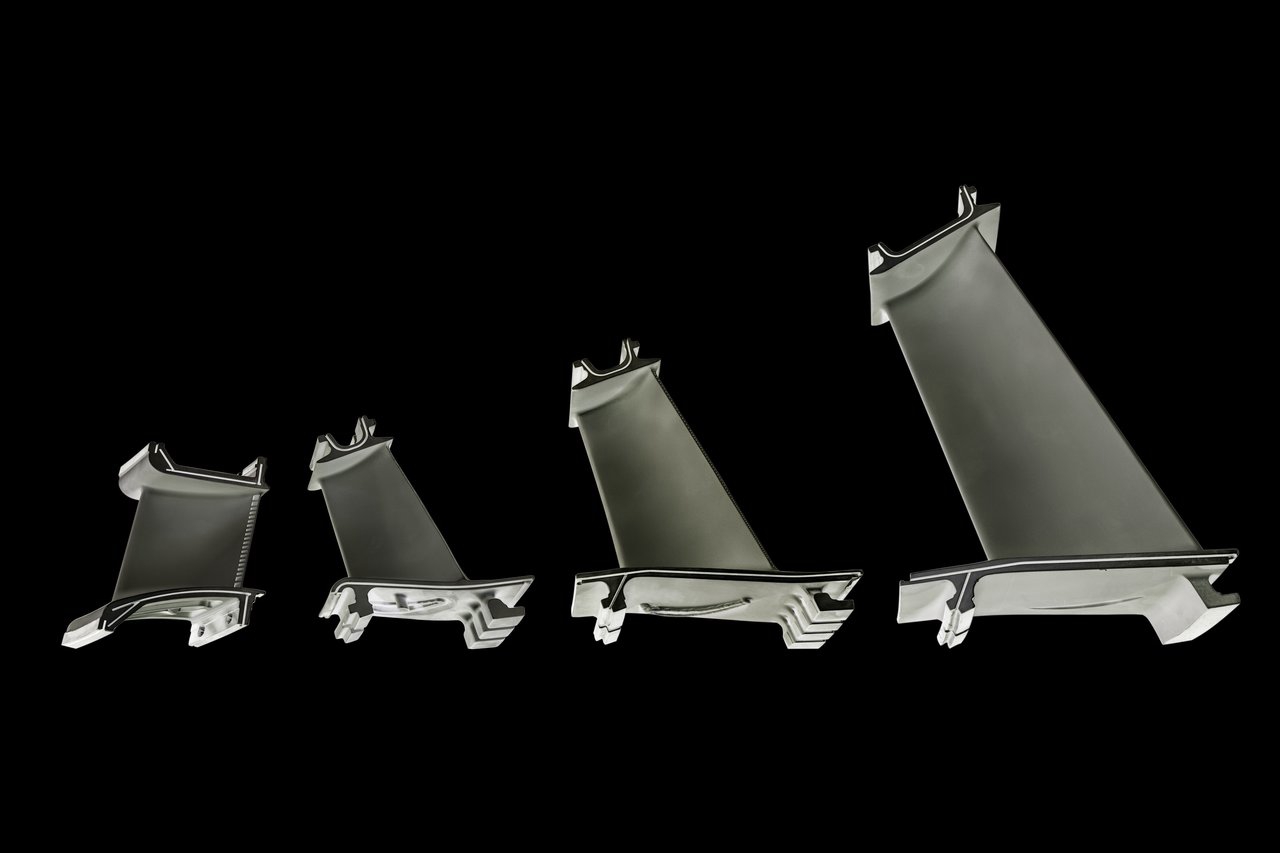
After casting, each single-crystal blade undergoes superalloy CNC machining and electrical discharge machining (EDM) for the creation of intricate cooling passages and precise root geometry. Structural reliability is verified through material testing and analysis, such as X-ray diffraction and metallography, to confirm crystal orientation and defect-free composition.
Industrial Benefits and Applications
The superior strength-to-weight ratio and oxidation resistance of single-crystal superalloys make them indispensable in aerospace and aviation, power generation, and energy turbines. These components ensure higher efficiency, reduced fuel consumption, and lower emissions by enabling higher turbine inlet temperatures without sacrificing reliability.