
Traitement thermique des pièces en superalliage : Optimisation des propriétés mécaniques
Traitement thermique pour la résistance, la stabilité et les performances
Les superalliages utilisés dans les industries aérospatiale, de production d'énergie, nucléaire et chimique doivent conserver leur résistance et leur résistance à la corrosion à des températures dépassant 800°C. Cependant, les microstructures à l'état brut de coulée ou de forgeage présentent souvent une morphologie granulaire non uniforme, des contraintes internes et des phases indésirables. Un traitement thermique contrôlé avec précision est essentiel pour optimiser les propriétés mécaniques, la distribution des phases et les performances au fluage des composants en superalliage.
Neway AeroTech fournit des processus de traitement thermique sur mesure pour une large gamme de pièces en superalliage coulées et forgées, y compris les alliages Inconel, Rene, CMSX, Nimonic et Hastelloy.
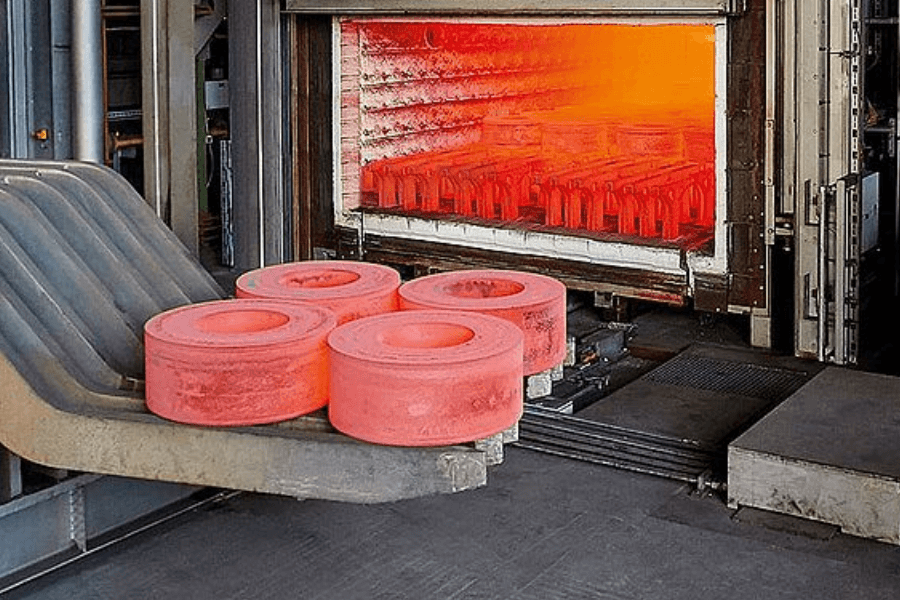
Méthodes de traitement thermique pour les superalliages
Le traitement thermique des superalliages implique plusieurs étapes conçues pour affiner la microstructure, dissoudre les phases secondaires et développer des zones renforcées par précipitation.
Traitement de mise en solution : 1050–1220°C pour homogénéiser la matrice γ et dissoudre les carbures
Vieillissement : 650–870°C pour la précipitation de γ′ et l'optimisation de la résistance
Détente des contraintes : 850–950°C pour éliminer les contraintes résiduelles après usinage ou soudage
Durcissement structural : Cycles temps-température contrôlés pour la résistance au fluage
Tous les traitements sont spécifiques à l'alliage et sont réalisés dans des fours sous vide ou atmosphère inerte avec un contrôle de température précis à ±2°C.
Superalliages couramment traités thermiquement
Alliage | Temp. max (°C) | Utilisation typique | Traitement thermique |
|---|---|---|---|
704 | Pièces de rotor, disques | Mise en solution + double vieillissement | |
980 | Aubes de turbine | Mise en solution + vieillissement | |
1140 | Aubes directrices de premier étage | Vieillissement uniquement | |
920 | Composants de chambre de combustion | Mise en solution + vieillissement | |
1175 | Chemises, brides | Détente des contraintes |
Le contrôle de la microstructure est essentiel pour atteindre la résistance, la résistance à la fatigue et la durabilité à l'oxydation.
Étude de cas : Traitement par double vieillissement d'un disque de rotor en Inconel 718
Contexte du projet
Un client aérospatial exigeait des performances mécaniques précises pour des disques de rotor en Inconel 718. Le traitement thermique impliquait un recuit de mise en solution à 980°C, suivi d'un vieillissement à 718°C (8h) et 621°C (10h). Les tests post-traitement ont montré une résistance à la traction de 1245 MPa et une amélioration de la durée de vie en fatigue de 60 % par rapport à l'état brut d'usinage.
Composants typiques traités thermiquement et applications
Composant | Alliage | Type de traitement | Industrie |
|---|---|---|---|
Aube de turbine | Rene 88 | Mise en solution + Vieillissement | |
Segment d'aube directrice | CMSX-4 | Vieillissement | |
Bride de chambre de combustion | Hastelloy X | Détente des contraintes | |
Anneau de buse | Nimonic 90 | Cycle thermique complet |
Ces processus restaurent la résistance mécanique, la stabilité dimensionnelle et la résistance à la corrosion des composants soumis à des conditions extrêmes.
Défis du traitement thermique des pièces en superalliage
Fenêtre thermique étroite ±5°C pour la précipitation de γ′ nécessite un contrôle strict du four
Contrôle de la croissance des grains est critique dans les pièces à solidification dirigée ou monocristallines
Zones soudées peuvent nécessiter un traitement thermique localisé ou échelonné
La formation de calamine d'oxydation doit être évitée pendant le maintien à haute température
Déformation des composants post-traitement nécessite une modélisation prédictive et un bridage adapté
Solutions de traitement thermique pour l'optimisation des superalliages
Fours sous vide ou à atmosphère d'argon maintiennent des environnements sans oxydation
Profils de vieillissement multi-étapes adaptés à la cinétique de précipitation spécifique de l'alliage
Séquence HIP + Traitement thermique pour l'élimination de la porosité et l'amélioration de la résistance
Cycles thermiques pré-usinage pour le contrôle dimensionnel pendant la finition
L'inspection post-processus garantit la cohérence des propriétés
Résultats et vérification
Exécution du processus
Tous les cycles thermiques ont été programmés à l'aide de bases de données spécifiques aux alliages et vérifiés par cartographie thermocouple. Une surveillance en temps réel a assuré une uniformité de ±2°C pendant tout le maintien.
Propriétés mécaniques
La résistance, la ductilité et la dureté post-traitement ont été mesurées pour vérifier la conformité. Les aubes en CMSX-4 ont montré une durée de vie au fluage >3000 h à 1050°C.
Stabilité dimensionnelle
Les composants ont été inspectés via une MMT et ont montré un changement dimensionnel <0,015 mm. L'état de surface a été préservé grâce à une purge par gaz inerte.
Analyse microstructurale
L'analyse MEB a validé une distribution uniforme de la phase γ′ et l'absence de réseaux de carbures indésirables. La diffraction des rayons X a confirmé l'orientation cristallographique dans les pièces à solidification dirigée.
FAQ
Quelle est la plage de température typique pour le traitement thermique des superalliages ?
Comment le traitement thermique affecte-t-il la résistance au fluage et la durée de vie en fatigue ?
Quelle atmosphère est utilisée pour les cycles thermiques à haute température ?
Le traitement thermique peut-il être combiné avec le HIP pour de meilleurs résultats ?
Comment les microstructures sont-elles validées après le traitement thermique ?
